 Kamil Askerkhanov
The EIA released some very interesting data yesterday. U.S. commercial crude inventories surged by 17.4 million barrels, reaching 424.4 million.
The American Petroleum Institute had reported a 9.1 million-barrel increase the day before—already an unusually large move.
But the real story emerges when you look beyond a single inventory number and follow the physical barrels.
U.S. crude imports rose to 7.3 million barrels a day, an increase of more than 1 million barrels a day in just one week. Shipments from Canada and Venezuela are rising, while Middle Eastern crude is returning to the U.S. market. At the same time, American crude exports collapsed to roughly 3.06 million barrels a day, their lowest level since November of last year.
The shift is particularly striking in Asia. Earlier this year, U.S. crude exports to Japan fell by roughly 67%, while shipments to South Korea dropped 39%.
And yet U.S. refineries are hardly idling. Refinery utilization is running at about 96%, with crude processing above 17 million barrels a day.
In other words, oil is being consumed aggressively—but even more physical crude is being pulled into the U.S. system.
And That is Where Things Get Really Interesting
At the same time, the Strategic Petroleum Reserve has fallen below 300 million barrels, approaching levels not seen since the early 1980s.
That creates a curious redistribution of physical oil: the government’s strategic reserve is shrinking while the commercial sector is accumulating additional barrels.
At first glance, that may seem contradictory. In practice, however, the logic could be quite rational.
The American private sector has ample reason right now to accumulate not merely cash, but control over physical assets.
Refiners are generating enormous profits. Marathon, Valero and Phillips 66 together earned roughly $12.6 billion in the second quarter. Diesel crack spreads approached $94 a barrel in August.
Meanwhile, the major commodity traders are expanding their physical operations. Trafigura’s balance sheet grew by roughly 40% over six months, while its combined trading volume in crude and petroleum products reached a record 8.7 million barrels a day.
And this is not just about oil.
We are seeing intense demand for gold and silver, a scramble for physical copper and efforts to build inventories of strategic minerals. China is expanding infrastructure for storing and settling transactions in physical gold in Hong Kong. The U.S. has previously been pulling physical copper onto its own territory at a remarkable pace.
There are simply too many pieces moving in the same direction.
One more detail is particularly important: the oil curve is in backwardation. Physical crude today is more expensive than crude for future delivery. That means the classic trade of buying oil, storing it and profiting from the futures curve is currently a poor proposition.
So if the commercial sector continues to build physical inventories under these conditions, the motivation may be something other than speculation.
The physical barrel itself becomes insurance.
I would view what is happening in precisely that context: as preparation for an acute phase of an economic and financial crisis.
If major pools of capital believe the probability of a financial-market collapse is rising, keeping wealth entirely in financial claims becomes increasingly risky. Add the prospect of a major war in the Middle East, and the logic becomes even clearer.
A serious new disruption to shipments through the Strait of Hormuz, the Red Sea or several major routes at once could turn physical oil into one of the world’s most valuable assets.
It can be refined. It can be sold. It can be pledged as collateral. It can be exchanged.
Most important, it allows production to continue when everyone else simply cannot get the raw material.
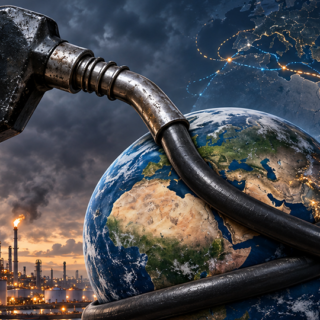
That is why I would describe the current trend not so much as oil accumulation, but as a transfer of capital from financial claims into control over physical resources.
And governments and corporations are entering this story from very different positions.
The federal government has a $432 billion budget deficit for July alone, rising debt obligations and a shrinking Strategic Petroleum Reserve.
The commodity-producing corporate sector, by contrast, has enormous cash flow, windfall profits, physical inventories, terminals, pipelines, refineries and control over the movement of commodities.
The resulting pattern is striking: the government’s financial obligations are growing while its physical reserve is shrinking; meanwhile, large pools of private capital are increasing their control over real assets.
If commercial inventories continue to rise, imports remain elevated and American crude does not return to export markets in significant volumes even when prices make exports attractive, that would be evidence of a broader strategy.
It would be even more telling if the same pattern continues across other physical assets.
It looks increasingly like large pools of capital are doing what capital often does ahead of major shocks: exchanging the promise of receiving something tomorrow for ownership of something tangible today.
Perhaps an acute phase of the economic and financial crisis really is approaching—this time potentially compounded by a major war in the Middle East.
And in such a world, the physical barrel of oil could become a remarkably valuable asset in the struggle for economic and geopolitical power.
 Sergey Stankevich
 Yuri Chekalin