 Tony Rocchi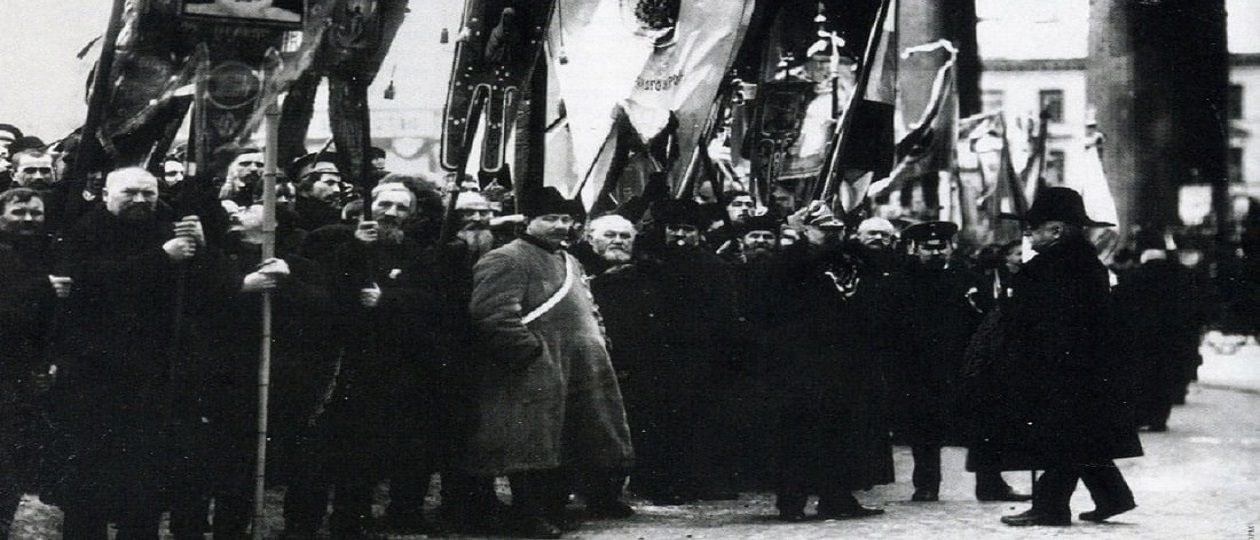
The far-right Black Hundreds movement had its biggest mass appeal in the borderlands of the Russian Empire, rather than in the core ethnic Russian regions in the empire.
Thousands of people in the nine Western Provinces, a transitional zone between the traditional Russian and Polish states, enthusiastically accepted the Black Hundreds message of <<Russia for the Russians!>>, <<Orthodoxy, Autocracy, Nationality!>>, <<Beat the Jews and save Russia!>>.
The Black Hundreds reached the peak of their appeal in the Western Provinces during the Revolution of 1905-1907 and they turned the region into a stronghold of mass Russian royalism. This mass counter-revolutionary tendency tends to embarrass historians. Until the 1980s, many French historians still argued if the people could be counter-revolutionary. The same can be said about people who express outrage that the Black Hundreds could enjoy mass support from the lower classes.
Just what made the nine Western Provinces so different from the ethnic Russian core regions of the Empire?
The six north-western provinces of Vilna, Vitebsk, Grodno, Kovno (Kaunas), Minsk, and Mogilev and the three south-western provinces of Volyn, Kiev and Podolia formed the nine Western Provinces. The region had been part of the Polish Commonwealth until the partitions of Poland in 1772, 1793 and 1795. The provinces were a transitional zone between traditional Russian provinces and the Kingdom of Poland (also known as the Vistula Provinces). The Western Provinces also formed part of a broader ethnocultural territory of Eastern Slavs in the Russian and Austro-Hungarian Empires.
The nine provinces include present day Right-Bank Ukraine, Belarus, Lithuania, and the Latgalian lands of contemporary Latvia (Latgalians speak a dialect of Latvian and are Roman Catholics in distinction to the mostly Lutheran Latvians). The nine provinces along with six other provinces—Bessarabia, Ekaterinoslav, Poltava, Tauria, Kherson, and Chernigov—comprised the Jewish Pale of Settlement, an area where Jews were forced to live. Jews also lived in the 10 Polish Vistula Provinces.[1]
Russian nationalists in the government, society, and political movements considered the Western Provinces to be Russian lands from time immemorial. These lands had been integral parts of the Kievan Rus state, torn away from Russia, and subjected to centuries of Polish and Catholic influence. Although the lands had been restored to Russia, Russian nationalists believed that the Russian Orthodox Church, autocracy (tsarist form of rule) and Russian people still faced serious threats from powerful non-Russian elements in the region. In fact, Russian nationalists regarded the entire region as the besieged and embattled front line of Orthodoxy, monarchism, and Russian nationalism.
The religious, linguistic, and ethnic composition of the population of the Western Provinces sharply distinguished the region from the core ethnic Russian regions of the Empire. One can see these differences from the 1897 census of the population. Here are the percentages for religions in the Western Provinces while corresponding percentages for the entire Empire are in brackets. The region had 19629841 residents. By religious affiliation, the percentages were: Orthodox—64.4% (69.3%); Roman Catholics—19.3% (9.1%); Protestants, mostly German Lutherans, but also Calvinists and Mennonites—2% (2.9%); Old Believers and sectarians, usually Stundists and Baptists—1% (1.7%) but Old Believers and sectarians were deliberately undercounted by the government; Jews—13.3% (4.1%). The region’s population included Karaim (nonrabbinical Jews), Polish-speaking Lithuanian Tatars, members of the Armenian Gregorian and Armenian Catholic Churches.[2]
Not only did the high number of Catholics and Jews in the Western Provinces alarm members of the government and society, but also the relatively fragile position of the Russian Orthodox Church. In the six north-western provinces, many of the Orthodox were descendants of Uniates (Greek Catholics) who had been voluntarily or usually involuntarily converted to the Orthodox Church during the 19th century. In the late 1890s and early 1900s, K. P. Pobedonostsev, Chief Procurator of the Russian Orthodox Church, often complained that many Orthodox in the region continued to practice Roman Catholic and Uniate customs and that Roman Catholicism strongly appealed to many nominally Orthodox believers.[3, pp. 222-223]
The census collected data on the languages and dialects spoken but did not collect statistics on the ethnic origins of the population. Again, these figures worried Russian nationalists because ethnic Russians clearly constituted a small minority of the population. The major languages included: “Little Russian (Ukrainian) —39.4%, Belorussian (Belarusian) — 27.9%; Yiddish (a Jewish dialect of German) —13.2%; Lithuanian — 6.7%; Russian — 5.0%; Polish-4.3%; Latvian—1.6%; German — 1.5%. The population also included Tatars, Romani (Gypsies) and members of other nationalities.[4]
It is extremely difficult to estimate the ethnic origins of the population of the Western Provinces. Many members of the government, society, and political movements from the right to left did not consider Ukrainians and Belarusians separate peoples but only as branches of a unified Russian people whose members included Great Russians, Little Russians (Ukrainians) and Belorussians (also called Western Russians. It is difficult to determine the degree of ethnic consciousness among Ukrainians, Belarusians, Russians, and other nationalities, especially among the peasants. In this respect, the Western Provinces and the rest of the Russian Empire were just like many European countries where the consolidation of ethnic and political nations was happening over a long period.
The stubborn insistence of Russian nationalists that the Western Provinces had belonged to Kievan Rus often led them to blur the distinction between русский (russkii–ethnic Russian) and руський (rus’kii, belonging to Kievan Rus) and resulting them in labelling many regions of the Western Provinces, Vistula Provinces, and Austro-Hungarian Empire as Rus lands. Although Russian nationalists could talk enthusiastically about the huge number of Rus lands, they generally were not enthusiastic about annexing Rus lands in the Austro-Hungarian lands to the Russian Empire for fear of adding millions of Roman Catholics, Greek Catholics, Protestants, and Jews to the population.
In many ways, the Western Provinces resembled a powder keg ready to explode and this explosion happened during the Revolution of 1905-1907. A major reason for the tense situation in the region was the division of labor along religious and ethnic lines. All regions of the Russian Empire had divisions of labor along religious and ethnic lines, but the Western Provinces had their peculiarities.
Polish and Polonized Roman Catholic nobles—the nobility was called szlachta in Polish—predominated in large, middle, and even small landholding while Jews were dominant among the merchants, wholesale and retail traders, and artisans. The Polish and Polonized Catholic nobles for decades formed the ruling elite in the region, because in Poland, they formed the Polish nation with extensive privileges and the exclusive right to participate in the ruling of Poland.
After the suppression of the Polish uprising of 1863, the region witnessed the emergence of a stratum of Russian and Russified nobles, officials, officers, city residents, Russian Orthodox clergy. The peasants generally included Belarusians, Ukrainians, Lithuanians, Latvians, Poles, and Russians. There were Polish-speaking Tatar nobles. German and Czech agricultural colonists lived mostly in Volyn Province. The working class was made up of people from different ethnic groups. The bourgeoisie included Jews, Russians, Poles, Germans, and members of other nationalities. Despite continual attempts by the Russian government to reduce Polish nobles to peasant status and restrict their landholding and positions in the administration and armed forces, Poles continued to form a large part of the Russian nobility.[5, c.31]
Although Russian nationalists insisted that major conflicts in the region were between Russians and Poles and Orthodox and Catholics, the situation was far more complex. German historian Andreas Kappeler emphasized that ethnic minorities in different regions generally did not direct against their hatred against Russians who predominated in the central parts of the Empire but rather against the “alien” upper and middle classes and strata of the population of their own regions. [6, p. 135] This meant that in the Western Provinces, members of different nationalities generally regarded Poles and Jews as the major alien elements and the sources of all their problems.
The intersection of social, ethnic, and religious conflicts in the Western provinces not only had horrific consequences in the Revolution of 1905-1907, but also gave the Black Hundreds a mass appeal that they could never have received in purely ethnic Russian regions.
Citations
- Pale of Settlement. The YIVO Encyclopedia of Jews in Eastern Europe. URL:
- Первая всеобщая перепись населения Российской империи 1897 г. Распределение населения по вероисповеданиям и регионам. (First general census of the population of the Russian Empire. Distribution of the population by religious adherence and regions. URL: https://www.demoscope.ru/weekly/ssp/rus_rel_97.php
- Kolarz, Walter. Religion in the Soviet Union. New York: St. Martin’s Press, 1961.
- Первая всеобщая перепись населения Российской Империи 1897 г. Распределение населения по родному языку, губерниям и областям. (First general census of the population of the Russian Empire. Distribution of the population by native language (mother tongue), provinces, and regions URL: https://www.demoscope.ru/weekly/ssp/rus_lan_97.php
- Рокки Т. Западные губернии Российской империи в Революции 1905–1907 гг.: элементы региональной самобытности и гражданской войны (The Western Provinces of the Russian Empire in the Revolution of 1905-1907: elements of regional uniqueness and civil war) // Известия АлтГУ. Исторические науки и археология. 2023. №3 (131), С. 28-35.
- Kappeler, Andreas. The Russian Empire: A Multiethnic History. Trans. from the German. Harlow UK: Pearson Education, 2001.
 Yuri Chekalin
 Kamil Askerkhanov
 Dmitri Drobnitsky