 Dmitri Drobnitsky
The Starshield Controversy and the Question of Presidential Authority.
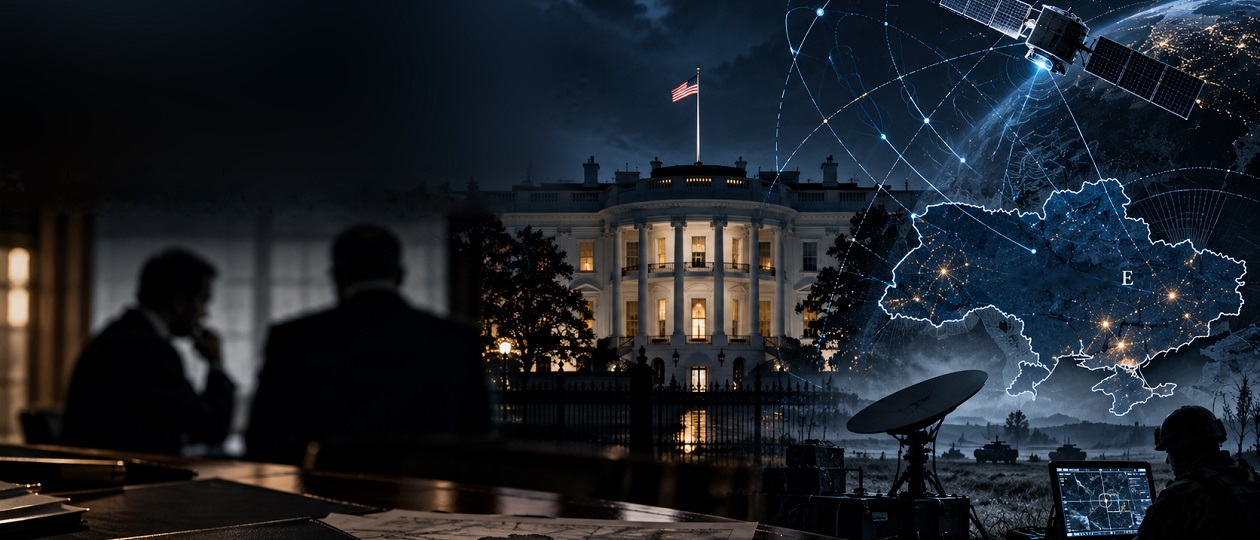
Reuters appears to be pursuing a sustained effort to establish one politically consequential proposition: that an order to restrict Ukraine’s access to SpaceX’s Starshield services originated in the White House, but not with President Donald Trump.
A new Reuters report, already generating considerable discussion in the United States and beyond, presents what it describes as fresh information about the alleged suspension or slowdown of Starlink and Starshield services for Ukraine. According to the report, the directive came from the White House, but Trump himself did not issue it. Who did? The agency’s unnamed sources apparently offered no answer.
Those sources are described as “two U.S. officials and a Western official briefed on the matter.” According to their account, Pentagon leadership received instructions to slow down SpaceX’s Starshield service for Ukrainian military operations. Yet the report also states that the president made no such request. Reuters further notes that the White House did not respond to questions about whether other administration officials might have issued the directive.
This raises an obvious question: Did someone act without Trump’s authorization? Or did Trump communicate his wishes verbally, leaving someone else to submit the formal request?
Trump, for his part, has denied that intelligence-sharing or Starlink and Starshield services were cut off for Ukraine’s armed forces. Meanwhile, xAI—not Elon Musk personally—attributed the disruption to a technical malfunction.
On Thursday, Ukraine’s armed forces announced that the services had been fully restored. Reuters, however, describes a more limited restoration, with service available only at speeds not exceeding 160 kilometers per hour, or approximately 100 miles per hour. That account is difficult to reconcile with the resumption of Ukrainian strikes against Russian targets on Thursday.
Meanwhile, a group of U.S. senators, led by Republicans, has asked the Pentagon’s inspector general to conduct an urgent investigation into the alleged disruption of critical services for an American ally.
Taken together, these developments suggest a deeply troubling political picture: Trump is being portrayed as a president who no longer exercises effective control over key foreign-policy and military decisions.
Responsibility for the alleged restriction of Starlink and Starshield services will presumably be assigned to someone else—perhaps Defense Secretary Pete Hegseth—while Trump is conspicuously removed from the decision-making process.
Indeed, there is reason to suspect that no meaningful suspension or slowdown occurred at all, or that any disruption was limited in scope and operational significance. If so, the controversy may have served a broader political purpose: to constrain Trump’s freedom of action on Ukraine and, eventually, on other major foreign-policy questions.
There is, of course, another possibility. Someone in the administration—perhaps even Trump himself—may have decided to restrict these services, only to retreat once the political consequences became apparent.
If that is what happened, the coming bipartisan congressional hearings will likely produce a familiar spectacle of denials, evasions, and officials distancing themselves from responsibility. Any remaining restrictions will presumably be lifted, while someone—Hegseth or another senior official—may ultimately be sacrificed to contain the political fallout.
But the damage is already done.
What message are Trump and his senior defense officials effectively sending? That they are not the ones exercising real authority—and that Ukrainian President Volodymyr Zelensky has greater influence over American decisions than the administration itself.
No number of interviews or public explanations can easily reverse that impression.
The political precedent has already been established.
 Kamil Askerkhanov
 Sergey Stankevich
 Yuri Chekalin