 Kirill Benediktov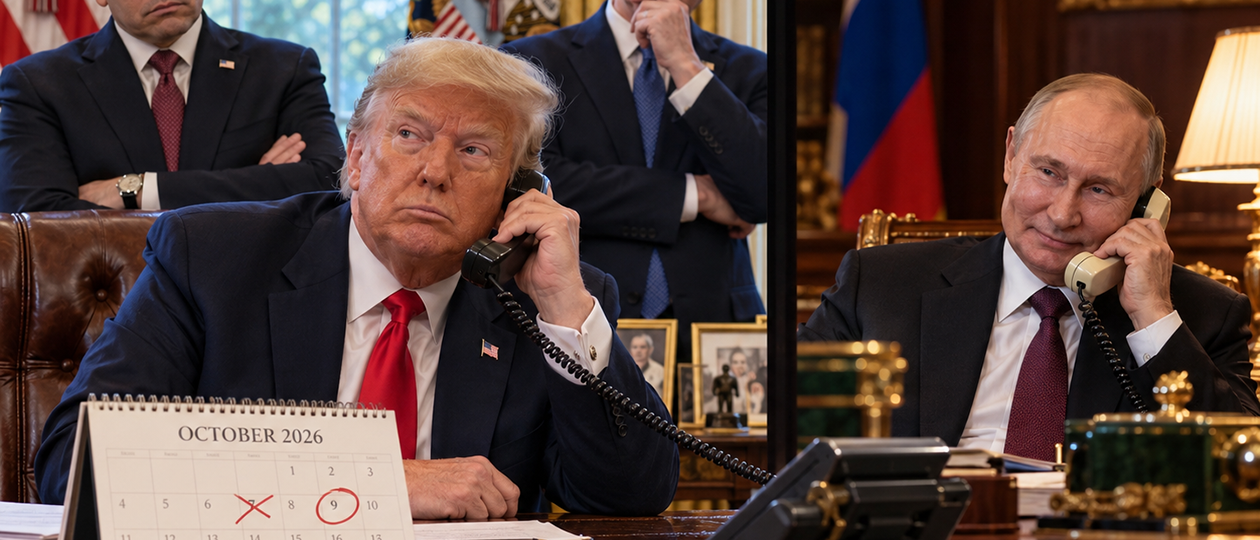
Another thaw has arrived in U.S.-Russian relations.
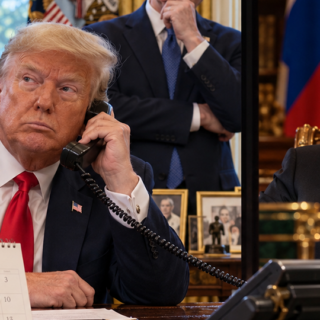
Donald Trump finally called Vladimir Putin to wish him a happy birthday. A little late, admittedly. Putin’s birthday was October 7; the call came on October 9. Even allowing for the time difference, Trump was more than a day behind schedule.
But never mind. Wishing someone a happy birthday in advance is supposed to bring bad luck. Doing so afterward is perfectly acceptable.
Of course, Trump might have preferred to call on the seventh.
Perhaps the “adults in the room”—Marco Rubio and Treasury Secretary Scott Bessent—were holding him back.
Why do I suspect as much? Because I remember a remarkably similar episode involving H.R. McMaster, Trump’s national security adviser in 2017 and 2018.
When Putin won reelection in March 2018, Trump’s briefing materials reportedly contained a warning written in capital letters: “DO NOT CONGRATULATE.”
Trump congratulated him anyway.
McMaster was replaced by John Bolton just days later. Whether the warning contributed to his departure remains a matter of speculation; relations between McMaster and Trump had already been strained. But the timing was certainly memorable. As for Bolton, the replacement proved no easier to deal with than his predecessor. That, however, is another story.
The point is that Trump congratulated Putin then, too—though not without a little delay.
And now he has done it again.
The two presidents spoke for an hour and a half. According to the Kremlin, neither seemed particularly eager to hang up first, in the finest tradition of the Trump-Putin “bromance” that characterized parts of Trump’s first term.
The conversation also produced something considerably more tangible than birthday wishes.
Washington temporarily eased sanctions on Russian diesel, while Moscow agreed to release more than 300,000 metric tons of the fuel to American and global markets, followed by another 500,000 tons in November and an additional million shortly thereafter.
The announcement provoked an angry reaction in Kyiv.
Meanwhile, negotiations involving Ukrainian, American, European, and NATO representatives in Miami ended earlier than originally scheduled. The timing inevitably invited speculation about a diplomatic rupture. However, U.S. special envoy Steve Witkoff described the discussions as constructive, and there has been no reliable confirmation that the Ukrainian delegation staged a demonstrative walkout or deliberately sabotaged the talks.
Still, the contrast was striking: while Washington’s representatives were discussing Ukraine’s future in Miami, Trump was reaching an agreement with Putin that Kyiv regarded as deeply damaging to its interests.
All very interesting.
But for Trump, it may already be too late.
The time to make such a deal was in late spring, or at the very latest in early summer, when gasoline and diesel prices began climbing at American gas stations.
Now, with just over three weeks remaining before the congressional midterm elections, even a reduction in fuel prices may not deliver the psychological effect the White House needs.
American voters have spent nearly six months watching prices rise. What difference will three weeks of potential relief really make?
And that assumes prices will fall substantially in the first place.
Russian diesel still has to reach its intended markets, pass through the relevant supply chains, and begin affecting prices at the pump. None of that happens overnight. Energy analysts have already questioned whether the volumes involved are sufficient to produce meaningful relief before Election Day.
For the White House, the timing is unfortunate.
For the Kremlin, it may be close to ideal.
From Moscow’s perspective, there is a certain advantage in making a conspicuous gesture to help Trump at precisely the moment when that help may no longer be enough to save him politically.
After all, the past year and a half has demonstrated something important: a politically strong Trump appears no more capable of overcoming the entrenched pro-Ukraine forces in Congress—and, let us be candid, within his own administration—than a politically weakened Trump.
The difference is that a weakened Trump could leave the United States facing two years of bitter domestic political warfare.
And from Russia’s point of view, an America consumed by internal confrontation is hardly the worst possible outcome.
Could Kyiv’s apparent willingness to resist Trump’s demands finally persuade him to take more drastic measures?
Could he cut off Ukraine’s access to Starlink, or suspend the flow of American intelligence that remains so critical to its military operations?
Such a decision could severely undermine Ukraine’s ability to continue fighting, although predictions of an immediate collapse would be speculative.
I find that scenario highly unlikely.
There are two reasons.
First, the gratitude of a seasoned businessman has its limits. Trump may reward Putin’s gesture with compliments, perhaps even lavish ones. But compliments are a peculiar currency: they cost almost nothing to produce and are sometimes valued far more highly than they deserve.
Second, even if Trump suddenly decided to impose such restrictions on Kyiv, it is difficult to imagine him successfully overcoming the institutional and political resistance that would follow.
Certainly, Trump is exceptionally skilled at keeping even his own allies guessing. His maneuvering over the much-discussed Lindsey Graham sanctions legislation demonstrated that talent once again.
But misleading political partners is one thing. Defying the established foreign-policy consensus on a matter of such consequence is another.
It would probably take an extraordinary crisis to change that calculation—something almost unimaginable, such as an accidental Ukrainian attack on an American aircraft or tanker.
Short of such a dramatic event, a fundamental reversal of Washington’s policy toward Kyiv seems improbable.
There is, however, another development worth watching much more closely.
The reaction of leading figures within the MAGA movement.
Following Trump’s military adventure in Iran, several prominent voices in the movement began distancing themselves from the president, or at least treating his decisions with considerably greater skepticism.
That change matters.
MAGA has never been an entirely unified political force. Its factions differ sharply on foreign intervention, America’s commitments abroad, and the proper limits of presidential power.
Trump’s latest gesture toward Moscow, however limited and conditional, may be received enthusiastically by segments of that movement that have grown increasingly frustrated with Washington’s traditional foreign-policy establishment.
And if that happens, the implications could extend well beyond the immediate controversy over Russian diesel.
For Trump himself, it would represent an important political signal.
He may soon need every ally he can find in a confrontation with a Democratic-controlled House of Representatives—and, a prospect almost too unsettling for Republicans to contemplate, possibly a Democratic Senate as well.
But the signal could be equally important for those preparing to inherit Trump’s political movement.
Above all, for Vice President JD Vance.
Contrary to conventional wisdom, the foreign-policy positions of American politicians do influence the support they receive from different electoral constituencies.
The clearest example is Israel.
Substantial segments of the MAGA movement, much like the progressive wing of the Democratic Party, have become increasingly skeptical of the traditional, nearly unconditional support for Israel that has long characterized much of the American political establishment.
There are, of course, prominent exceptions within MAGA, including commentators such as Mark Levin and Laura Loomer, who remain outspoken defenders of Israel.
But the broader trend illustrates an important political reality: foreign policy is no longer an issue that can be safely separated from the domestic loyalties and divisions of American voters.
Russia may be becoming another such dividing line.
If the applause reportedly greeting Trump’s recent expressions of gratitude toward Moscow at a MAGA gathering reflects a broader shift in sentiment, then his limited rapprochement with Putin could help bring at least some disaffected supporters back into the fold.
That would hardly guarantee Republican success in November.
Nor would it resolve the contradictions within Trump’s foreign policy.
But it could tell us something important about where the MAGA movement is heading—and about the political opportunities awaiting those who hope to lead it after Trump.
Especially JD Vance.
The immediate economic benefits of the Russian diesel agreement may prove modest. Its diplomatic consequences remain uncertain.
Its political significance, however, may ultimately lie somewhere else entirely: not in the fuel that Russia promises to deliver, but in the response of the American political movement Trump created.
For the president, the thaw may have come too late.
For his would-be successors, it may have arrived just in time.
 Kamil Askerkhanov
 Robert Reich