 Yaroslav Listov
How Khrushchev orchestrated the secret removal of Stalin’s remains from Lenin’s Mausoleum in 1961.
We loved Stalin with all our hearts.
What faith have we been given in return?
We believed, while our faith was being destroyed…
Yet life without belief is three times harder still,
And “Stalin is our glory in battle”
We sang in bitter, open defiance.
— Felix Chuyev
Sixty-five years ago, Nikita Khrushchev committed what would become his final act of political betrayal against Joseph Stalin.
On November 1, 1961, the Soviet newspaper Pravda published a brief announcement under its routine news section:
“In accordance with the resolution of the 22nd Congress of the Communist Party of the Soviet Union, the coffin containing the body of J. V. Stalin has been transferred from the Mausoleum of Vladimir Ilyich Lenin to a grave by the Kremlin Wall.”
Behind those few words lay a carefully orchestrated political operation.
The removal of Stalin’s body was intended to erase the public memory of a leader under whom the Soviet Union had been transformed from a predominantly agrarian nation into an industrial power, defeated Nazi Germany, and emerged as one of the world’s two superpowers.
The driving force behind the operation was Khrushchev himself.
His ambition went beyond condemning Stalin. He sought to remove Stalin’s name from public life, claim his predecessor’s political legacy, and recast the preceding decades of Soviet history as an era defined by crimes and abuses. In the author’s view, this campaign has found successors among present-day liberals, now displaced from positions of power, as well as among the Nazis and monarchists who have proliferated in recent years.
Yet Khrushchev understood that an open debate over Stalin’s reburial could provoke serious resistance. The decision was therefore prepared behind closed doors. The role of the 22nd Party Congress would be to provide formal approval for a measure that had already been decided.
Even before the matter was raised at the congress, Khrushchev reportedly informed the KGB officers responsible for carrying out the operation:
“Please bear in mind that today the Party Congress will decide to rebury Stalin. The location has been designated. The commandant of the Mausoleum knows where the grave is to be dug… The reburial must be carried out without any disturbance. Everything must be completed this evening.”
A Decision Made Behind the Scenes
Khrushchev entrusted Frol Kozlov with selecting the speakers who would raise the question of Stalin’s removal.
The objective was to create the impression that the initiative had come from below—from local Party organizations and ordinary Soviet citizens.
On October 30, 1961, as the 22nd Congress of the Communist Party of the Soviet Union drew to a close, the carefully prepared proceedings began.
The first to speak was Ivan Spiridonov, First Secretary of the Communist Party’s Leningrad Regional Committee.
“On behalf of the Leningrad Party organization and the working people of Leningrad, I submit to the 22nd Congress a proposal to remove Stalin’s remains from the Mausoleum of Vladimir Ilyich Lenin to another location, and to do so without delay.”
Spiridonov invoked resolutions supposedly adopted at meetings of Leningrad workers—resolutions the author maintains were fictitious.
He was followed by Pyotr Demichev, First Secretary of the Moscow City Party Committee.
“When we listened to the concluding remarks of Nikita Sergeyevich Khrushchev, our hearts were filled with pain and bitterness over all the hardships our Party had endured… Criticism of the cult of personality and the elimination of its consequences, together with the defeat of the anti-Party group that sought to preserve and perpetuate the corrupt methods of Stalin’s leadership, have made our Soviet skies clear and cloudless…”
The most emotionally charged contribution, however, came from Dora Lazurkina, a veteran Bolshevik who had joined the revolutionary movement in 1902.
Arrested in 1937, Lazurkina endured years in Soviet labor camps. Her husband was among the victims of Stalin-era repression.
During her imprisonment, she suffered psychiatric illness and was reportedly haunted by nightmares for the rest of her life.
Her testimony was intended to lend particular moral authority to the proposal.
“I have always carried Ilyich in my heart,” she declared, referring to Lenin. “And in the most difficult moments, comrades, I survived only because I carried Ilyich in my heart and consulted him about what I should do.
“Yesterday I consulted Ilyich again. It was as though he stood before me, alive, and said: ‘It is unpleasant for me to lie beside Stalin, who brought so much suffering upon the Party.’”
More than 30 Party veterans whose membership dated back to before the 1917 Revolution were reportedly present at the congress, but they were not permitted to speak.
Two prominent Old Bolsheviks, Lydia Fotieva and Elena Stasova, also allegedly requested the floor. According to the account, Khrushchev personally refused them permission.
Only four speakers addressed the issue before Nikolai Podgorny, acting on behalf of the Leningrad, Moscow, Ukrainian, and Georgian delegations, introduced the formal resolution.
According to the official transcript, the delegates voted unanimously to approve the removal of Stalin’s body.
The resolution declared: “The continued presence in the Mausoleum of the sarcophagus containing the coffin of J. V. Stalin shall be deemed inappropriate.”
There was no comprehensive discussion of Stalin’s historical role, his achievements, or the broader significance of his leadership.
Voices of Opposition
Not every senior Communist was willing to support Khrushchev’s decision without objection.
Nuritdin Mukhitdinov, a member of the Presidium of the Communist Party’s Central Committee, reportedly challenged Khrushchev on the eve of the vote.
“Nikita Sergeyevich, he was placed in the Mausoleum by a decision of the Central Committee, the Presidium of the Supreme Soviet, and the Council of Ministers. I doubt the people will respond favorably if we treat the remains of the deceased in this manner. Among Muslims in the East, disturbing the body of the dead is considered a grave sin.”
Anastas Mikoyan interrupted him.
“Don’t impose your Muslim customs on the congress.”
Vasily Mzhavanadze, First Secretary of the Georgian Communist Party, was also unwilling to take part in the operation.
On the morning of October 30, he reportedly appeared at the congress with his throat wrapped in a scarf, claiming that he had lost his voice and could not speak.
That evening, he conspicuously departed for Tbilisi.
As the account puts it, Mzhavanadze “did not want to return to Georgia as Stalin’s gravedigger.”
The Secret Operation on Red Square
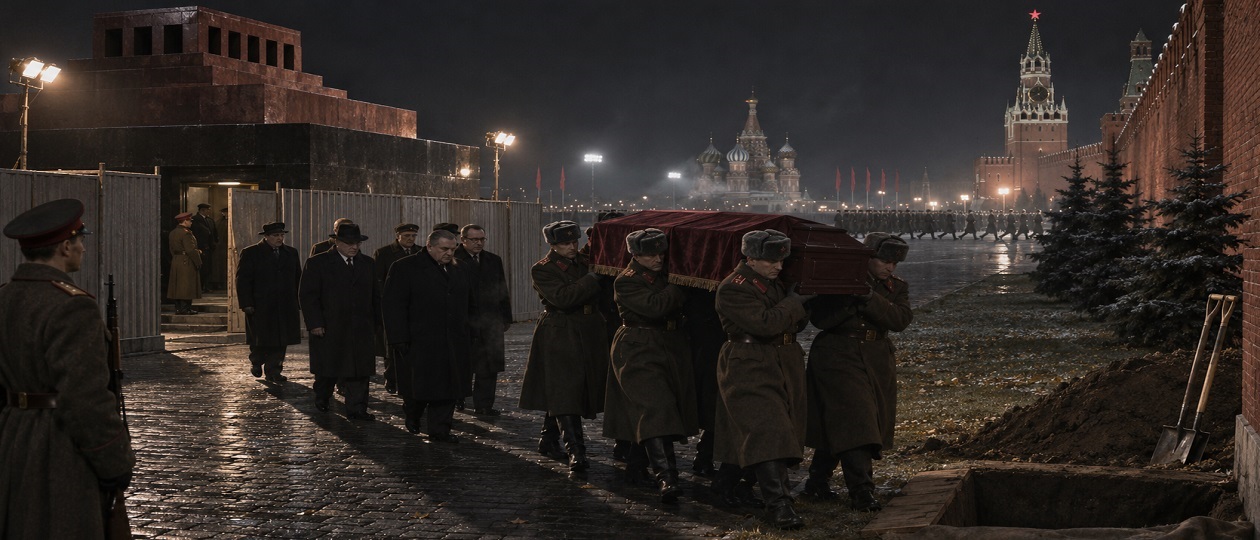
The operation was scheduled for the evening of October 31, when preparations were underway for the annual military parade marking the anniversary of the October Revolution.
Red Square was closed to the public. Special screens were erected behind the Mausoleum to conceal the burial site.
Nikolai Shvernik was appointed chairman of the commission responsible for the reburial.
Vladimir Semichastny later recalled a conversation with his longtime friend Alexander Shelepin about the operation.
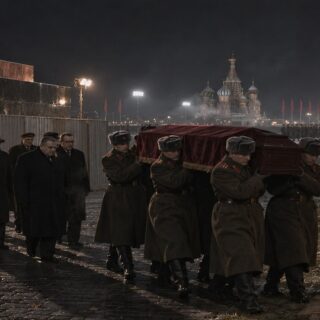
“Everything in the Mausoleum was already prepared. They removed the sarcophagus, transferred the body into a coffin, hoisted it onto the shoulders of soldiers, and quickly carried it to the grave.
“I asked Shelepin, ‘How did you feel at that moment?’
“‘Bad, of course. Like a vandal. It didn’t feel right to be carrying a dead man back and forth. But the Party had made its decision, and the orders had to be carried out.’
“The soldiers quickly shoveled earth into the grave, stamped it down, and went off to sleep. The entire procedure took no more than forty minutes.”
The ceremony reportedly proved distressing even for some of those directly involved.
Nikolai Shvernik and Givi Javakhishvili were said to have been unable to hold back their tears.
The grave was covered with a marble slab bearing a simple inscription: JOSEPH VISSARIONOVICH STALIN 1879–1953
The man whose embalmed body had rested beside Lenin for more than eight years had been removed from the Mausoleum in a matter of minutes.
A Country Divided by Memory
Khrushchev and his associates expected the removal of Stalin’s remains to mark the symbolic end of the Stalin era.
Yet the public response was not as straightforward as the organizers had hoped.
No wave of mass approval followed the decision.
Letters expressing anger and dismay reportedly reached the Communist Party’s Central Committee, local Party organizations, and newspaper editorial offices.
Some citizens invoked Stalin’s role in Soviet industrialization, the victory over Nazi Germany in World War II, and the transformation of the Soviet Union into a global power.
One particularly revealing contemporary account comes from Lieutenant General Nikolai Kamanin, a senior figure in the Soviet space program.
In his diary entry dated November 5, 1961, Kamanin recorded the following:
“Last night my sisters Lida and Polina came to visit and told me about the people’s reaction to the congress’s decisions concerning Stalin. A great many people disapprove of these decisions, and many are openly saying so in the subway, on trams and buses, and in the streets.
“Along with the removal of Stalin’s body from the Mausoleum, other measures are being quietly introduced to eradicate his memory. Moscow’s Stalin District has become Pervomaisky District, and the Stalinskaya subway station has been renamed Semyonovskaya, and so on.
“This is shortsighted and even foolish policy.
“Undermining Stalin’s authority is causing us serious difficulties abroad and doing enormous harm to the education of young people, who are losing faith in authority figures.
“All attempts to create new figures of authority, Khrushchev in particular, are failing.
“Stalin was called great. Thousands of people went willingly to their deaths with his name on their lips.
“Stalin ruled the country for thirty years, and under his leadership our homeland became a mighty power.
“The pathetic efforts of pygmies will not obscure Stalin’s name. It will rightfully shine again alongside Lenin’s.”
Kamanin’s words offer a striking glimpse into the reaction of at least one senior Soviet official to the campaign against Stalin’s memory.
They also illustrate the depth of the emotional and ideological divisions that de-Stalinization continued to provoke within Soviet society.
Why Was There No Mass Protest?
If the decision aroused such discontent, why were there no large-scale public demonstrations?
One explanation lies in the speed and secrecy of the operation.
By the time most Soviet citizens learned what had happened, the decision had already been implemented.
The Party Congress had voted. Stalin’s body had been removed from Lenin’s Mausoleum. The grave by the Kremlin Wall had been sealed.
There was no public consultation and no opportunity for citizens to influence the outcome.
The reburial had been carried out under conditions of strict secrecy, while the official announcement appeared only after the operation was complete.
Khrushchev had succeeded in removing Stalin’s remains from the Mausoleum.
But removing Stalin from history would prove another matter entirely.
 Yuri Chekalin
 Kamil Askerkhanov
 Robert Reich