 Yuri Chekalin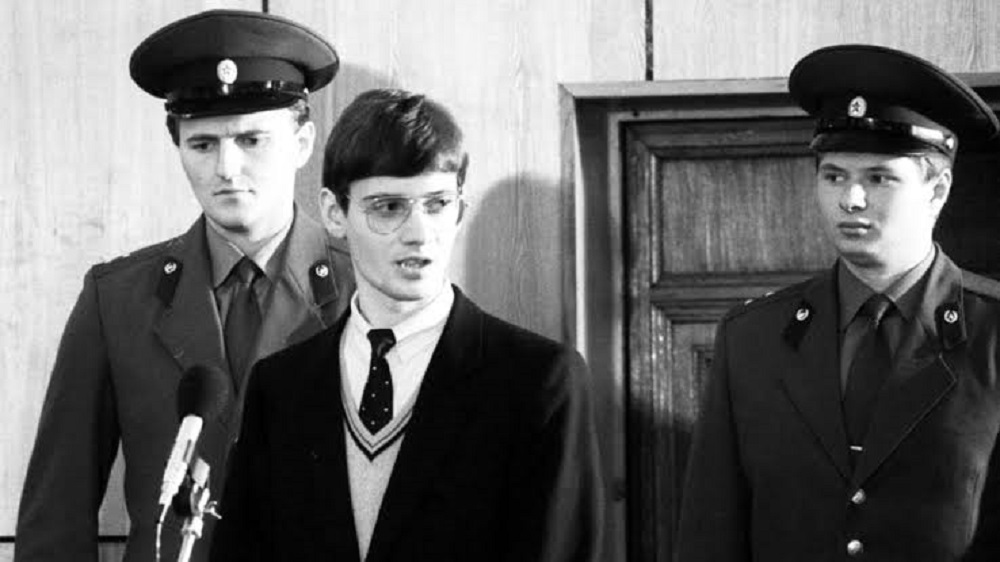
Mathias Rust: The Trial of the Man Who Landed a Plane Beside the Kremlin.
On September 4, 1987, one of the most extraordinary trials of the late Soviet era came to an end in Moscow.
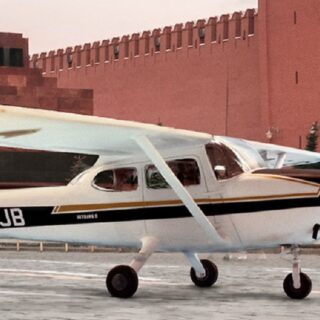
Standing before the court was nineteen-year-old West German citizen Mathias Rust—a young man who, only months earlier, had accomplished something that seemed almost impossible. Flying a small single-engine aircraft, he crossed into Soviet airspace, traveled hundreds of miles across the country, and landed within sight of the Kremlin.
The Soviet Union possessed one of the most formidable air-defense systems on Earth.
Mathias Rust had managed to penetrate it in a small Cessna.
That was not the sort of thing governments usually forgave.
Three Days in Court, Four Years Behind Bars
Rust’s trial began on September 2, 1987, and lasted three days. He faced three charges: illegally crossing the Soviet state border, violating international aviation regulations, and malicious hooliganism.
The final charge—malicious hooliganism—may sound almost absurd to a modern reader. But behind the dry legal language was a very real danger.
Rust had landed a light aircraft in the center of Moscow, near one of the busiest and most symbolic places in the Soviet Union. People were nearby. A single mistake during his low-level flight or landing could have caused a disaster.
The hooliganism charge, therefore, was not simply an attempt by Soviet prosecutors to find a suitable legal category for an unprecedented act. Rust’s flight had genuinely endangered the lives and safety of others.
And yet there was something almost surreal about the wording.
A young German had crossed the border of a superpower, slipped through one of the world’s most heavily defended air-defense networks, and landed practically beside the Kremlin.
One of the charges against him was hooliganism.
Rust insisted throughout the trial that his flight had been a “peace mission.” He said he wanted to draw attention to the dangers of renewed Cold War tensions and hoped to meet Soviet leader Mikhail Gorbachev.
The failure of the 1986 Reykjavik summit between Gorbachev and Ronald Reagan had deeply disappointed him. Nineteen-year-old Rust apparently concluded that the world’s leaders needed some assistance.
And, naturally, he decided to provide it himself.
In court, Rust admitted illegally crossing the border and violating aviation regulations but initially contested the hooliganism charge. He later appealed for leniency and acknowledged the seriousness of what he had done.
On September 4, the court delivered its verdict: four years in prison.
Rust received three years for violating international flight regulations, two years for illegally crossing the Soviet border, and four years for malicious hooliganism. The sentences, however, were to run concurrently.
Soviet justice, it seemed, had its own approach to arithmetic.
The final answer was four years.
From Red Square to Lefortovo
Following his spectacular landing on May 28, 1987, Rust was taken to Moscow’s Lefortovo Prison.
He would spend his entire period of Soviet imprisonment there.
Although the court sentenced him to a general-regime labor camp, Rust was never actually transferred. Instead, the young man who had arrived in Moscow unannounced remained in one of the Soviet Union’s most famous prisons.
There was a certain irony in the situation.
Rust had hoped to meet the Soviet leadership.
Instead, he received an extended introduction to another side of the Soviet state—one considerably less welcoming.
After his release, Rust said that he had been treated well in prison and that the experience had profoundly changed him.
“I arrived as a child. Now I return as an adult.”
That was how he described himself during his flight home.
In total, Rust spent roughly fourteen months in Soviet custody.
Freedom as a Diplomatic Gesture
On August 3, 1988, Mathias Rust was unexpectedly released.
The decision came from the Presidium of the Supreme Soviet, which officially described the move as an act of humanitarianism.
Rust’s release came at a time of rapidly improving relations between Moscow and Bonn.
Shortly before his release, West German Foreign Minister Hans-Dietrich Genscher had visited Moscow. Soviet Foreign Minister Eduard Shevardnadze indicated that Rust would soon be freed.
West German Chancellor Helmut Kohl welcomed Moscow’s decision as a positive gesture.
Rust’s release, therefore, was not the result of some secret personal appeal from Kohl to Gorbachev, as is sometimes claimed. It was part of a broader diplomatic thaw between the Soviet Union and West Germany.
Still, one suspects that the Soviet authorities had concluded that the young German had spent enough time in Lefortovo to learn a simple lesson:
when traveling to Moscow, it is generally advisable to obtain permission first.
Rust was released and almost immediately placed aboard a Lufthansa flight to Frankfurt.
A large crowd of journalists was waiting.
But the day’s most famous passenger declined to speak with them. The exclusive rights to his story had already been acquired by the German magazine Stern.
Even after fourteen months in a Soviet prison, Mathias Rust understood the value of an exclusive contract.
Hero, Adventurer, or Something Else Entirely?
Back in West Germany, Rust once again found himself at the center of international attention.
But it would be misleading to suggest that the Western press unanimously regarded him as a hero.
Some admired his extraordinary audacity. His flight looked like an almost unbelievable challenge to the Soviet military machine: one small airplane, one teenage pilot, and Red Square.
The story was so cinematic that journalists barely needed to improve the script.
Others saw something very different.
To many observers, Rust’s actions had been reckless and deeply irresponsible. Rust himself later acknowledged that the flight had been a serious mistake.
The problem was that he had become internationally famous almost overnight.
And history has repeatedly demonstrated that sudden fame is not a condition everyone survives gracefully.
A Hard Landing
Rust’s return from the Soviet Union did not lead to a conventional happy ending.
In 1989, while performing alternative civilian service at a hospital in Hamburg, he became involved in an incident that shattered whatever remained of his image as the idealistic young man who had flown to Moscow on a “peace mission.”
Following a conflict with a young nurse, Rust attacked her with a knife and seriously injured her.
In 1991, a German court convicted him and sentenced him to two and a half years in prison.
The story of the young man who had once spoken of peace on Red Square had taken a dark and disturbing turn.
The Man Who Refused to Disappear
In the years that followed, Mathias Rust repeatedly changed direction.
He went into business, traveled, pursued various projects, and periodically returned to the headlines. By his own account, he became a serious poker player and once won around one million dollars.
The phrase by his own account is important here.
Rust belongs to that rare category of historical figures whose biographies occasionally sound as if they were written by a screenwriter repeatedly told by an editor:
“No. That’s too much. Nobody is going to believe that.”
In 1994, he returned to Russia for several weeks. Rust hoped to meet Mikhail Gorbachev, but the meeting never took place.
Later, he became involved in various international and public initiatives, including projects connected with Middle Eastern peace efforts.
But for most people around the world, Mathias Rust would forever remain the man who decided that the best way to speak with Mikhail Gorbachev was to fly to Moscow without an appointment.
Did Rust Help Gorbachev?
There is a persistent theory that Rust’s flight played an important role in the internal political struggle of the late Soviet Union.
In the aftermath of the scandal, Soviet Defense Minister Sergei Sokolov was dismissed, along with Air Defense Forces commander Alexander Koldunov.
Major personnel changes followed throughout the military establishment.
For Mikhail Gorbachev, who was pursuing reforms and seeking to reduce the influence of conservative elements within the Soviet system, the incident provided a powerful justification for a major shake-up in the military leadership.
Rust himself later suggested that he might, unintentionally, have helped Gorbachev.
There is a certain historical irony in that.
A nineteen-year-old German set out for Moscow hoping to meet the Soviet leader and talk about peace.
He never met Gorbachev.
But his small airplane triggered consequences within the Soviet military establishment that Rust himself could hardly have imagined.
Where Is the Plane Now?
And what became of the aircraft that carried Mathias Rust to the Kremlin’s doorstep?
The legendary Cessna 172 changed hands several times after returning from the Soviet Union and eventually ended up in Japan.
In 2008, the aircraft returned to Germany and became an exhibit at the German Museum of Technology in Berlin.
Today, the little airplane that embarrassed one of the world’s most powerful air-defense systems in May 1987 stands quietly inside a museum.
It is not going anywhere.
And perhaps that is for the best.
Some moments in history are best experienced only once.
And then placed in a museum.
 Egor Yakovlev
 Yaroslav Listov
 Kamil Askerkhanov