 Vitaly Golovkov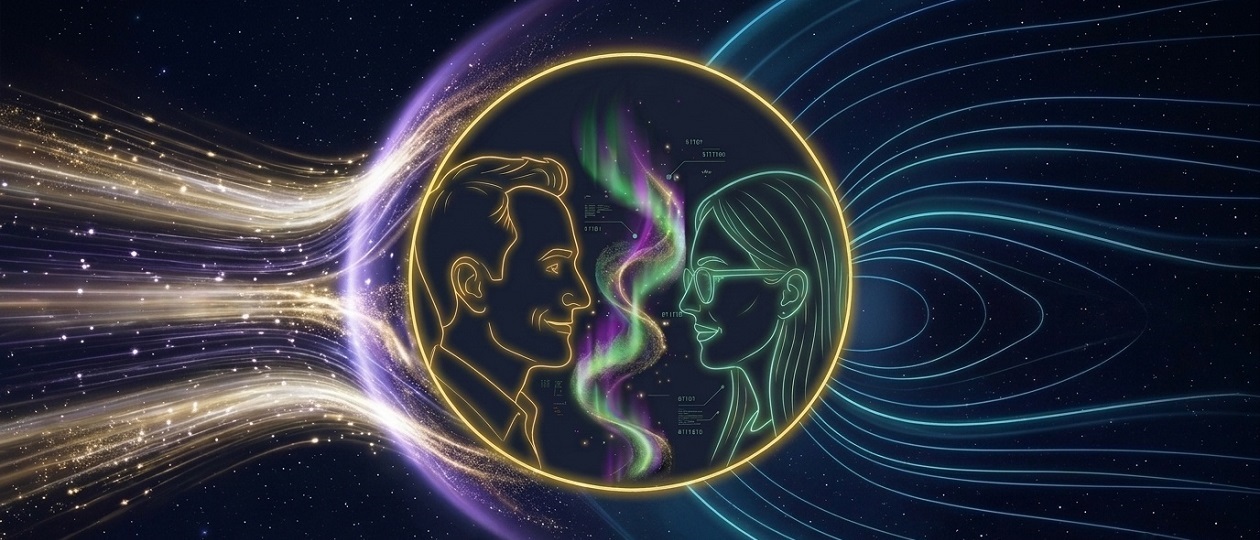
How the phenomenon of sapiosexuality is redefining our understanding of attraction — and why the collision of two powerful minds can create the most intense psychological chemistry?
The architecture of the mind and the physics of mental resonance.
The Great Dopamine Fatigue
We live in an age of unprecedented visual abundance.
Modern dating algorithms have reduced one of the most complex human processes — the formation of emotional connection — to a mechanical conveyor belt: a glance at a screen, a swipe to the right, a swipe to the left. Superficial visual assessment has become the dominant criterion of choice.
Yet this triumph of instant accessibility has unexpectedly revealed a profound humanitarian crisis: acute sensory fatigue and a widespread deficit of genuine interest.
The aesthetics of the body, when detached from the aesthetics of the mind, quickly lose their power. What remains is often a lingering sense of emotional emptiness. Against the backdrop of this “fast dopamine diet,” modern society has developed a powerful countercurrent — a renewed hunger for mental resonance.
People have begun to seek not merely the experience of looking at one another, but the deeper experience of encountering each other’s worlds.
It is precisely at the intersection of this deprivation and this longing for depth that a phenomenon increasingly discussed by psychologists and sociologists has emerged: sapiosexuality.
Who Are Sapiosexuals? The Evolution of Attraction
The term sapiosexual — derived from the Latin sapio, meaning “to be wise,” “to taste,” “to understand” — is often interpreted too narrowly, reduced to a simple attraction toward highly educated people or holders of academic degrees.
In reality, within contemporary psychological and cultural discourse, the phenomenon is far more complex.
For a sapiosexual person, the primary trigger of attraction is the human mind itself. But this does not mean dry intellectualism or the ability to recite encyclopedic facts. The true magnet is the architecture of thought: the way a person reasons, the metaphors they create, their ability to sustain a complex conversation, and their response to intellectual challenges.
The human brain is the most energy-consuming organ in the body, and throughout evolutionary history, the capacity for complex and creative thinking has been perceived as a sign of adaptability, vitality, and cognitive strength.
The Psychology of Mental Resonance and the “Aftertaste” of Conversation
Unlike the rapid spark of visual attraction, intellectual attraction follows an entirely different trajectory.
Psychologists suggest that for sapiosexual individuals, the process of emotional attachment often passes through what might be called a cognitive filter. First comes the mental spark — a mutual fascination with each other’s thoughts — and only afterward do deeper mechanisms of attachment begin to unfold.
This process has a crucial marker: the phenomenon of mental aftertaste.
Physical presence is always limited by space and time. But a conversation that leaves a profound impression continues to vibrate within consciousness hours, days, and even weeks later.
A person finds themselves continuing the dialogue internally, replaying another’s words, examining their arguments, returning to their ideas. This subtle and almost enveloping sensation — the presence of another mind within one’s own thoughts — possesses extraordinary psychological power.
Within this paradigm, the language of metaphor and subtle association becomes the central instrument of communication.
A metaphor allows people to express the most delicate emotional states while bypassing ordinary conversational clichés. It functions like an intricate code decipherable only by two people — instantly creating an intimate, protected space that exists beyond the reach of the outside world.
The Physics of Connection: How Resistance Creates Radiance
When two strong, thinking personalities encounter one another, their communication inevitably takes on the character of an intellectual duel.
Each rational mind possesses its own gravity, its own protective barriers. The psyche guards its boundaries, refusing to allow just anyone to disrupt its internal equilibrium.
Nature itself offers a striking analogy for this phenomenon.
The aurora borealis is a rare and breathtaking spectrum of beauty, something entirely unlike the ordinary atmosphere surrounding it. In the union of two minds, psychological chemistry operates in a similar way: it creates a unique universe of meanings understood only by those two individuals.
This closeness lifts them beyond everyday experience, gently envelops consciousness, and leaves behind a deep, warm emotional resonance.
True resonance is always symmetrical: the state that emerges finds an immediate response and inner agreement within both participants.
It is the result of the encounter between two immense energies.
If we turn to academic physics, the northern lights are not a mystical miracle but a magnificent consequence of the interaction between two powerful physical systems.
The Earth possesses a protective shield — its magnetic field, or magnetosphere. The Sun, meanwhile, continuously releases streams of charged particles into space: the solar wind.
When this energetic flow encounters Earth’s magnetic shield, a tremendous interaction occurs. The magnetic field does not collapse under the pressure; instead, it redirects the energy, concentrating it in specific regions.
The particles penetrate the upper atmosphere, where they collide with atoms.
In scientific language, this moment carries an almost poetic description: the collision places atoms into an “excited state.”
Having absorbed external energy, an atom temporarily loses stability. When it returns to its normal state, it releases that excess energy in the form of a photon — a particle of light.
Billions of such microscopic flashes combine to create the soft, shimmering aurora that seems to wrap the planet itself in beauty.
This fundamental law of nature can be projected onto the psychology of sapiosexual connection:
1. The charged stream of energy is the active will, confident intention, and intellectual force of one partner moving toward connection.
2. The magnetic field is the autonomous psychological defense and rational control of the other partner, protecting their independence.
A brilliant psychological “aurora” of emotion cannot emerge where there is no resistance between minds.
But when intellectual energy is sufficiently mature and powerful, it does not destroy mental barriers — it gently moves around them and passes through them.
That very resistance transforms the mind into a state of pleasurable, stimulating excitement, later experienced as a warm emotional afterglow.
This reveals a deeper truth: the most profound form of attraction does not unfold merely at the level of bodies, but at the level of interacting fields of energy and systems of meaning.
The Synergy of IQ and EQ: When the Mind Agrees with the Heart
It is important to understand that sapiosexuality is not a mathematical equation.
Cold calculation or a purely competitive clash of intellects quickly becomes exhausting. Genuine attraction emerges only when intellectual development (IQ) is combined with emotional intelligence (EQ).
Emotional intelligence allows partners not merely to engage in sophisticated conversations, but also to perceive each other’s inner states, recognize hidden fears, respect personal boundaries, and understand a person’s deepest values even during the earliest exchanges.
In such a relationship, the mind is neither defeated nor broken — it willingly and consciously chooses closeness.
This is not the surrender of control before superior force.
It is the recognition of equality between two developed forms of intelligence.
And within this act of trust there is not the slightest trace of weakness — only the highest expression of psychological maturity.
The Architecture of Cognitive-Emotional Synergy
Social psychologists have long studied this mechanism.
Research into sapiosexuality suggests that mental attraction is not merely a selective aesthetic preference, but a complex cognitive-emotional process of a higher order.
The well-known Self-Expansion Model, developed by psychologist Arthur Aron and frequently cited in relationship research, argues that people are naturally drawn toward those whose worldview has the potential to expand their own.
Encountering a deeply thoughtful and original partner is perceived by the psyche not as competition or a threat to independence, but as a rare opportunity to transcend the limits of ordinary experience — a source of extraordinary enrichment of one’s own mental universe.
Modern neuroscience has also shown that during moments of profound interpersonal understanding, a phenomenon known as neural coupling may occur: the synchronization of cognitive processes between individuals.
The initial rational resistance — the natural “magnetic shield” of a strong, autonomous personality — gradually gives way to a sense of psychological safety.
At that moment, intellectual confrontation transforms into a rare form of emotional trust and profound receptivity.
The New Intimacy of the Twenty-First Century
In the twenty-first century, sapiosexuality is redefining the very meaning of intimacy.
In a world increasingly losing its capacity for depth, the ability to recognize and embrace the architecture of another person’s mind becomes one of the strongest bridges between human beings.
And it is precisely at this intersection — where mutual recognition meets the resonance of meaning — that a form of attraction emerges capable of enduring the ultimate test: time.
 Dmitri Drobnitsky
 Kamil Askerkhanov
 Sergey Stankevich