 Yuri Chekalin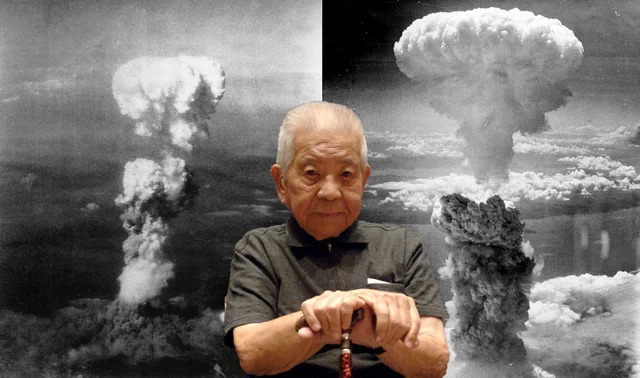
The man who survived both atomic bombings — Hiroshima and Nagasaki — was Tsutomu Yamaguchi (1916–2010).
He is the most famous and officially recognized double hibakusha — a term meaning a person who was exposed to the atomic bombings twice.
Hiroshima — August 6, 1945
Tsutomu Yamaguchi was an engineer working for Mitsubishi Heavy Industries and was in Hiroshima on a business trip.
On the morning of August 6, when the American B-29 bomber Enola Gay dropped the first atomic bomb, engineer Yamaguchi was approximately three kilometers from the blast’s epicenter.
He suffered severe burns, was wounded by fragments, and temporarily lost his hearing. Despite his injuries, he managed to reach the railway station and eventually returned to his hometown.That city was Nagasaki.
Nagasaki — August 9, 1945
Three days later, on August 9, Yamaguchi once again found himself at the center of history.
Despite his injuries, he went not to a hospital, but to work at the Mitsubishi office in Nagasaki. There, at precisely the moment when he was telling his supervisors about what had happened in Hiroshima, American aircraft appeared above the city once again.
The second atomic bomb — Fat Man — was dropped.
Yamaguchi survived the explosion a second time.
He was approximately two kilometers from the epicenter, yet somehow managed to survive.
After the War
For many years, Yamaguchi did not seek public attention or speak openly about his experiences. In postwar Japan, many hibakusha faced discrimination because people feared that radiation exposure could be hereditary or contagious.
With age, however, Yamaguchi became an outspoken advocate against nuclear weapons.
Yamaguchi once said: “I cannot understand why the world cannot comprehend the suffering of those who survived the atomic bombings.”
He met with young people, spoke before international organizations, and in 2005 published his memoirs recounting his experiences.
In 2009, the Japanese government officially recognized him as a survivor of both atomic attacks.
Tsutomu Yamaguchi died on January 4, 2010, at the age of 93.
His life remains one of the most powerful symbols of the tragedy of Hiroshima and Nagasaki: one man became a witness to two moments when humanity first unleashed a weapon capable of destroying entire cities in a single instant.
 Robert Reich
 Vladimir Golstein
 Paul Sadchikov