 Yuri Chekalin
Morita-san first appeared near Yoyogi Park in late April.
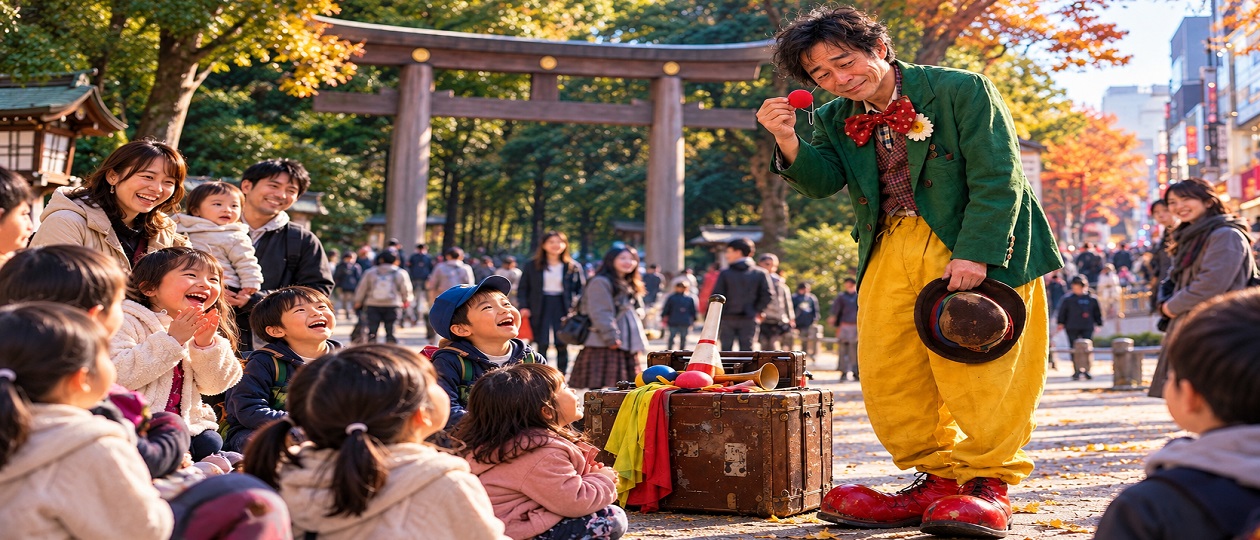
He wore yellow pants, a green jacket, enormous red shoes, and a round nose that, for some reason, kept falling off.
Apparently, the nose was the only part of his costume with a mind of its own.
Morita would try to put it back on. The nose would fall off. He would put it on again. The nose would fall off again.
Two schoolboys stopped to watch.
Within five minutes, about twenty people had gathered around him.
Within ten, nearly fifty.
And so his career began.
He was forty-seven years old.
At first, he came only on weekends.
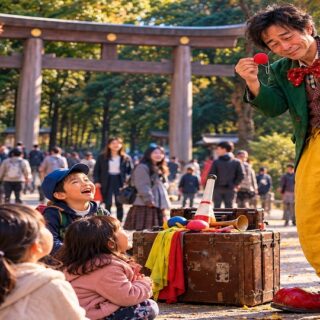
He would set an old brown suitcase near the entrance to Meiji Shrine, not far from Harajuku Station, change into his costume, and begin his performance.
No music. No loudspeakers.
Just a suitcase, three brightly colored balls, a few balloons, and a rather peculiar sense of humor.
He might spend ten minutes trying to open a suitcase that he himself kept discreetly pushing shut with his foot.
Or he would ask a child to hold an imaginary rope, then struggle desperately to get past it, as though running into an invisible barrier.
One day, a little girl of about four gave him a piece of candy.
Morita accepted it with the solemnity of a man receiving a decoration from the emperor. He bowed, unwrapped the candy, and discovered that it had vanished.
He searched his pockets, his shoes, and under his hat.
The little girl was howling with laughter.
The candy had been behind his ear the whole time.
She spotted it first and shouted with delight.
Morita felt behind his ear, discovered the candy, and stared at it in horror.
The audience applauded.
That day he earned eleven thousand six hundred yen.
At home, his wife said:
“Not bad. Now imagine how much they’d pay you if you stopped terrifying small children.”
“I don’t terrify them.”
“You’ve got a red nose and size fifteen shoes. Some children that age are afraid of vacuum cleaners.”
“They laugh.”
“Possibly from nervousness.”
Morita kissed her forehead.
“I’ll buy you strawberries tomorrow.”
“Buy yourself some decent shoes first. Those things are going to kill you one day.”
Before becoming a clown, Morita had worked for seventeen years at a small trading company.
The company supplied equipment to restaurants: refrigerators, freezers, dishwashers, and assorted stainless-steel appliances and utensils.
The work was dull but dependable.
Morita knew the dimensions of commercial refrigerators, the prices of replacement compressors, and the names of the managers of nearly two hundred restaurants.
He also knew how to make people laugh. That was what he would later remember most fondly.
At company parties, someone inevitably asked him to perform. He impersonated the head of sales, mimicked the company president’s voice, juggled tangerines, and somehow managed to turn an ordinary napkin into a remarkably convincing chicken.
His wife said he had chosen the wrong profession.
He replied that clowns didn’t get annual bonuses.
When Akiko fell ill, the question of bonuses gradually lost its importance.
First came the examinations. Then surgery. Then treatments that were supposed to help, but helped less and less.
Morita began asking for time off.
Sometimes a few hours. Sometimes an entire day.
He needed to take Akiko to the hospital, meet with doctors, pick up medication, or simply stay beside her when she was feeling particularly bad.
At first, the head of sales was understanding.
Eventually, he stopped being understanding.
And when the company announced staff reductions, Morita’s name appeared on the list.
They explained that the decision was based entirely on economic considerations.
He didn’t argue.
By then, Morita had learned that there were things in life it was absolutely pointless to argue with.
They lived in Nakano, in a small, single-story house squeezed between two other houses just like it.
The street was so narrow that the garbage truck negotiated it with the caution of a man wearing an expensive suit for the first time.
Electrical wires hung above the rooftops.
There were so many that Morita once suggested that if they all suddenly snapped, the houses would simply drift apart.
Akiko said that was the only reasonable explanation for why they hadn’t fallen down already.
The house was old. The bathroom door closed properly only on the third attempt. In winter, cold air came through the windows; in summer, mosquitoes.
But a small camellia bush grew outside the window.
Akiko loved it.
Morita couldn’t understand why anyone would want a bush that bloomed in winter, when sensible people preferred to stay indoors.
“Because there ought to be something beautiful in winter, too,” she would say.
Akiko was three years younger than her husband, but she spoke to him as though she’d spent thirty years trying to raise him properly and was gradually losing hope of success.
When Morita lost his job, she asked:
“So what now?”
“I’ll look for another one.”
“Will you find one?”
“Of course.”
They both knew he was lying.
At forty-seven, finding a job with flexible hours proved difficult. Especially when you warned prospective employers in advance that you might sometimes have to leave unexpectedly.
After a month, Morita stopped sending out résumés every day.
After two, he began calculating how much money they had left.
In the third month, Akiko asked him to bring down an old suitcase from the storage space above the closet.
Inside were the magic tricks he’d once performed for his nieces and nephews, three juggling balls, and a ridiculous green jacket.
“You’ve always wanted to try it,” she said.
“I’m forty-seven.”
“I’ve noticed.”
“It’s too late to become a clown at my age.”
“Of course. Much better to become an unemployed accountant.”
“I’m not an accountant.”
“All the worse. You aren’t even qualified for that.”
He looked at her.
Akiko was smiling.
By then, she rarely smiled anymore.
“Give it a try,” she said. “You’re good at making people laugh.”
“What if I don’t earn anything?”
“Then at least you’ll have made somebody laugh.”
And that was how the clown appeared outside Meiji Shrine.
By June, Morita had regular spectators.
On Saturdays, an elderly woman came with a little white dog. The dog hated the red nose and barked at it with such fury that Morita once built an entire performance around their confrontation.
On Sundays, a boy of about six appeared in a blue baseball cap. He always stood in the front row and was genuinely astonished by the same tricks every single time.
Sometimes tourists stopped to watch.
Americans laughed loudly. Europeans took pictures. Chinese children tried to figure out how the tricks worked.
One day, an elderly German dropped two thousand yen into Morita’s suitcase and delivered a lengthy speech in a language Morita didn’t understand.
Morita nodded solemnly.
When the German had gone, the boy in the blue cap asked:
“What did he say?”
“I think he offered me a job in Germany.”
“Are you going?”
“No.”
“Why not?”
“It’s too cold there for my shoes.”
The boy considered this for quite some time.
Then he nodded.
A perfectly reasonable explanation.
By August, people had begun recognizing Morita.
They stopped and pulled out their phones.
Short videos appeared on social media.
“The Funniest Clown in Harajuku.”
“The Man Whose Nose Keeps Falling Off.”
“A Must-See If You’re Visiting Tokyo.”
Morita knew nothing about it.
He had an old phone that he used for calls, text messages, and taking pictures of price tags at the supermarket.
Akiko discovered the videos by accident.
“You’re famous,” she announced one evening.
“Really?”
“You’ve got a hundred and forty-three thousand views.”
“How much do they pay you for that?”
“Nothing.”
“Terrible kind of fame.”
“Absolutely.”
She showed him a video.
On the screen, Morita was trying to inflate a balloon. The balloon refused to inflate. Morita grew angry, wagged his finger at it, and finally sat on it.
There was a loud pop.
Morita himself jumped nearly two feet into the air.
Children all around him burst out laughing.
Akiko watched the video three times.
The fourth time, she let out a little snort. Then another. And finally she began to laugh in earnest.
She had always done that. When something struck her as especially funny, she would try to hold back her laughter, make a comical little snorting sound, and only then start laughing—quietly, a little hoarsely.
“You’re snorting again,” Morita said.
“You’re the one who’s snorting!”
She laughed again and began to cough.
Morita was frightened. He brought her water and adjusted her pillow.
“All right. That’s enough.”
“One more time.”
“You’re not supposed to laugh that hard.”
“Then stop being funny.”
He put the phone away.
But later, after Akiko had fallen asleep, he opened the video again.
Not to watch himself.
He wanted to hear her laugh.
Every evening, Morita followed more or less the same route home.
First he walked to Harajuku Station.
People crowded the streets. On Takeshita Street, teenagers bought brightly colored sweets, tourists photographed shop windows, and lines formed outside stores.
Tokyo seemed like a city that had no intention of ever going to bed.
Then came the train.
A few stops, a transfer, another short ride.
And then a different Tokyo began.
Low houses, old wooden fences, narrow alleys, bicycles leaning against walls. Vending machines glowing at deserted intersections.
The voices of television announcers drifted through open windows.
Somewhere, dishes clattered.
The air smelled of grilled fish, soy sauce, and asphalt still damp from the rain.
Morita loved that walk.
Especially the last turn before his house.
Because there was always a light in the window.
Akiko left a little lamp on beside her chair, even when she was already in bed.
He grumbled that electricity was getting more expensive.
She replied that a famous entertainer could surely afford one extra lightbulb.
Lately, Morita had begun coming home earlier.
Akiko was growing weaker.
Sometimes she had trouble even holding a cup.
Morita helped her get up, wash, and change her clothes. He kept track of her medication, wrote down the times she took it, and prepared meals she sometimes didn’t even taste.
He hardly slept anymore.
One evening, after an especially difficult day, Morita sat in the kitchen staring at the dirty dishes.
Akiko called from the bedroom.
He closed his eyes.
Just for a second.
And suddenly he thought how wonderful it would be to spend just one evening without medication, hospitals, or endless questions about how someone was feeling. Just sit in front of the television, drink a beer, and not worry about anything.
His wife’s voice came from the bedroom again.
“Coming!” he answered, more sharply than he’d intended.
He felt ashamed immediately.
It wasn’t Akiko’s fault. She hadn’t chosen this illness. And she would surely have given anything in the world to be able to walk into the kitchen and pour herself a glass of water.
Morita got up.
He stopped outside the bedroom, rubbed his hands over his face, and only then went in.
“What’s wrong?”
“Some water, please.”
“I’ll get it.”
He adjusted her pillow.
“Are you tired?” Akiko asked.
“No.”
“You’re lying.”
“A little.”
“Go get some sleep.”
“Who’s going to bring you water? The emperor?”
“That would be nice. I’ve never seen the emperor carrying a tray.”
Morita smiled.
“I’m sure he’s got more important things to do.”
“There you are, then. It’ll have to be you.”
He brought her water and sat beside her while she drank.
Akiko took his hand.
“Thank you.”
Morita turned away.
For some reason, those two simple words made him feel even more ashamed.
He did have some help, after all. A nurse came in the mornings. A doctor visited twice a week.
One day, Morita asked the doctor how much time she had left.
The doctor answered cautiously.
Too cautiously.
Morita understood.
That evening, he sat beside his wife’s bed peeling a tangerine.
“I’m not going tomorrow,” he said.
“Why not?”
“They’re forecasting rain.”
“Just a little.”
“Still.”
“Go.”
“Akiko…”
“I don’t need you hanging around here.”
“Very nice to hear.”
“You spend the whole day adjusting my blanket, offering me tea, and asking if I’m cold.”
“You do get cold.”
“I do. But you’ve asked me four times in the last half hour.”
Morita put the peeled tangerine on a plate.
“I just want to be with you.”
Akiko looked at him for a long time.
Then she reached out and touched his cheek.
“I know.”
He covered her hand with his.
“Then why are you sending me away?”
“Because when you go out to make children laugh, you get this look on your face…”
“What look?”
“Like you’re alive again.”
Morita said nothing.
“Go,” she repeated. “And tonight you can tell me how many people laughed themselves off their feet.”
“Hopefully none. I don’t have insurance.”
She smiled.
In the fall, Morita began going almost every day.
If Akiko had no medical procedures scheduled that morning and was feeling well enough, he packed his suitcase, checked his phone, and headed for Harajuku.
Sometimes he performed for only an hour.
Sometimes two.
He never stayed longer than he’d promised his wife.
The money in the suitcase varied wildly. On good days, he brought home fifteen thousand yen.
On others, he barely made three thousand.
One day, a little boy dropped a chestnut into Morita’s suitcase.
Morita picked it up with an important air, examined it against the light, and slipped it into his breast pocket as though he’d been presented with a rare jewel.
That evening, he showed the chestnut to Akiko.
“Look. Today’s earnings.”
“That bad?”
“On the contrary. A chestnut of exceptional quality.”
“Shall we pay the electric bill in chestnuts?”
“I’ll try to negotiate.”
“Tell them you’re famous.”
Morita placed the chestnut beside the lamp.
And there it stayed.
By November, Akiko hardly got out of bed at all.
They no longer talked about the future.
Instead, they talked about ordinary things.
The weather.
The neighbor who had once again put his garbage out incorrectly.
Strawberries, which for some reason had become obscenely expensive.
Sometimes Akiko asked him to show her a new trick.
Morita would sit on the edge of the bed and attempt to make a coin disappear.
The coin almost always fell onto the floor.
“You’re hopeless,” his wife would say.
“But consistent.”
“That’s true.”
One day, she asked:
“Will you keep doing it after I’m gone?”
He pretended not to hear.
“Doing what?”
“Performing.”
“Akiko…”
“Don’t.”
He lowered his eyes.
“I don’t know.”
“Keep going.”
“We’ll see.”
“No. Promise me.”
Morita was silent for a long time.
Then he nodded.
“I promise.”
“Good.”
She closed her eyes.
A minute later, she opened them again.
“And buy some new shoes.”
“These are still fine.”
“You’re lying. The left sole is coming loose.”
“Nobody notices.”
“I notice.”
“You notice far too much.”
“That’s why I married you. Somebody had to make sure you didn’t get yourself killed doing something stupid.”
He laughed.
Akiko smiled, too.
It was one of the last evenings when they were still able to laugh together.
In early December, the clown disappeared.
On Saturday, no one opened the brown suitcase near the entrance to Meiji Shrine.
Not on Sunday, either.
The boy in the blue cap waited a long time beside the familiar tree.
“Is he sick?” he asked his mother.
“Probably.”
“Really sick?”
“I don’t know.”
“Do clowns get sick?”
“Of course.”
The boy thought about that.
“Then who makes them laugh?”
His mother had no answer.
It rained on Tuesday.
Wednesday turned colder.
By Friday, nobody stopped beside the tree anymore.
Only the elderly woman with the white dog paused for a moment. The dog sniffed the spot where the suitcase usually stood.
Then they walked on.
Akiko died on a Monday, at 4:17 in the morning.
Morita was beside her.
He held her hand as her breathing grew slower, then almost imperceptible, and finally stopped.
For a while, he continued sitting there, holding her fingers.
Then he called the doctor.
After that came people.
Medical certificates. The funeral home. Telephone calls. Relatives he hadn’t seen in years.
Everyone spoke softly.
Everyone tried to help.
Everyone asked how he was holding up.
Morita said he was fine. Though inside he felt empty and cold, like one of the enormous industrial refrigerators he’d once sold.
But he really was holding up.
As long as there were things to organize, papers to sign, bills to pay, choices to make, and decisions to take.
The trouble began afterward.
When everyone had gone home.
When the house grew quiet.
When nobody asked him anymore whether he wanted something to eat.
The first evening, Morita bought two prepared dinners at a convenience store.
At home, he noticed what he’d done and stared at the packages for a long time.
Then he put one in the refrigerator.
The next morning, he woke at six.
As always.
He lay there for a while, listening.
Nobody called from the next room.
Nobody asked for water.
Nobody complained about being cold.
Nobody told him he was stomping around too loudly again.
He got up, put the kettle on, and took out two cups.
He put one back.
After breakfast, he sat at the table for a long time.
Then he washed the dishes.
Checked the mailbox.
Watered the camellia.
At nine thirty, he discovered that he had absolutely no idea what to do next.
That was how the day passed.
And the next.
On Saturday morning, Morita opened the closet.
The green jacket lay on the top shelf.
Beside it were the yellow pants and the red shoes.
He took everything down, laid it on the bed, and sat beside it.
The costume looked ridiculous.
Especially the shoes.
The left sole really was coming loose.
Morita picked up the shoe.
“Well, there you go,” he said aloud. “You were right again.”
The house said nothing.
He took a tube of glue from the toolbox and carefully glued the sole back into place.
Pressed it down.
Waited.
Then he began getting dressed.
It was cold that day, but sunny.
Families with children, tourists, and young couples were walking near Meiji Shrine. Someone was taking pictures of the last autumn leaves.
Morita arrived a little later than usual.
He set down his suitcase.
Spread out his little mat.
Put on his red nose.
For several minutes, nobody paid any attention to him.
Then a little girl with a pink backpack stopped.
Morita bowed.
His nose fell off.
The girl laughed.
He picked up the nose, examined it carefully, and tried to put it back on.
It fell off again.
Two more children stopped.
Morita sighed, took a piece of string from his suitcase, and tied the nose to his ear.
Now it dangled against his cheek.
The children roared with laughter.
Gradually, a crowd gathered.
Morita performed his old tricks.
He mixed up his juggling balls.
Argued with balloons.
Marvelled at disappearing coins.
As he bent to retrieve his fallen hat, Morita suddenly heard a laugh.
Among dozens of children’s voices, someone gave a soft little snort. Then another. And then came a laugh—quiet, slightly husky.
Morita froze.
He knew that laugh.
Slowly, he raised his head.
Behind the children stood several adults. A young woman in a light-colored coat, an elderly man with a camera, two girls carrying shopping bags.
And a little farther away, beside the tree…
Akiko?
He straightened and took a step forward.
Someone passed between him and the tree.
When Morita looked again, all he saw were strangers.
“Hey!”
The voice came from below.
In front of him stood a boy in a blue baseball cap.
The same boy.
“You’re back!”
Morita nodded.
“I’m back.”
“Why were you gone so long?”
Morita looked at the boy.
Then at his suitcase.
“I lost someone.”
“Did you look for them?”
“I did.”
“And you couldn’t find them?”
Morita shook his head.
“No.”
The boy thought about that for a while.
“Are you coming tomorrow?”
Morita felt his throat tighten.
“I’ll be here.”
“Then I’ll come, too.”
The boy ran back to his mother.
And Morita stood in the middle of the plaza, holding his ridiculous hat.
Then he straightened his red nose.
Turned toward the audience.
And began a new trick.
That evening, he rode home on a crowded train.
A young couple sat across from him.
The girl was telling a story, waving her hands as she spoke. The young man laughed.
Morita looked out the window.
His face was reflected in the dark glass.
Without makeup, it looked tired.
There were bags under his eyes.
It suddenly occurred to him that tomorrow he would have to get up early again.
Check his costume.
Buy some new balloons.
And perhaps finally replace his shoes.
The thought made him feel a little better.
He got off the train in Nakano and walked along the familiar streets.
The city was gradually settling down for the night.
Low houses stood shoulder to shoulder. Electrical wires crisscrossed above their roofs. Someone had left a bicycle outside a small shop without locking it.
The laughter of a television audience drifted from a ground-floor window.
Morita turned into his alley.
His house stood ahead.
The window was dark.
He stopped.
There had always been a little light shining through that window.
Now there was no one waiting for him to come home.
He took out his key.
Opened the gate.
Went inside.
Took off his shoes.
Set his suitcase beside the wall.
Then he walked into the living room and switched on the lamp by the window.
He sat in Akiko’s chair.
For a while, he looked at the little chestnut that still lay beside the lamp.
He picked it up and held it in his palm.
“Made eight thousand four hundred today,” he said.
Silence.
“And one little boy promised he’d be back tomorrow.”
Morita turned the chestnut between his fingers.
“You would’ve liked him.”
He paused.
Then added:
“Although you’d probably have said he deserved a proper clown.”
For the first time in days, Morita gave a quiet laugh.
And almost immediately began to cry.
He cried for a long time.
In the empty room, beneath the little lamp Akiko had always left on for him.
When the tears finally stopped, he wiped his face with his sleeve.
Sat for a while longer.
Then he got up, went to the kitchen, and put the kettle on.
He took out one cup.
Thought for a moment.
Went back to the cupboard and took out a second.
He placed both on the table.
Filled one with tea.
Left the other empty.
Then he sat by the window.
Outside, the street was quiet.
Only the distant sound of a train broke the silence.
The following morning, Morita-san arrived at Meiji Shrine at exactly ten o’clock.
He wore yellow pants, a green jacket, and an enormous pair of brand-new red shoes.
The boy in the blue cap spotted him first.
“Look, Mom! The clown!”
Morita bowed.
His nose fell off.
The boy burst out laughing.
The clown picked up his nose, regarded it with astonishment, and shook his head.
Then he opened his suitcase.
Inside were brightly colored balls, balloons, and a little chestnut.
Morita slipped the chestnut into his jacket pocket.
Turned toward the children.
And began his performance.
He was still very good at making people laugh.
It was just that now he needed it a little more himself.
 Kamil Askerkhanov
 Robert Reich