 Yuri Chekalin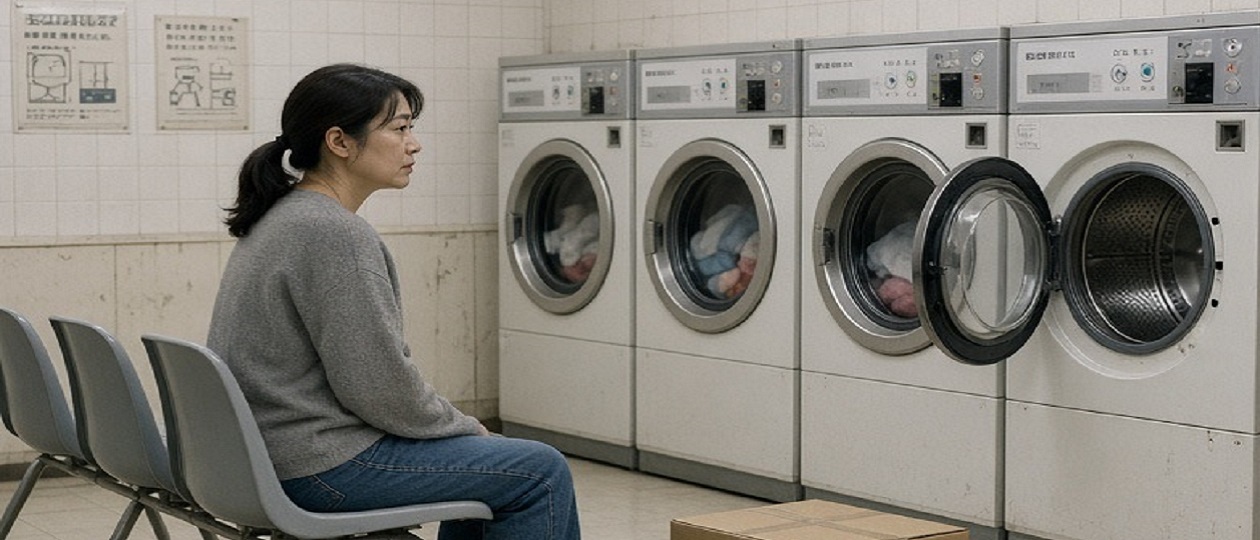
I met her in a laundromat in Nakano at half past midnight.
Not the most promising place to meet someone. But then, if you think about it, there really aren’t any promising places. People meet wherever they happen to be when they least want to meet anyone.
I was fifty-four, and I’d been living alone for five years.
I worked as a technical translator. Industrial pumps. Packaging machines. Ventilation systems. Manuals for things designed to keep other things from going wrong.
Sometimes I thought my whole life was made up of words nobody ever said out loud.
Pressure relief valve. Discharge pressure. Emergency shutdown.
I lived in a small apartment ten minutes from the station. There was a bed, a desk, a bookcase, a PS5, a television, a washing machine, and a refrigerator.
A calendar hung on the wall. I kept forgetting to turn the page.
Sometimes I’d wake up, look at the date, and realize I’d been living in the previous month for two weeks.
At night, I listened to music and drank whisky.
That night, the washing machine broke. I could have called a repairman, but a middle-of-the-night service call would have cost more than the machine was worth. I could have taken the laundry to a dry cleaner in the morning.
Instead, I stuffed everything into a large blue bag and walked to a twenty-four-hour laundromat on the next street.
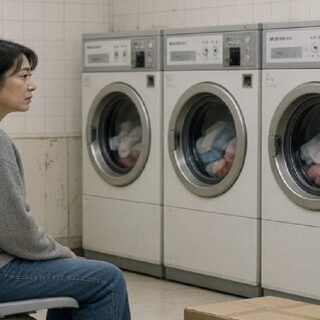
It was warm inside and smelled of detergent. Four machines were running. Clothes turned slowly behind the glass of three of them.
A woman sat on a plastic chair beside the fourth. She looked about forty. Maybe a little younger. Gray sweater. Jeans. White sneakers. Her hair was pulled back in a ponytail.
On the floor beside her was a cardboard box marked: “FRAGILE”
She watched the laundry turn.
I loaded my machine, fed it a handful of coins, and sat two chairs away from her. For about five minutes, neither of us said anything.
Then she asked,
“Do you always do laundry this late?”
I thought about it.
“Only when my washing machine breaks.”
She nodded.
“Then you’re lucky.”
“Why?”
“Mine is broken too.”
I wasn’t sure what she meant. I decided not to ask.
The machines kept turning. Through the glass door, the street was empty.
“I’m Akiko,” she said.
I told her my name.
“Do you live around here?”
“Not far.”
“Alone?”
I looked at her.
“Is it that obvious?”
“A little.”
“And you?”
She smiled.
“A little.”
I couldn’t tell if she was joking. I liked the answer anyway. Forty minutes later, we walked out of the laundromat together.
The night was warm, almost unnaturally so for the season. The kind of night that made you think chance encounters might actually mean something.
We walked in the same direction. I carried my blue bag. She carried the cardboard box on top of her laundry basket.
“What’s in the box?” I asked.
“Plates.”
“You bring plates to the laundromat?”
“No. I’m moving.”
“At one-thirty in the morning?”
She looked at me.
“Some things are better done at night.”
I thought she had a point.
We reached an intersection. That was where our paths separated.
She stopped.
“Thanks for the company.”
“We barely talked.”
“Sometimes that’s good company.”
She said it without a trace of irony. Then she lifted the basket slightly, like a small wave.
“Good night.”
I watched her walk down the dark street. After a while, she turned around, as if she’d thought of something she wanted to say. Then she didn’t. A few seconds later, she disappeared around the corner.
I stood there for another minute. Then I went home.
A week later, I went back to the laundromat.
My washing machine was working again. I didn’t use it. Akiko wasn’t there.
I loaded a bag of clean clothes that didn’t need washing.
For some reason, I wanted to stay.
While the machine ran, I read. Then I put the clothes in the dryer.
When I got home, they smelled like detergent and, faintly, hot metal.
The next Thursday, I went again.
Akiko showed up at half past midnight. She was carrying the same cardboard box.
“Still haven’t unpacked the plates?”
She looked at the box.
“No.”
“Why not?”
“I don’t know where to put them.”
I looked at her.
“You moved?”
“Yes.”
“And you still don’t know where to put the plates?”
“Sometimes it takes a while to figure out where you live.”
I wanted to tell her I understood.
Instead I asked, “Coffee?”
She thought about it.
“Only if it’s bad.”
We walked to the vending machines near the station. The coffee was exactly as bad as she’d hoped.
After that, we started meeting on Thursdays. Neither of us ever suggested it. We just started showing up. Every Thursday, sometime around midnight, we’d find each other in the laundromat. Sometimes we actually did laundry. Sometimes we didn’t.
We sat beside each other and watched clothes turn behind the glass. Then we’d get coffee.
I learned that Akiko edited textbooks. That she’d been married once. That she had no children. That she liked mandarins, hated sweet red wine, and could sit for hours watching fish in an aquarium.
She learned that I’d once spent three months in Hokkaido and had spoken almost exclusively to supermarket cashiers because my Japanese was still terrible back then.
“Why did you come back?” she asked.
“It got cold.”
She laughed.
I liked the way she laughed. Not loudly.
More as if she were surprised to find herself laughing.
She didn’t talk much about her ex-husband.
One night, I asked why they’d divorced.
We were sitting in a small café near the station.
Snow was falling outside. The first snow of the winter.
“He was a good man,” she said.
“That’s a strange reason to get divorced.”
“Sometimes it’s the reason.”
I waited. She didn’t say anything else.
In the spring, Akiko suddenly stopped coming to the laundromat.
At first I thought she’d gotten sick. Then I thought she’d gone somewhere.
After that, I stopped trying to explain it. I kept going for another three weeks.
Thursday.
Half past midnight. The machines turning. Someone else’s shirts. Towels. Children’s clothes.
One night, I watched a young woman pull a pair of tiny socks from a dryer.
I remember thinking there were an enormous number of things in the world I knew nothing about.
Then I stopped going to the laundromat.
I called Akiko a few times. No one answered.
She called me in June.
I knew her voice immediately.
Almost three months had passed.
“Are you busy?”
“No.”
“Good.”
She was quiet for a moment.
“There was something I wanted to ask you.”
“What?”
“Do you still live alone?”
I looked around the apartment.
Nothing had changed.
The bed.
The desk.
The books.
The PS5.
The refrigerator.
The calendar said June.
This time, I’d remembered to turn the page.
“Yes,” I said.
“Me too.”
Neither of us spoke.
I could hear her breathing.
A train went by outside my window.
“Akiko,” I said.
“What?”
There were a dozen things I wanted to ask.
Where had she gone?
Why had she stopped coming?
Had she finally unpacked the plates?
Instead, I said,
“I have a good bottle of wine.”
She laughed softly.
“You know I don’t like red.”
“Then I’ll get white.”
“Will it be cold?”
“Very.”
She was quiet again.
“All right,” she said. “I’ll come.”
“When?”
“Thursday.”
I looked at the calendar. Four days.
“Why Thursday?”
“I don’t know,” she said. “Maybe because some things are better started on the same day they began.”
After we hung up, I sat by the window for a long time. The last train went by outside, low and distant.
I watched it disappear and thought about loneliness.
It was like an apartment you’d lived in for too long. At some point, you stopped noticing that the door wasn’t locked.
On Thursday, I bought a bottle of white wine. I took two glasses from the cupboard. Then I spent a long time trying to decide what to cook. In the end, I cooked nothing.
Some things were better left alone.
At nine that evening, the doorbell rang. I opened the door.
Akiko stood there. In her hands was the familiar cardboard box.
FRAGILE.
“You still haven’t unpacked the plates?”
She shook her head.
“I thought they might be useful here.”
I took the box from her and set it on the floor.
Then I poured the wine.
We sat by the window. For a long time, neither of us said anything.
Outside, Tokyo moved slowly through the night.
Akiko touched her glass to mine.
“What should we drink to?”
I thought about it.
“To washing machines.”
She laughed.
“No.”
“Why not?”
“Because they break.”
I considered that.
“Then to things that break at the right time.”
She stopped laughing. Then she nodded.
We drank.
A train passed outside.
This time, I didn’t watch it disappear.
 Kirill Benediktov
 Dmitri Drobnitsky
 Kamil Askerkhanov