 Yuri Chekalin
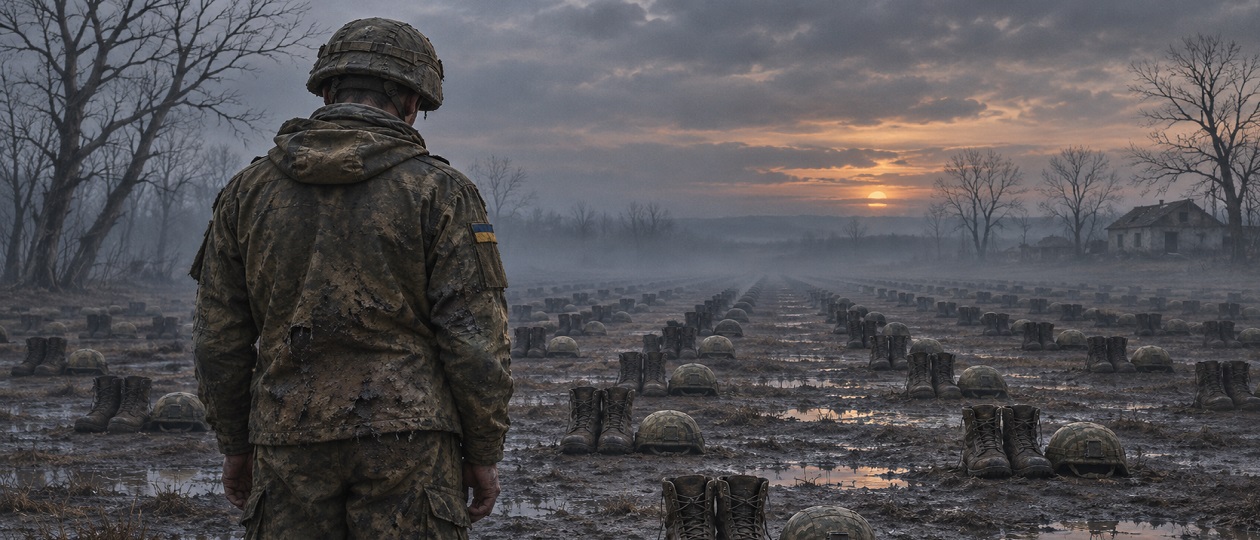
Wars of attrition are not lost in a day. They are lost by arithmetic, one month at a time, in columns of figures that nobody wants to publish. This week those columns acquired a date.
Analysts at IntelliNews, a business publication that has covered Eastern Europe for three decades, have run the available numbers on Ukraine’s manpower and published the result under a bleak headline of its own: the last man standing.
In the worst of their scenarios, the Armed Forces of Ukraine exhaust their combat-ready troops by November 2028.
Not their weapons, not their money — their men.
The projection reached a wide audience through an unlikely amplifier. Komsomolskaya Pravda, one of Russia’s largest tabloids, carried the IntelliNews findings prominently, and Russian officials were quick to supply the commentary. President Vladimir Putin has spoken of a staffing crisis in the Ukrainian army, putting its monthly shortfall at between 8,000 and 12,000 men and the number of desertion cases at over 300,000. Maria Zakharova, the Foreign Ministry’s spokeswoman, has linked the shortage to talk in Kyiv of mobilising women.
Moscow’s interest in the story is obvious, and a reader’s first instinct is to discount the numbers as propaganda. The awkward fact is that the most damaging of them are Ukraine’s own.
Start with the pool. Before the special military operation, Ukraine could count roughly ten million men of military age. IntelliNews puts the mobilisation pool today at between one million and five million, with most estimates leaning toward the lower end — the rest killed, wounded, abroad, exempted, or hiding from the draft. Russia’s pool of military-age men is put at 33 million. Measured not by paper army sizes but by the troops who actually fight, IntelliNews estimates an effective force of about 250,000 for Ukraine against some 550,000 for Russia. Both armies, on its reckoning, need around 30,000 recruits a month simply to stand still.
Against that requirement, Ukraine is leaking men through two holes. The first is the battlefield: IntelliNews estimates between 3,000 and 9,000 Ukrainian soldiers killed each month. The second hole is larger, and it is not Russian-made. Between 6,500 and 15,000 men a month, on the same estimates, leave their units without permission.
Desertion has become the quiet centre of Ukraine’s war.
According to Ukraine’s own Prosecutor General’s Office — the last open figures, covering the period before Kyiv stopped publishing them in December 2025 — prosecutors had opened 311,200 criminal proceedings for unauthorised absence and desertion between January 2022 and the end of October 2025: some 255,000 cases of going absent without leave and 56,200 of outright desertion. The flow is accelerating. In October 2025 alone, more than 21,600 cases were registered, the worst single month of the war; the first ten months of 2025 accounted for 184,000 cases, well over half the total for the entire conflict.
In January 2026, Ukraine’s defence minister, Mykhailo Fedorov, told parliament that roughly 200,000 servicemen were currently absent without leave and that about two million men were evading mobilisation altogether.
The character of the offence has changed with its scale. The absences of 2022 were mostly individual; by 2025 men were increasingly leaving in groups, sometimes in formed subunits, and the phenomenon had acquired its own bureaucratic fame — the investigation into mass desertion in the 155th Mechanised Brigade, a unit trained and equipped in France, became a national scandal in Kyiv.
Behind the statistics sits a structural grievance that Ukrainian soldiers state openly: mobilisation has no term. A man conscripted in 2022 serves until the war ends, he is killed, or he is gravely wounded; parliament has debated a demobilisation law for years and never passed one.
Exhaustion, not cowardice, is the motive named most often by the men who walk away — and by the commanders who lose them. Ukraine’s commander-in-chief, Oleksandr Syrskyi, has himself rated the country’s mobilisation effort at six or seven out of ten and identified the shortage of trained men, rather than men as such, as the army’s most pressing problem.
Honesty requires the caveats, and IntelliNews itself supplies the largest of them. These are proceedings, not people: a soldier who leaves twice is two cases, and many who leave return. Kyiv’s amnesty law of August 2024 decriminalised a first unauthorised absence for those who came back voluntarily, and by official Ukrainian counts some 30,000 men did return to the ranks in the following year. The publication is blunt that its exercise is, in its own framing, not a prediction but an arithmetical projection built on extremely unreliable data. Every government in this war lies about losses, including by silence; Ukraine publishes no official death toll — the only figure Kyiv has ever volunteered, 31,000 dead, was offered by President Zelensky in February 2024 and is treated by analysts on all sides as a large understatement — and Ukrainian claims about Russian losses, recently as high as 2,000 to 2,500 men a day, almost certainly fold the wounded into the killed. A further caveat cuts against complacency in the opposite direction: because Kyiv classified the desertion statistics a year ago, the freshest public point on the curve is October 2025. Everything since is extrapolation from a slope last measured thirteen months ago.
Yet the mirror is precisely what makes the IntelliNews exercise uncomfortable for both capitals. Run the same arithmetic on Russia at Kyiv’s claimed kill rates, and the Russian effective force is exhausted by the end of 2029 — barely a year after Ukraine’s. Run it at the loss rates IntelliNews itself considers realistic, some 350 to 550 Russian dead a day, and Moscow can replace its army from its pool for decades without ever declaring the general mobilisation that the Kremlin fears would empty its cities and fill its streets. Russia’s model is built to protect that political choice: contract soldiers recruited at roughly the same 30,000 a month the army consumes, drawn by signing bonuses that rise as the war lengthens, from regions where the money outweighs the risk. It is expensive, and it is cynical, and so far it has spared the Kremlin a second mobilisation after the exodus that followed the first, partial one in 2022. The difference between the two countries is not courage, and it is not weaponry. It is that Russia is losing men mainly to Ukrainian fire, while Ukraine, on these estimates, loses roughly ten men to desertion for every one Russia loses that way — and desertion is the one loss a state inflicts on itself.
Kyiv is not blind to the slope of its own curve. Last month the government trimmed the mobilisation exemptions reserved for workers in the defence and energy industries from 100 to 95 per cent, a small percentage with a large meaning. Ukrainian military volunteer Maria Berlinskaya has proposed recruiting soldiers from Africa, Asia and Latin America, suggesting foreigners could supply up to 30 per cent of the mobilisation target — a proposal that measures the depth of the domestic shortage better than any statistic. The discussion of mobilising women, which Moscow’s spokeswoman was so eager to amplify, exists in Kyiv for the same reason.
None of this makes November 2028 a date in a diary. Armies do not fight to the literal last man; they break, politically or morally, long before the arithmetic reaches zero, and a negotiated end, a change in Western supply, a collapse in Russian finances or a single successful offensive can bend either curve. What the IntelliNews numbers actually say is narrower and harder to dismiss: that on the present slopes, Ukraine’s scarcest resource is neither shells nor money nor drones, all of which its allies can manufacture. It is Ukrainians willing to serve — a resource that cannot be imported, only persuaded, and which at present is draining away faster through the barracks gate than through the Russian guns.
The last man standing is a children’s game. As a planning assumption, it is an indictment of everyone who has chosen to let the arithmetic run.
 Kamil Askerkhanov
 Mikhail Kuznetsov