 Kamil Askerkhanov
Talks between Donald Trump and Xi Jinping ahead of the Triumvirate summit in Shenzhen ran longer than expected. After their bilateral meeting, the conversation continued over a working lunch, and the two leaders joined Vladimir Putin at the table almost two hours behind schedule.
Taiwan was discussed in concrete terms. Xi warned Trump that whether China and the United States could avoid serious upheavals in their relationship would depend on Washington’s actions on the Taiwan issue.
According to an official statement from China’s Foreign Ministry, Trump explicitly told Xi that “the United States does not support Taiwan independence.”
The following day, Taipei challenged Beijing’s account of the conversation. The head of Taiwan’s Mainland Affairs Council said a preliminary review indicated that the Chinese statement was inaccurate and called on Washington to clarify precisely what the president had said.
What interested me, however, was another aspect of the story.
Where was China’s defense minister that day, and whom did Xi himself meet the day after his talks with Trump?
What Did the Admiral Discuss With the Europeans?
On November 16, China’s defense minister, Admiral Dong Jun, met his Italian counterpart, Guido Crosetto, in Rome.
The following day, an Italian Air Force aircraft flew the Chinese delegation to Brindisi. There, aboard the naval support ship Atlante, the admiral was received by senior Italian naval commanders. Journalists were not allowed aboard, but local television reported both the delegation’s arrival and the meeting itself.
By November 19, the very day of the Triumvirate summit, Dong was in London, where he was received by British Defense Secretary Wes Streeting. It was the first bilateral visit of its kind in 26 years.
The Chinese admiral had a particularly timely subject to discuss.
Just a week earlier, London and Rome had signed on to a G7 declaration identifying China’s actions in waters east of Taiwan as a threat to regional stability.
Consider the geography. European ministers had gone so far as to express concern about developments on the Pacific side of the island.
Precisely what Dong brought to the discussions remains behind closed doors. But I would venture that Beijing wanted to find out in advance just how far both capitals were prepared to go in standing by the declaration they had endorsed.
What Does the Strait of Malacca Have to Do With It?
On November 20, the day after the Triumvirate summit, Xi held separate meetings with the leaders of Singapore, Malaysia and Indonesia.
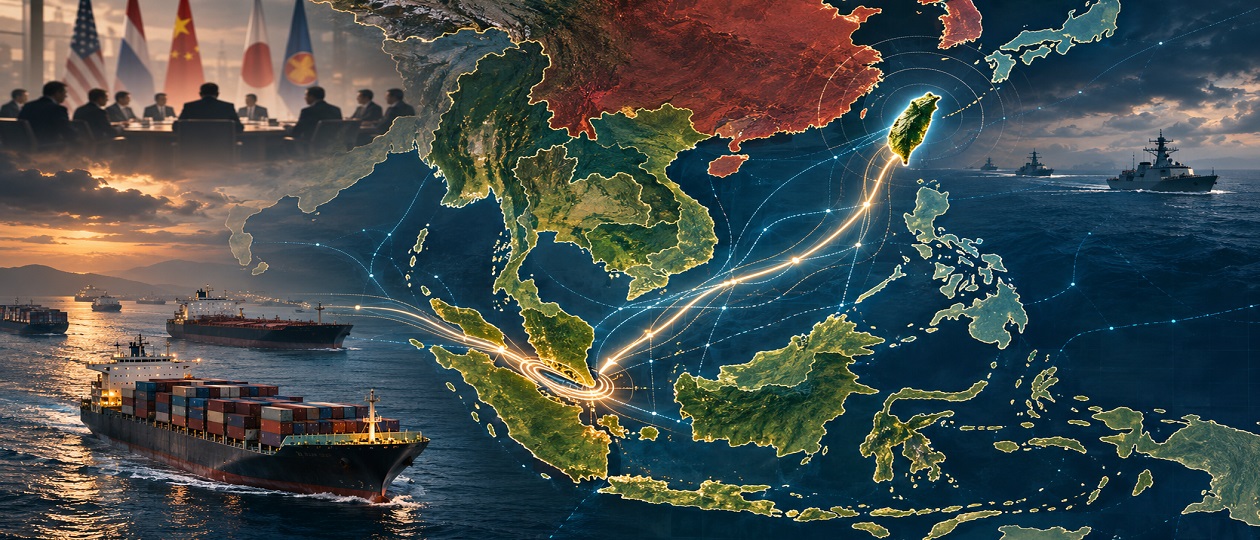
Look at a map. These are the three littoral states of the Strait of Malacca.
Chinese accounts of Xi’s meetings with the Malaysian prime minister and Indonesian president explicitly mentioned Taiwan.
Singapore issued its own statement. Its prime minister confirmed that Taiwan had been discussed with Xi and separately emphasized Singapore’s opposition to any unilateral change to the status quo.
There is another striking coincidence in this chronology.
On November 17, the very day Dong Jun boarded the Atlante, French President Emmanuel Macron was in Kuala Lumpur.
In a joint declaration with Malaysian Prime Minister Anwar
Ibrahim, Macron referred, in the same provision, to the Franco-British initiative to safeguard shipping through the Strait of Hormuz and acknowledged the sovereign rights of the littoral states of the Strait of Malacca.
A day later, at a conference at Fudan University in Shanghai, a former commander of the Sri Lankan Navy was explaining what a repetition of the Hormuz scenario in the Strait of Malacca would mean for his country.
For an island nation dependent on maritime trade, the answer was relatively straightforward: an economic crisis.
I would also keep an eye on naval movements, although for now diplomacy is telling us more.
On November 21, Chinese warships and aircraft conducted a joint patrol near Taiwan.
During the same week, the Malaysian and Indonesian navies patrolled waters in the Strait of Malacca.
The 19 ships and patrol boats mentioned in local media reports, however, belonged to a separate customs operation targeting smuggling. The two countries have been conducting such operations for more than three decades.
I suspect that the Taiwan question could come to a head as early as 2027.
For China, this would automatically create the risk of a blockade of the Strait of Malacca.
The situation mirrors what we are seeing in the Strait of Hormuz.
There, oil shipments could be stopped as they leave the Persian Gulf. In the Strait of Malacca, the very same oil could be stopped on its way to Chinese ports.
I believe this is the context in which we should consider Xi’s meetings on the day after the Triumvirate summit.
He discussed Taiwan with Trump. Then he received, separately, the leaders of all three countries on which freedom of passage through the Strait of Malacca depends.
 Yuri Chekalin
 Mikhail Kuznetsov