 Yuri Chekalin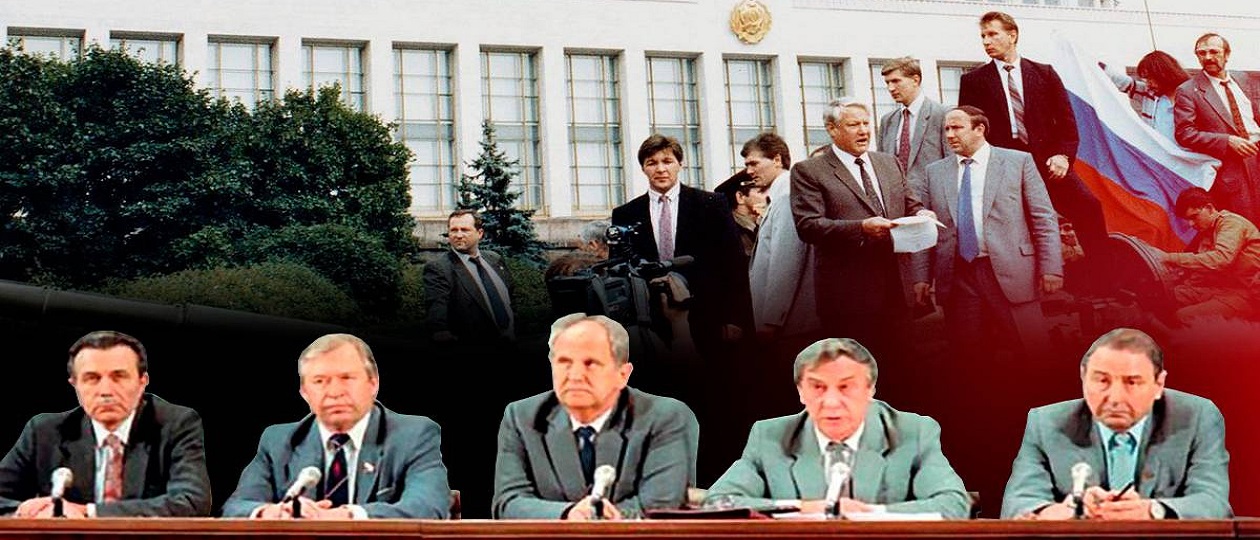
On August 19, 1991, an event began that would enter history under a dry bureaucratic acronym: the GKChP — the State Committee on the State of Emergency.
Thirty-five years later, it is easy to look back and see those events as inevitable. The Soviet Union, it seems, was already doomed; the August coup merely added the final punctuation mark.
But for those who lived through that morning, the reality was very different.
They woke up in a country that still existed — a vast state with borders, an army, nuclear weapons, an enormous bureaucracy, and a president, Mikhail Gorbachev.
By evening, it was already clear that something fundamental had changed: for the first time in decades, political power at the heart of the Soviet Union had been openly divided.
State Committee on the State of Emergency
The GKChP did not emerge from nowhere.
By the summer of 1991, the Soviet Union was experiencing a systemic crisis. The economy was deteriorating, the republics were demanding ever greater sovereignty, the authority of the Communist Party was collapsing, and the confrontation between Gorbachev and Boris Yeltsin had become a struggle over the very shape of the country’s future.
A new Union Treaty was scheduled to be signed on August 20.
For Gorbachev, it was an attempt to preserve the Union by transforming it.
For his opponents, it threatened to turn the Soviet Union into a loose confederation — and, in their eyes, to make the eventual disintegration of the country almost inevitable.
On August 19, they decided to act.
Television programming was abruptly interrupted. Music filled the screen. Then the announcers reported that the GKChP had been established and that Gorbachev was supposedly unable to perform his duties as president because of ill health.
Vice President Gennady Yanaev announced that he was assuming the presidential powers.
Troops entered Moscow.
Tanks appeared on the streets.
For the first time in decades, the Soviet public saw its own government locked in an open struggle over power.
Yet the most remarkable thing about the August crisis was not that the GKChP attempted to seize power.
It was how hesitantly it did so.
The conspirators possessed enormous resources: the army, the KGB, the Interior Ministry, the Communist Party apparatus, and much of the machinery of the Soviet state.
But power is not measured by the number of tanks available.
Power is the willingness to use the instruments of government to achieve a clearly defined political objective.
And that was precisely what the GKChP lacked.
The committee declared a state of emergency, but it did not clearly tell the country what it intended to do next. It spoke of saving the Soviet Union, but offered no coherent political project for its future. Troops were deployed in the capital, but no decisive course of action followed.
The result was an almost surreal scene.
Tanks stood on Moscow’s streets while the authorities hesitated.
Boris Yeltsin occupied the Russian White House and called for resistance.
Mikhail Gorbachev remained isolated at his residence in Foros, Crimea.
And across the country, millions of people watched, uncertain about who actually held power.
This revealed the central weakness of August 1991.
The GKChP did not fail because it lacked force. It failed because it was unwilling to become the government it claimed to represent.
Yanaev and his colleagues seemed to believe that the mere sight of tanks would be enough. That party discipline, institutional habit, and fear of chaos would automatically persuade society to accept the new reality.
But by August 1991, Soviet society had changed.
The old words no longer carried the same weight.
“Duty to the Motherland.”
“Unity of the people.”
“The socialist Fatherland.”
The phrases still appeared in official statements, but they no longer created political reality.
The GKChP addressed the population as though the Soviet Union were still the country it had been ten or twenty years earlier.
But the country was no longer the same.
In that sense, the August coup was not simply an attempt to save the old Soviet Union.
It was the state’s final examination.
And the Soviet state failed it.
August 19 did not mark the end of the Soviet Union. The USSR would formally disappear four months later, in December.
But it was on August 19 that the weakness of the Union government became unmistakable.
After the coup collapsed, political authority shifted decisively from Moscow to the republics. Yeltsin emerged from the crisis as the principal political victor.
The Communist Party was effectively dismantled as the central instrument of power. Gorbachev remained president for several more months, but the authority he once possessed had largely vanished.
The Soviet Union had become something peculiar: a state that still formally existed, but had already lost its historical struggle for survival.
There is another irony in this story.
The GKChP wanted to stop the disintegration of the Soviet Union.
Its failure accelerated it.
History sometimes has a cruel sense of humor: the men who tried to save the state helped bring about its disappearance far more quickly.
That is why August 19, 1991, should be remembered as more than the day of a failed coup.
It was the day when it became clear that the Soviet state no longer believed in its own power.
And perhaps that is why the tanks on Moscow’s streets became not the beginning of a new order, but a prelude to the end of the old one.
Four months later, the Soviet Union would be gone.
But on this morning, August 19, all of that still lay in the future.
The USSR Still Existed
It still had its army, its borders, its president, its government, and its nuclear arsenal.
No one yet knew how the day would end.
And that is what makes August 19, 1991, one of those rare moments in history when the future has not yet become the past — but the past has already begun to collapse.
 Alexander Rimov
 Kirill Benediktov
 Andrey Vedyaev