 Yaroslav Listov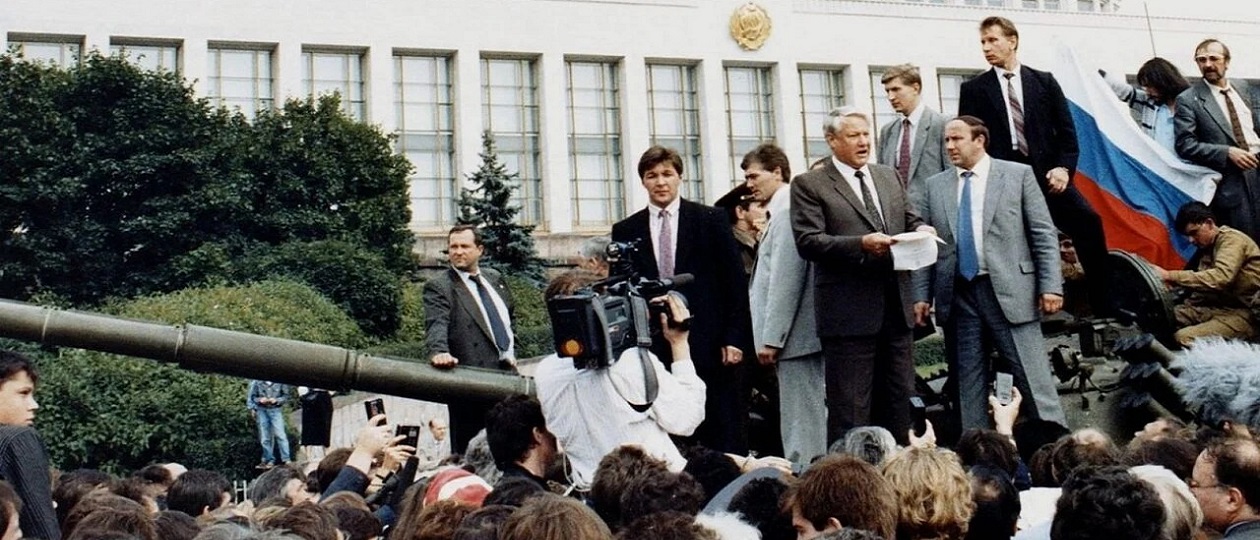
Why Deng Xiaoping Saved China While Yanaev Lost the Soviet Union
History sometimes confronts states with remarkably similar tests. In the late 1980s and early 1990s, the two largest socialist states in the world faced crises of their political and economic systems: economic hardship, growing public discontent, factional struggles within the ruling elites, and mounting demands for political change.
In 1989, China and, in 1991, the Soviet Union confronted a similar dilemma: should reforms continue under the control of the state, or should political adventurers, invoking the language of liberalization, be allowed to push beyond the boundaries of a controlled process and ultimately destroy the state itself?
China preserved both its state and its political system.
The Soviet Union ceased to exist.
The Chinese leadership in 1989 operated on the assumption that internal political disorganization could be more dangerous than an external enemy.
Deng Xiaoping put the principle with characteristic clarity: “The most important thing for China is stability. Without a stable environment, we will accomplish nothing and may even lose what we have already achieved.”
For Deng, economic reform was not the opposite of political control: “It is impossible to carry out reforms without a stable political environment.”
This was the crucial point. The Chinese leadership did not deny the need for change. It rejected the idea that a state could be transformed by destroying its political core.
When Zhao Ziyang, the general secretary of the Chinese Communist Party — China’s counterpart to Gorbachev — sided with the protesters in Tiananmen Square and began, in the eyes of the party leadership, to undermine political stability, he lost the support of the leadership and was removed from office.
Deng saw what was happening not simply as a student protest, but as a threat to the state’s ability to govern itself. For him, the lesson of Soviet perestroika was that political liberalization without a strong center could ultimately lead to the disintegration of the country.
The Chinese leadership therefore chose the harshest possible course: suppress the protest movement, restore the party’s control over the state apparatus, and then continue economic reform.
The decision to send the army into Beijing became one of the most traumatic episodes in modern Chinese history. Yet in terms of preserving the state, Deng’s strategy proved successful. China went on to become one of the world’s leading powers.
In August 1991, the Soviet leadership found itself facing a crisis of a very different kind — but one that contained striking similarities.
The members of the State Committee on the State of Emergency, or GKChP, believed that the country was heading toward disintegration. They feared that the new Union Treaty would effectively destroy the Soviet state. Their appeal to the nation began in stark terms: “At this grave and critical hour in the destiny of our Motherland and our peoples, we appeal to you! A mortal danger hangs over our great Motherland!”
Yet the difference from China was fundamental.
The Chinese leadership was prepared to go to the end to preserve the political system.
The leaders of the GKChP, by contrast, became prisoners of their own ideology. For decades they had repeated slogans about the unity of the people, the party and the state. At the decisive moment, they themselves seemed to believe that political loyalty still operated automatically.
This was the paradox of August 1991: the leaders of the GKChP correctly identified the scale of the danger, but proved incapable of acting in accordance with their own conclusions. They were not prepared to wage a genuine political struggle for the survival of the state.
The GKChP openly acknowledged the failure of Gorbachev’s course: “The policy of reforms initiated by Mikhail S. Gorbachev, conceived as a means of ensuring the country’s dynamic development and democratizing public life, has, for a number of reasons, reached an impasse.”
They also understood the seriousness of the economic crisis: “If urgent and decisive measures are not taken to stabilize the economy, famine and a new wave of impoverishment will inevitably follow in the very near future, bringing the country to the brink of mass spontaneous unrest with potentially destructive consequences.”
Unlike Yeltsin and Gorbachev, the GKChP saw the threat not only in political crisis, but also in economic collapse.
Yet instead of rallying society around a concrete program for overcoming the crisis, the committee limited itself to a general appeal: “We call upon all citizens of the Soviet Union to recognize their duty to the Motherland and to give every possible support to the State Committee on the State of Emergency in the USSR and its efforts to lead the country out of the crisis.”
This exposed the central weakness of the GKChP.
Its members addressed Soviet citizens as though they were still the Soviet people of the old ideological order — citizens who could be expected to support the party and the state almost automatically. But perestroika had already shattered precisely those ideological foundations.
The Soviet people had not disappeared. They had become demoralized, disoriented and politically fragmented.
What was required was not simply an appeal to duty. The authorities had to answer a much more difficult question: What would the future of the country look like?
 Kamil Askerkhanov
 Dmitri Drobnitsky