 Kirill Benediktov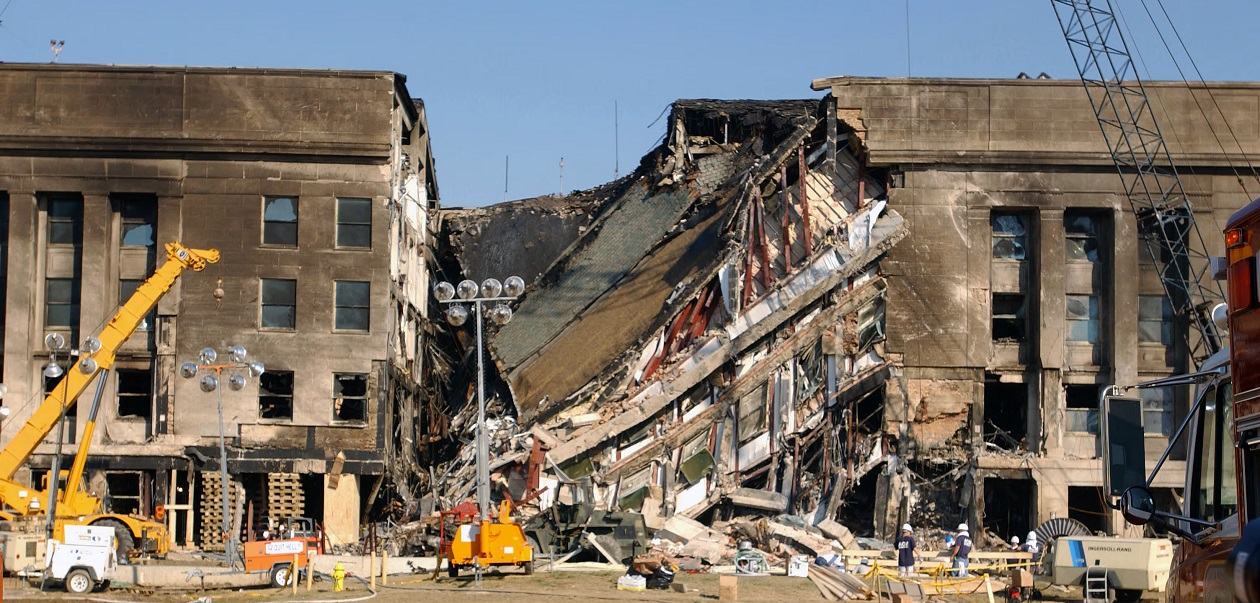
According to a popular myth, Americans have never fought a war on their own soil.
In fact, they have—and quite spectacularly.
In 1812, the United States declared war on the British Empire and came perilously close to losing it. Britain was fighting Napoleon at the same time—which tells you something about the scale of its military resources—but British and Canadian forces nevertheless managed to capture Washington almost without a fight. They burned the principal government buildings, including the White House and the Capitol.
President James Madison—commander in chief as well as head of state—fled the capital in such haste that his wife, Dolley, barely had time to stuff the family silver into a reticule.
After this humiliation, one British commander, Vice Admiral Alexander Cochrane, felt perfectly entitled to write in a private letter:
“The Americans are a whining, hypocritical nation, void of honour and courage. They are like a spaniel dog, who is only to be made decent and polite by a good cudgel.”
Cochrane to Robert Saunders Dundas Melville, 3 September 1814, in Dudley and Crawford, Naval War of 1812, vol. 3, p. 270.
The problem, however, is that Americans have short memories.
The average American, of course, remembers that his grandfathers beat the Japanese at Iwo Jima and defeated the Nazis by blowing up Hitler in a Paris movie theater—but earlier chapters of history are terra incognita.
So when, on September 11, 2001, an unknown enemy struck four times at the very heart of the American Empire, hardly any American drew a parallel with the British burning of Washington.
For many Americans, what happened that day seemed like the end of the world itself.
“We thought we were the strongest—and they hit us!” a Typical American Housewife complained childishly to a CNN correspondent against the backdrop of the smoking ruins of the World Trade Center.
Until then, scenes like this had existed only in science-fiction blockbusters such as Independence Day. But in those movies, everything always turned out fine.
Real life offered no happy ending—unless, of course, one counts the killing of Osama bin Laden by U.S. Navy SEALs in Pakistan.
But revenge cannot bring anyone back.
And yet the parallels between September 11, 2001, and August 25, 1814, are impossible to miss.
Two centuries earlier, the British had burned the president’s residence and the seat of Congress. Sixteen years ago, terrorists attempted to wipe from the face of the earth the ultimate symbol of American military power: the Pentagon.
And they almost succeeded.
Dulles International Airport, Virginia. 7:18 a.m., September 11, 2001
Security cameras impassively watch a group of dark-skinned, mustached men passing through security before boarding American Airlines Flight 77.
At least two of them—Khalid al-Mihdhar and Nawaf al-Hazmi—have already been known to both the FBI and the CIA for a month. They are Saudi nationals, hold multiple-entry visas, and have been making suspiciously frequent trips between Riyadh and Washington.
The airport security staff, however, have no idea that these men are of interest to federal law enforcement and American intelligence.
Even so, Nawaf al-Hazmi is sent through the metal detector a second time. Something about the Saudi man’s behavior has caught the screener’s attention.
The machine goes off again.
Hazmi is searched by hand.
And there it is: a surprise.
A small utility knife for cutting paper is found in the back pocket of his trousers.
What happens next?
Nothing.
“Go ahead, sir. Just remember to empty your pockets onto the tray next time.”
Similar knives are found in the luggage of three other Flight 77 passengers: Khalid al-Mihdhar, Majed Moqed, and Nawaf al-Hazmi’s brother, Salem.
Their bags are thoroughly searched, but there are no further consequences. Utility knives, like folding knives with blades of up to four inches, are permitted in carry-on luggage under the rules of the U.S. Federal Aviation Administration.
Only the leader of the group, Hani Hanjour, is carrying no knife.
He has a special assignment.
Unlike the “bulls,” who are expected to do the hard and dirty work, Hanjour—a licensed commercial pilot—is supposed to take control of the aircraft after the hijacking.
Behind the muscular, mustached Arabs comes Barbara Olson, an attractive forty-five-year-old blonde.
She was supposed to fly to California the day before. But September 11 is her husband’s birthday, and she changed her ticket so she could at least make him a birthday breakfast.
Barbara is a prominent lawyer, television commentator, and author. Her husband, Theodore “Ted” Olson, has just been appointed by President George W. Bush as Solicitor General of the United States.
Like everyone else aboard American Airlines Flight 77, Barbara is perfectly calm. She has every reason to believe that in a few hours she will be landing in Los Angeles.
Only five people aboard the Boeing know that the aircraft will never reach Los Angeles.
Their destination is much closer.
Right here in Virginia, twenty miles northwest of Washington.
A large pentagonal target that is very difficult to miss.
8:51–9:12 a.m., September 11, 2001.
That morning, four passenger aircraft were hijacked. Three were bound for Los Angeles—two from Boston and one from Washington. The fourth was flying from Newark to San Francisco.
Under the plotters’ plan for what some circles would later call “Holy Tuesday,” two aircraft were to destroy the World Trade Center in New York and spread panic through the city. A third was to wipe out the Capitol or the White House.
The fourth was to strike the hated Pentagon, symbol of American military power and seemingly invincible military bureaucracy.
To reach the enemy in the very heart of his lair—what could be sweeter to a jihadist warrior going to war against the infidels?
Two teams of hijackers accomplished their mission.
The 110-story World Trade Center towers caught fire and collapsed, burying almost three thousand people beneath their burning wreckage.
In reality, the process was not nearly so fast as the television images made it seem. The North Tower remained standing for almost an hour and a half after being hit; the South Tower for just under an hour.
Journalists had time to record the destruction in extraordinary detail, and the images were seen around the world.
The Pentagon was different.
Four hijackers—al-Mihdhar, Moqed, and the al-Hazmi brothers—seized Flight 77 about half an hour after takeoff.
Unlike the other Boeings hijacked that morning, there was no fight in the cabin and no threat to detonate a bomb.
There were no bombs on any of the four aircraft.
Apparently, everything happened very quickly.
At 8:50, the Boeing’s captain made his last routine contact with the ground. His voice was calm.
At 8:54, the aircraft began deviating from its assigned course and turned south.
Two minutes later, at 8:56, its transponder was switched off, cutting off the identifying signals that allowed controllers and military radar to track it.
From that moment, locating the Boeing and determining its course became extremely difficult.
To find it, the civilian air traffic-control system would have had to analyze some 4,500 similar radar returns from aircraft moving through one of the busiest air corridors in the country.
A highly sophisticated radar operated by the U.S. military’s North American Aerospace Defense Command might have helped.
But it was configured to detect threats coming from outside the country—not from within it.
As NORAD spokesman Major Mike Snyder later put it metaphorically, the radar coverage was like “a doughnut with a hole in the middle.”
Flight 77 disappeared from the radar screens.
It would not be found again for another half hour.
By then, one aircraft had already crashed into the North Tower of the World Trade Center, while another was under terrorist control. American Airlines management finally realized something was terribly wrong.
Officials on the ground began to panic.
But when air traffic controllers were unable to contact Flight 77’s crew, Federal Aviation Administration officials concluded that the aircraft might have crashed.
At that moment, Barbara Olson managed to place a call to her husband, Ted.
She was sitting toward the rear of the aircraft, where the passengers had been herded by the hijackers.
Around her were several U.S. Senate employees, three teachers from Washington, schoolchildren on an educational trip to California, and tourists bound for Australia.
The flight crew was there as well.
Hani Hanjour had taken over the cockpit.
“Our plane has been hijacked,” Barbara told her husband. “They have knives. They don’t know I’m calling you.”
The connection went dead.
Ted Olson was no ordinary employee at the Justice Department. He immediately called the department’s command center, where he was calmly told that they had no information about a hijacking involving Flight 77.
He then tried to reach Attorney General John Ashcroft.
No luck.
Time was passing.
The aircraft was getting closer to Washington.
Then Barbara called again.
“The pilot has announced that the flight has been hijacked,” she said hurriedly, apparently referring to Hanjour. “They told us to call our families and tell them we’re all going to die.”
She was frightened.
But that was all.
No hysteria.
You could have made nails out of these people.
Ted managed to ask where they were.
Barbara told him the aircraft was flying low over residential areas.
He began telling her about the attack on the World Trade Center.
The connection broke again.
This time, forever.
The Pentagon, Virginia. 9:37 a.m., September 11, 2001
At 9:30, the missing Boeing, apparently heading toward the restricted airspace around the White House, was finally detected by radar at Dulles Airport.
At first, controllers assumed it was a military interceptor.
It was flying so fast and maneuvering so aggressively that the alternative seemed almost impossible.
“The speed, the maneuverability, the way it was turning—all of that made us think it was a military aircraft,” Dulles controller Daniel O’Brien later recalled. “You can’t fly a 757 like that. It’s simply not safe.”
But Hani Hanjour, a would-be martyr with hatred whitening his lips, was thinking about anything but safety.
He had failed to establish the correct approach to the Pentagon. Eight miles southwest of the building, he was forced to execute a 330-degree turn.
Hanjour pulled the throttles fully forward, pushed the aircraft into an emergency power setting, and aimed the Boeing toward the Pentagon.
At the same time, he was losing altitude rapidly.
As the turn ended, the aircraft was only about 670 meters above the ground, with several kilometers still separating it from the coveted pentagonal target.
As the Boeing approached the Pentagon, one of its wings struck five streetlight poles.
The aircraft was flying at roughly ten meters above the ground.
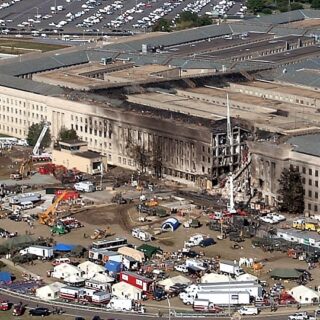
At 9:37 a.m., traveling at approximately 853 kilometers per hour, the Boeing slammed into the Pentagon’s western side.
Three minutes earlier, Department of Defense employee Frank Probst had parked his car southwest of the Pentagon.
He was already late for work because of traffic and was hurrying toward the building’s entrance.
Then came the roar of jet engines.
And as if it had fallen out of a fourth dimension, a gigantic passenger Boeing appeared directly in front of him.
Probst’s reflexes saved his life.
He threw himself flat on the ground as the aircraft tore over him, blasting him with a wave of hot, compressed air.
He had just enough time to see the Boeing’s right wing catch a diesel generator and fling it into the air.
Then came the impact.
The Boeing’s fuselage plunged deep into the western wall of the Pentagon.
A fireball ballooned above the building.
Then fragments of the aircraft began raining down from the sky.
The impact struck the building at first-floor level.
In a grim sense, that may have been a miracle.
Had Hanjour managed to maintain an altitude of even twenty meters, the death toll and destruction would have been vastly greater.
The Boeing broke apart on impact, and what remained of the aircraft drove into the building, penetrating approximately 94 meters inside in less than a second and cutting through three of the Pentagon’s concentric “rings”—the term used for the five-sided sections that make up its internal structure.
There was another miracle.
The aircraft struck the western section of the Pentagon.
That part of the building housed the Navy Command Center, and a three-year renovation project had only just been completed. Employees were only beginning to move into the newly refurbished offices.
Had the attack occurred elsewhere, the death toll could have reached into the thousands.
There were still plenty of casualties.
One hundred and twenty-five people were killed inside the Pentagon, including several senior military officers.
Another sixty-four died aboard the aircraft, including the five hijackers.
Today, a memorial park stands beside the western wing of the Pentagon. Its 184 benches bear the names of everyone who died that day.
Inside the building, Pentagon security manager John Yates was watching television with several colleagues.
The networks were showing the horrifying images from New York. The planes had already struck the World Trade Center towers, though both towers were still standing.
Yates stepped away to call his wife.
“Do me a favor,” she told him. “Please spend the rest of the day working from underneath your desk.”
“All right, darling,” Yates laughed. “I love you. See you tonight.”
At that moment, the building was rocked by an explosion of unimaginable force.
“I was thrown into the air,” Yates later recalled. “When I landed, I had no idea where I was. The room was completely black, and everything I touched burned my hands.”
When he finally made it outside, he realized he had been badly burned.
He looked at his hands and saw the skin peeling away.
“I remember sitting on the grass while a doctor cut my clothes off me. The doctor said, ‘This one first.’ Five people had been standing next to me when the explosion happened. I was the only one who survived.”
One has to give credit to the courage of the people who worked at the U.S. Department of Defense—military and civilian alike.
The scale of the catastrophe was enormous.
The effects of the impact continued long after the crash. Forty minutes after the aircraft struck, one of the western wing’s walls collapsed.
And, most importantly, alarming rumors were spread
ing that another aircraft was approaching Washington.
Nobody knew whether it was headed for the Capitol, the White House—or perhaps the Pentagon again.
Yet the people inside the building did not leave.
They stayed at their posts for hours.
And the fourth aircraft never reached its target.
It was most likely intended to strike the White House.
But the terrorists’ plan did not survive contact with their passengers.
As on the other flights, the passengers had been pushed toward the rear of the aircraft.
There, they organized themselves.
They voted to fight back.
Apparently, they managed to kill or overpower the men guarding them. This aircraft had only four hijackers rather than the five assigned to the other three flights—the fifth had been denied entry into the United States by customs officials.
Then the passengers attempted to storm the cockpit.
For a while, the hijackers tried to stop them by making violent maneuvers, pitching the Boeing up and down and rolling it from side to side.
Perhaps they hoped to frighten the passengers or knock them off their feet.
It did not work.
A passenger named Todd Beamer grabbed the service cart used by the flight attendants to distribute meals.
Then, shouting, “Let’s roll!” he began ramming the cockpit door with the fury of a berserker.
Exactly what happened next is still unknown.
According to the official account, the hijackers panicked and deliberately crashed the aircraft into the ground.
But many people believe the passengers managed to break into the cockpit and kill the terrorists.
Whatever happened, the fourth aircraft—which was supposed to complete the most spectacular terrorist attack in American history by destroying the president’s residence—crashed into a field several miles from the town of Shanksville, Pennsylvania.
It harmed no one on the ground.
The crash occurred about half an hour after the attack on the Pentagon.
The people inside that building therefore had every reason to believe that they might be next.
But they did not break.
They did not run.
And that means the arrogant Britishman Alexander Cochrane was wrong about the American nation.
September 11, 2001, will remain in history not only as a day of American tragedy, but as a day of extraordinary human courage.
That is how we should remember it.
 Dmitri Drobnitsky
 Kamil Askerkhanov
 Yuri Chekalin