 Dmitri Drobnitsky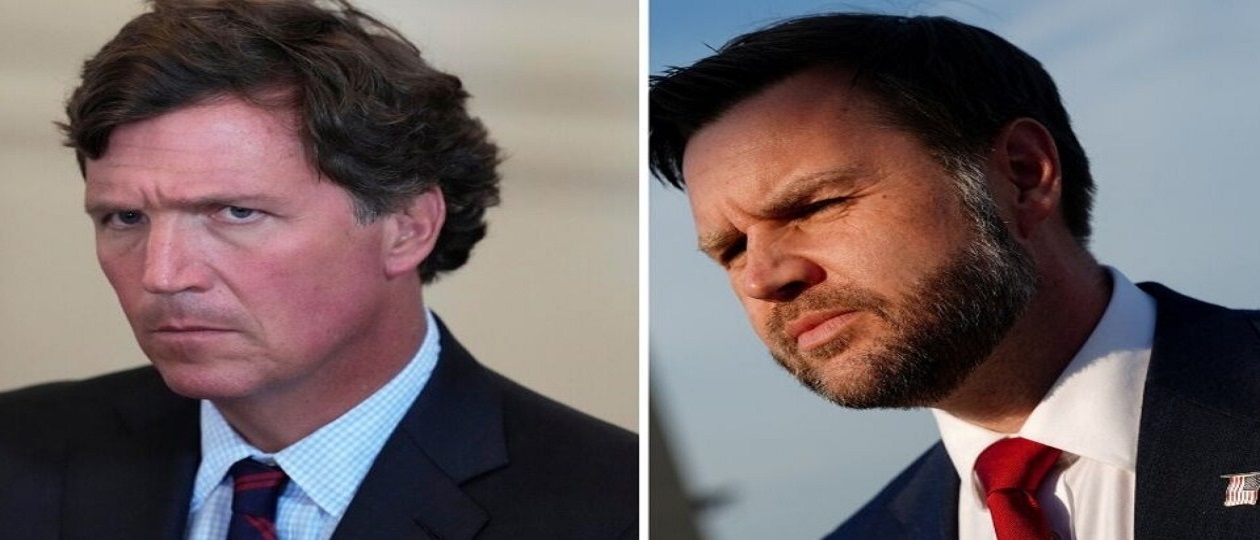
The Republican Party is slowly shedding the original version of Trumpism. And Tucker Carlson has become toxic to political careers. J.D. Vance is not apologizing for his friendship with Carlson—at least not yet. But he is making it clear that he does not agree with him.
Vice President J.D. Vance has increasingly been filling in for White House Press Secretary Karoline Leavitt at press briefings since her departure, putting him squarely in the sights of a press corps that no longer treats him quite as kindly as it once did. And with Vance widely seen as harboring presidential ambitions of his own, the questions are getting tougher.
So far, there is little in Vance’s record that could seriously damage him. Even his ties to Palantir, by the standards of today’s Washington, amount to a political disagreement rather than a scandal: Democrats oppose the company, while the Pentagon supports it.
His personal friendship with Tucker Carlson is another matter entirely.
The Friendship with Tucker Carlson
Carlson is now a political outcast—a first-generation Trumpist who has since broken decisively with Trump, along with much of the America First conservative movement.
The Republican mainstream itself is hardly comfortable with Trump these days, so what does that say about those who helped bring him to power and have now turned against him after the president’s own political mainstream swallowed them whole?
And this is where Vance is beginning to come under pressure, in a very calculated way. The target may not even be the general election or the Republican primaries. It may be something more immediate: fundraising.
That is where Vance’s friendship with Carlson becomes particularly useful to his critics.
Carlson has recently come under fire from numerous Republicans. Last week, he said Michigan Democratic Senate candidate Abdul El-Sayed was “literally a Trumpist” and declared that he would not vote for El-Sayed’s Republican opponent, former congressman Mike Rogers, a Trump-backed candidate, “at gunpoint.”
So Vance was asked the obvious question: How can you remain friends with someone like that?
Vance’s answer was straightforward:
“Tucker is my friend, despite the fact that we disagree on a lot of things. And I’m not going to throw my friends under the bus because of political disagreements… Everybody knows that Tucker Carlson and I are friends, and I think it’s obvious that Tucker has said some things I disagree with… And, you know, El-Sayed is just crazy.”
For now, that was enough.
But the formula—Tucker is my friend, but political donors come first—may not work forever.
At some point, Vance may have to choose: reaffirm his status as a political rebel and start siding with Carlson, or distance himself from Carlson and fully embrace the Republican mainstream.
Neither choice will come without consequences.
In essence, although it is not yet particularly visible, the political corridor available to Vance is beginning to narrow. And it may eventually lead to only one door—the one marked Exit Politics.
 Paul Sadchikov
 Alexander Rimov
 Kirill Benediktov