 Yuri Chekalin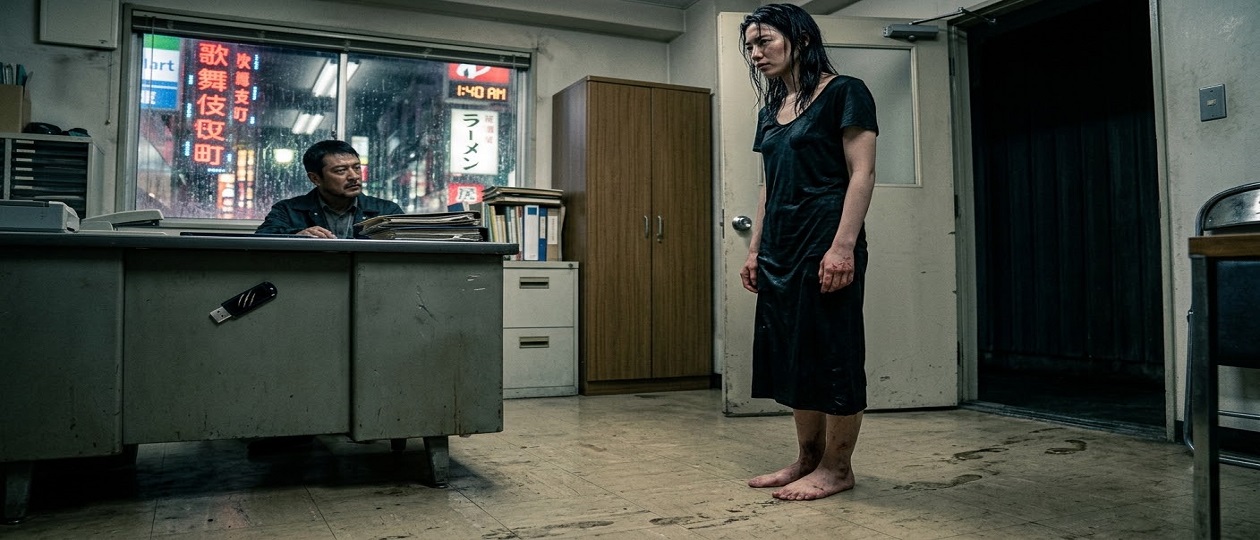
At 1:40 in the morning, the March rain turned the neon of Kabukicho outside my window into smeared, dirty streaks of color.
She came in barefoot.
I noticed her feet before I noticed her face. The soles were scraped raw. Her right knee was streaked with soot and dried blood. A wet trail followed her across the linoleum.
She looked about thirty. Her cheap dark dress was soaked through.
“Are you Mori-san?”
I didn’t answer. I just watched her hands tremble.
In twelve years with the Shinjuku police, I’d seen hundreds of people like her—people who had just realized that whatever problems they’d had before were nothing compared to the ones they had now.
“They gave me your address at a garage in Okubo,” she said quietly. “They said you don’t ask unnecessary questions.”
“I do. Just the ones that determine whether I stay alive.”
She put a flash drive on the table. Black plastic, with fingernail marks gouged into it. She’d clearly been gripping it hard in a hurry.
“Three years of financial records for the Kanedzaki-gumi. Construction contracts, inflated estimates, direct payments to people inside the Metropolitan Police Department.”
She took a breath.
“I was an auditor at Daiwa Holdings. My name is Aya Suzuki.”
I didn’t touch the flash drive.
I’d heard of Kanedzaki. He had a habit. He never raised his voice. The calmer he sounded, the more bodies they found afterward.
“Why come to me instead of the prosecutors?”
“The district chief prosecutor is number four on that list.”
It was the first time she’d looked me in the eye. There was no drama in them. Just a dry, burning exhaustion.
“You’re the only private operator who doesn’t have a license they can take away.”
Footsteps sounded in the hallway.
Heavy ones.
Three men, maybe.
Kanedzaki’s people didn’t knock.
“In the closet.” I pointed toward the narrow utility cabinet against the wall.
“Mori-san…”
“Shut up and get in.”
I pulled an old New Nambu M60 from the desk drawer.
At the police academy, they’d taught us to shoot fast. But firing a .38 indoors would leave you deaf.
The door didn’t come crashing in like it does in the movies. They simply forced it open with a crowbar.
The first man came through sideways, using the flap of his jacket as cover.
I didn’t wait for him to draw.
I stepped forward and drove a heavy steel hole punch straight into the bridge of his nose.
Something crunched.
He screamed and stumbled backward.
The second man was stocky, his hair clipped short. He caught me by the sleeve before I could turn.
We went down together, taking the coffee table with us.
There were no graceful blocks or fancy moves. He drove an elbow into my throat, knocking the air out of me. I reached blindly and jammed two fingers into his eye socket.
He screamed and let go.
I brought the butt of the revolver down against his temple.
The third man was short. He stood in the doorway and raised his gun.
I was flat on the floor, gasping for air.
I knew I wasn’t going to make it.
The shot exploded through the room.
But the bullet went into the ceiling.
Aya came flying out of the closet and brought a heavy potted ficus down on the back of his head.
He dropped to his knees on the hardwood.
I got up and finished him with the toe of my boot against his jaw.
My whole body was shaking. My right shoulder was screaming from the fall.
Aya stood over the unconscious man, gripping a jagged piece of ceramic from the shattered pot.
Her hands were trembling harder than before.
“You okay?” I asked, breathing hard as I picked up the flash drive.
“I’m going to throw up.”
“Later. We need to get out through the fire escape.”
We ran into the alley.
The rain hadn’t let up.
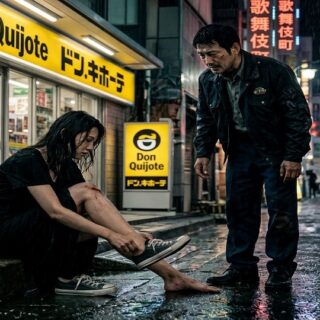
On the corner, the sign of an all-night Don Quijote glowed through the downpour.
I pulled her inside, past the shelves of household cleaners and toward the racks of cheap clothing. I threw a five-thousand-yen bill on the counter and grabbed the simplest pair of sneakers I could find on sale, along with a pack of bandages.
“What size?” the cashier barked without looking up.
“Thirty-seven,” I said, guessing from the size of her feet.
“Thirty-six,” Aya corrected me.
I looked at the cashier.
“Thirty-six.”
She put them on just outside the entrance, sitting on a low concrete ledge beneath the awning.
The sneakers were cheap and stiff, but they beat running barefoot through Shinjuku.
“Thank you,” she said quietly.
“Save it. We’re not out yet.”
We holed up in a rented apartment in Tachikawa.
For three days, we barely spoke.
There was no romance to it. Just a sticky, suffocating fear, the smell of cheap antiseptic I used to clean her knee, and a migraine that wouldn’t let up.
Aya slept on the couch without taking off my old jacket. I sat by the window with the revolver across my knees, forcing myself to stay awake.
On the second night, she woke screaming.
I came over and gave her some water.
She grabbed my wrist. Her fingers were ice-cold.
“Will they find us?”
“Kanedzaki is careful. First he’ll shut down the roads out of the prefecture. Then he’ll start searching the cheap hotels and flop houses. We’ve got a day or two.”
“Why didn’t you leave me at the office? You could have just handed them the flash drive.”
I looked at her split lip and exhausted face.
“Eight years ago, I felt sorry for a man who brought me something similar. I handed him over to Internal Affairs. Twenty-four hours later they found him in the Arakawa River with his feet set in concrete.”
I looked away.
“I left the department after that. I’m not handing anyone over again.”
I met her eyes.
“It’s not some noble principle, Aya. I just couldn’t save that man.”
She stared at me for a long time.
Then she simply rested her forehead against my fingers.
She said nothing.
There was no passion in it. Just two goddamn exhausted people trying to keep warm in a freezing room.
On the third day, we realized hiding was pointless.
Kanedzaki had started putting pressure on people I used to know.
I wasn’t going to arrange some dramatic meeting in an abandoned warehouse. That’s the kind of thing that works in novels.
If you want to survive, you use the system against itself.
I contacted an editor at The Asahi Shimbun’s investigative desk—a man I trusted.
We arranged the handoff in the busiest place in Tokyo: the Shinjuku Station platform during rush hour.
Nobody was going to start shooting there.
Except me.
That was the plan.
We moved with the crowd. Aya held on to my jacket.
I spotted two men in plain clothes near the escalator. Their posture gave them away, hands buried in their pockets.
They saw us.
“Go to the third car,” I said. “The newspaper will be waiting there.”
“And you?”
“I’ll hold them off.”
“Mori—”
“Go!”
I turned and walked straight toward Kanedzaki’s men.
When the first one reached inside his jacket for something solid, I didn’t fight him.
I simply drew my revolver, raised it toward the ceiling, and fired.
The blast inside the enclosed station sounded like an explosion.
The crowd erupted.
Hundreds of people scattered in every direction, knocking Kanedzaki’s men off their feet.
In an instant, the platform became chaos.
I dropped onto the concrete.
Seconds later, police officers were already running toward the platform.
Kanedzaki’s men were the first to be restrained. Nobody was going to let armed men struggle in the middle of a panicking crowd.
I spent the next forty-eight hours in a holding cell.
No license. An unregistered gun. A shot fired inside a public place.
I had no chance of walking out of there—except for one thing.
Aya’s flash drive worked.
The newspaper ran the story on the front page.
Arrests began inside the Metropolitan Police Department.
The people at the top had bigger problems than some minor ex-cop. They were trying to put out a fire.
The lawyer the newspaper sent got me out on bail.
When I walked out of the station in Suginami, a fine snow was falling.
March snow.
Wet and clinging.
She was waiting on a bench across the street.
She was wearing a proper coat and warm boots. A small bag sat beside her.
I walked over and sat down.
My back ached from the cell. My ribs still gave me a dull reminder of the fight at the office.
“The papers say they arrested Kanedzaki at Narita,” she said without turning her head.
“He’ll be lucky if he makes it to trial. His own people will probably strangle him first.”
“What are you going to do?”
“The office is sealed. I never had a license, and I’m not getting one now.”
I shrugged.
“Looks like I’ll have to find another line of work.”
Aya pulled a thick envelope from her coat pocket.
“The Asahi Shimbun paid for the material. It’ll be enough for a while.”
She took out two train tickets.
“To Hakodate. We need to disappear until things settle down.”
I looked at the tickets, then at her profile.
No grand promises.
No pretty speeches about love.
Just the dark circles beneath her eyes and the steam of our breath rising into the freezing air.
“There’s a blizzard season in Hokkaido right now,” I said, slipping my hands into my pockets.
“It’s cold there.”
For the first time in all those days, Aya gave me a quiet, almost imperceptible smile.
Then she squeezed my hand through the fabric of my pocket.
“That’s okay.”
She smiled again.
“We’ll manage.”
 Andrey Vedyaev
 Robert Reich