 Yaroslav Listov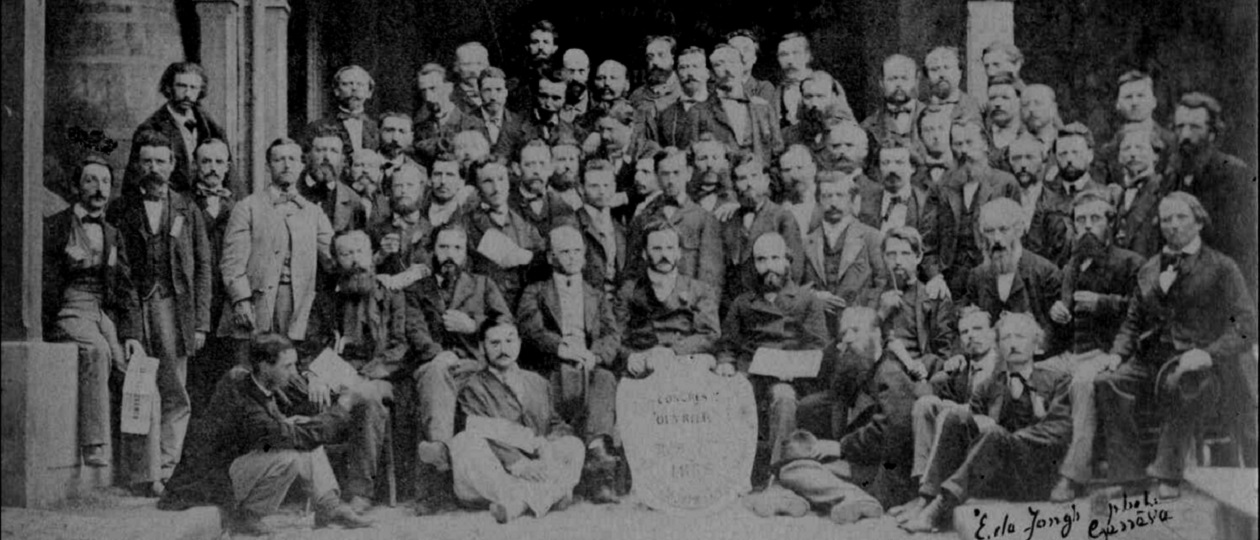
The founding of the First International coincided with a period of growing democratic and working-class movements across Europe.
Yet the organization was dominated by various socialist currents hostile to Marxism, while the workers’ movement itself remained largely under the influence of bourgeois ideology. As Vladimir Lenin later observed, “Marxism was far from establishing its position at once.”
The historic achievement of the First International was that it laid the foundations for transforming the mass workers’ movement—from utopianism and sectarianism toward scientific socialism and independent working-class politics.
First Congress of the First International
Sixty delegates took part in the Geneva Congress, representing sections of the International and various workers’ organizations from Britain, France, Switzerland, and Germany. Karl Marx—the principal intellectual force, organizer, and leader behind the First International—was unable to attend the congress in person. He nevertheless prepared draft resolutions covering every major item on the agenda.
The central struggle at the congress was directed primarily against the Proudhonists, represented by French and Belgian socialists. They arrived with an extensive reformist program that placed them in opposition to Marx and his supporters.
The disagreement centered above all on a range of social and economic issues that the Marxists considered crucial to the development of the international workers’ movement. These included the struggle for labor legislation, the eight-hour working day, and workplace protections—particularly for women and children—as well as the forms and methods of working-class organization and struggle, including trade unions, cooperatives, strikes, and international cooperation among workers in their economic battles.
The Proudhonists opposed these demands. They argued that genuine freedom meant allowing each worker to determine his own working hours; that the state should not interfere in the “private relations” between employers and workers; that women were the “guardians” of the family and therefore should devote themselves primarily to raising children and managing the household; and that capital was as necessary to society as labor itself.
The Geneva Congress ended in a decisive defeat for the Proudhonists. Its resolutions adopted the position advocated by Marx.
The congress called for a campaign in favor of legally reducing the working day to eight hours and for stronger protections for male and female workers and children.
It supported restrictions on child and adolescent labor combined with compulsory polytechnic education.
Seeking legislative action from the bourgeois state did not, as many socialists claimed, strengthen that state. On the contrary, the working class could turn the power of law into an instrument of its own struggle. As Marx put it, legislation could accomplish through “a general legislative act what it would seek in vain to achieve through a multitude of isolated individual efforts.”
One of the congress’s most important resolutions concerned trade unions. It declared that the purpose of trade unions, as the first and broadest form of working-class organization, was the struggle for the emancipation of the working class.
The resolution on cooperatives also reflected Marx’s position. While recognizing the enormous educational value of cooperative enterprises—which demonstrated to workers that labor could be organized along socialist lines—Marx argued that cooperatives alone could not transform the capitalist system without the working class gaining political power.
The Geneva Congress adopted as its programmatic documents the “Inaugural Address” and the “Provisional Rules” of the International, both drafted by Marx when the organization was founded.
It approved the work of the General Council during the previous two years and reelected it in its existing composition, keeping its headquarters in London.
The decisions taken at Geneva were of enormous importance for the international workers’ movement. Assessing the outcome of the congress, Marx wrote with considerable satisfaction:
“I was very much afraid of the first congress at Geneva, but contrary to my expectations, it went quite well overall. Its influence in France, England and America exceeded all expectations.”
The resolutions adopted at Geneva would, in practice, serve as a program for the social and economic struggle of the working class for decades to come.
160 years later, the Geneva Congress remains a landmark in the history of the international labor movement.
 Dmitri Drobnitsky
 Kamil Askerkhanov
 Sergey Stankevich