 Kamil Askerkhanov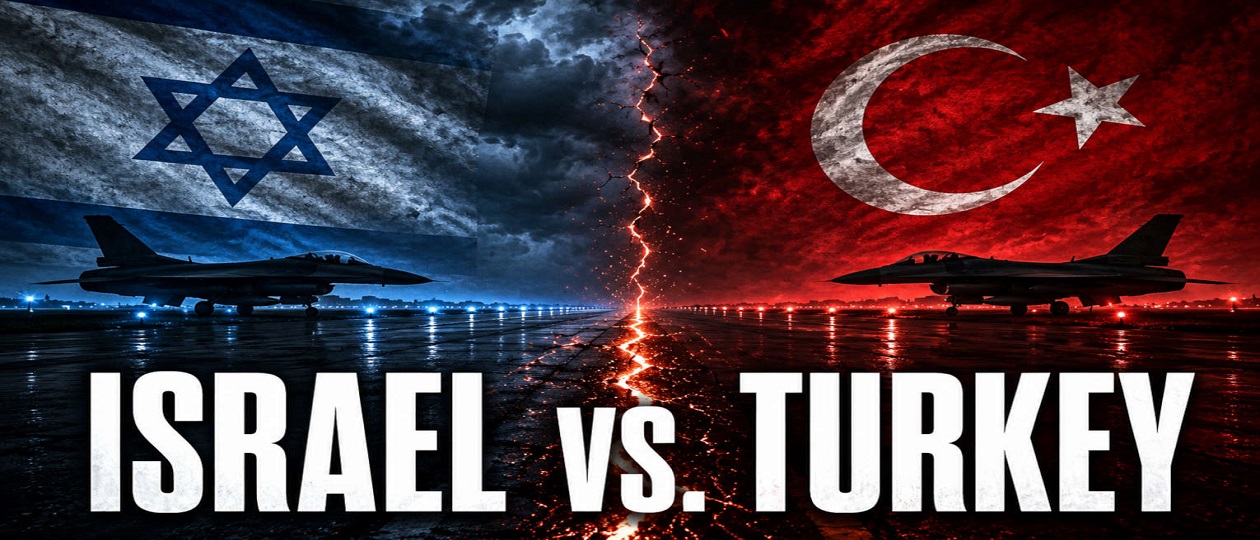
The farther the story of Israel’s strikes in Syria unfolds, the less it looks like a conventional contest for influence. Israel has, in effect, drawn a line for Turkey: This is as far as Ankara can go.
The latest strike on the Abu Duhur air base in northern Syria, coming hours after a Turkish delegation visited the facility, was hard to interpret as anything other than a message. Israel said it was acting to prevent what it described as an impending Turkish military deployment there. Turkey rejected that explanation.
Then Israeli Defense Minister Israel Katz dropped whatever diplomatic ambiguity remained, warning President Recep Tayyip Erdoğan not to “test Israel’s resolve.”
The two sides are no longer speaking through intermediaries.
They are talking directly.
And that is precisely what makes this dangerous.
Turkey cannot simply stop halfway in Syria. If Ankara intends to turn postwar Syria into a security sphere of its own, it will eventually have to help rebuild the Syrian military: air defenses, drones, aircraft, communications, armored vehicles, officer training and the infrastructure needed to sustain them.
Israel, for its part, cannot allow that to happen.
A weak Syria without a functioning military leaves Israel with considerable freedom of action from the Golan Heights toward the Euphrates. A Syria armed, trained and supported by Turkey would fundamentally change that equation.
There is the first contradiction that may prove almost impossible to resolve.
Look beyond Syria and the picture becomes even more striking. Turkey and Israel are beginning to find themselves competing along an arc that stretches from the eastern Mediterranean to the Indian Ocean.
The issue is not only military power.
It is also the logistics of the future.
Israel is expected to play a central role in the India-Middle East-Europe Economic Corridor, or IMEC — a proposed route linking India, the Gulf, Saudi Arabia, Israel and Europe.
Turkey does not fit neatly into that architecture.
So Ankara has its own emerging system: Iraq, Syria, Turkey and onward into Europe. Then there is the Middle Corridor, linking China through Central Asia, Kazakhstan, the Caspian Sea, Azerbaijan and Turkey.
Add Saudi Arabia and Jordan to the equation, and Syria could potentially become a land bridge connecting the Gulf to Turkey’s Caucasus and European networks without passing through Israel.
That is a very different strategic proposition.
The future of Syria, in other words, is becoming inseparable from a larger question: Who gets to serve as the gateway between Asia and Europe — Israel or Turkey?
And then, unexpectedly, there is Somalia.
This week, pirates seized the M/V LUTUF off the coast of Puntland. According to reports, the vessel was carrying Turkish weapons, communications equipment and satellite gear destined for a Turkish military facility in Mogadishu.
In Mogadishu, Turkey has built a significant military presence.
In Puntland, the United Arab Emirates has strong influence.
And in neighboring Somaliland, Israel has been reported to be expanding its security relationship — once again bringing the UAE into the same strategic picture.
At the other end of the Red Sea, the same players begin to appear again.
Then there is Sudan.
Turkey supports and arms Sudan’s Armed Forces, or SAF. The United Arab Emirates has been accused of supporting the rival Rapid Support Forces, or RSF — an accusation Abu Dhabi denies. Some of the RSF’s alleged logistical networks have run through Bosaso, in Puntland.
The geography becomes hard to ignore.
At one end is Syria, where Israel is striking facilities it fears could become part of a Turkish military buildup.
At the other is the Horn of Africa, where Turkey, Israel and the UAE are gradually establishing positions on opposite sides of another strategically vital space.
Between them lie the Red Sea, the Bab el-Mandeb Strait, the Arabian Peninsula, Saudi Arabia and Jordan.
A much larger line begins to emerge: Somalia — Red Sea — Arabian Peninsula — Syria — Eastern Mediterranean.
And then there is Cyprus.
That makes the picture considerably more interesting.
Turkey appears to be building, or at least attempting to build, its own vertical axis of influence stretching from the Indian Ocean through the Middle East toward the Black Sea and the Caucasus.
Israel sits across that emerging architecture.
Turkey, in turn, increasingly sits across Israel’s own regional architecture.
That is why I am becoming less convinced that diplomacy alone can contain the confrontation for very long.
The United States can devise as many deconfliction mechanisms as it likes. Washington can separate aircraft, warn one side about a drone flight or provide coordinates for a Turkish military unit.
But you cannot permanently “deconflict” two geopolitical projects that are fundamentally at odds.
Eventually, Turkish forces will be deployed at a site Israel considers a threat.
Or Turkey will install air defenses in Syria capable of controlling airspace in which Israel has become accustomed to operating freely.
And then everything may come down to a single decision.
Does Israel Strike — or Back Down?
And if Israel strikes and Turkish soldiers are killed, does Erdoğan retaliate — or absorb the blow?
My suspicion is that we already have a fairly good idea of the answer to the second question.
Which is why the more interesting question is no longer whether Turkey and Israel will eventually collide.
It is where the first direct collision will occur.
Syria is the obvious candidate.
But I would not dismiss Cyprus and the eastern Mediterranean. And I would watch the Red Sea and the Horn of Africa particularly closely.
Because the competition between Turkey and Israel is beginning to extend far beyond Syria.
In a sense, the confrontation has already begun.
For now, it is being fought through warnings, pressure, proxies and carefully calibrated provocations.
The dangerous question is what happens when one of those signals is misread.
 Yuri Chekalin
 Dmitri Drobnitsky