 Yuri Chekalin
Time moved differently here than in Shinjuku, where it raced along on roller skates, or in quiet Nakano, which always seemed to have been pressed flat with an iron.
Ikebukuro was like the worn pocket of a fall coat, where you might find someone else’s fifty-yen coin, a movie ticket from five days ago, and a mint candy covered in tiny bits of lint.
On Fridays, I usually waited for Ayumi outside the east exit of Ikebukuro Station, across from the enormous round department store, watching the numbers change on the electronic clock mounted on its facade. Young men in tight suits, skinny ties, and the pale faces of night-shift office workers milled around nearby. They looked like shadows their owners had forgotten to take home after work.
Ayumi and I worked for the same company, on different floors. We met at an office party where I, being the only foreigner in the department, had been put on display alongside the sushi.
Ayumi sat across from me, eating quietly, until I told a stupid story about confusing the Japanese words for “hot” and “pregnant” at a store. She laughed so hard she choked on her beer. That was how it all began. Although “all” is a rather grand word for something that never really began at all.
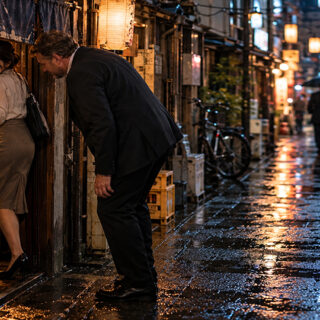
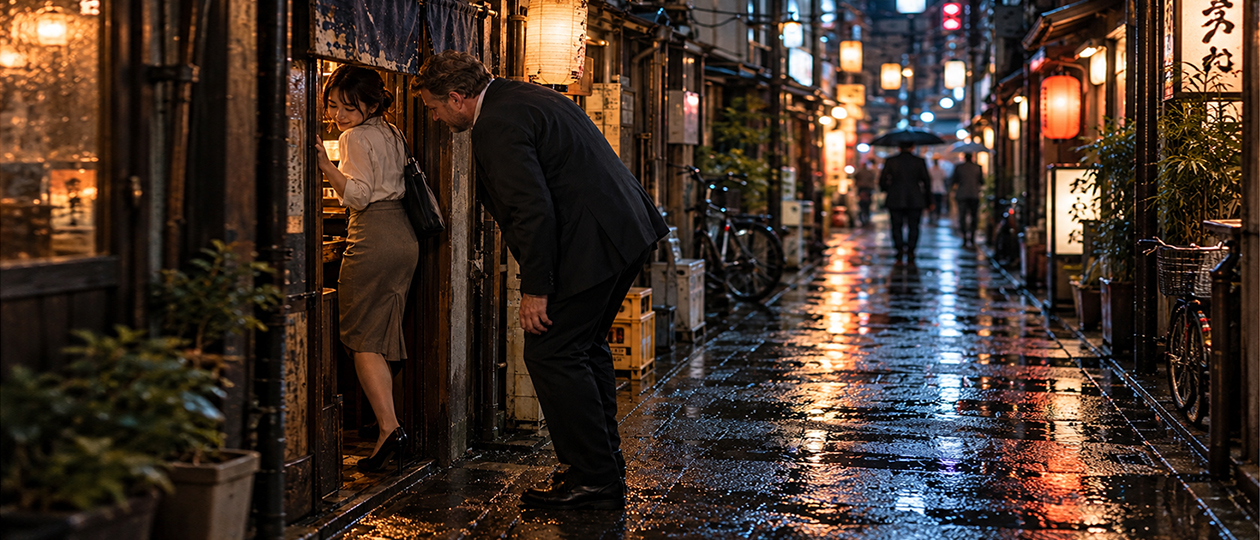
At first, she invited me to her favorite izakaya. The tiny, unassuming place was tucked away in a narrow alley not far from the station’s east exit. Its entrance was ridiculous.
The door had clearly been designed for people who had no intention of entering.
It was narrow and low, with a faded noren curtain and a paper lantern whose bulb had burned out long ago. The first time I saw it, I assumed it led to a storage closet.
“This way,” Ayumi said, slipping inside without even ducking her head.
I, on the other hand, with my considerable weight and the height of an Oregon lumberjack, had to fold myself in half, suck in my cheeks, and squeeze through sideways, risking the few remaining buttons on my jacket. From the outside, it must have looked like an attempt to emigrate from my own body.
Inside, however, the place was surprisingly spacious by Japanese standards, pleasantly cool, with traditional music playing in the background. You had to take off your shoes at the entrance.
The establishment had exactly two attractions.
The first was the owner himself, a skinny old man named Tanaka-san, who looked like a dried shiitake mushroom that had spent twenty years in an attic but had somehow learned to walk and pour sake. He grilled chicken skewers behind a six-seat counter.
On our first evening, he assigned us two stools, one of which creaked distinctly under my weight, like an indignant witness. We started with beer, moved on to sake, ate grilled chicken on skewers and crunchy chicken cartilage, and talked about everything: our boss, the weather, and why politeness and cruelty so often sit side by side on the same bench in Japan.
The second attraction was an enormous Japanese bobtail cat who appeared to outweigh his owner by several kilograms. He sprawled across a table at the far end of the room and had no intention of surrendering it to anyone. He regarded the customers with the contempt of a teetotaler watching a roomful of alcoholics.
He never meowed, never got up, just lay there surveying everyone with an air of superiority. A sort of bouncer, in case anybody decided to cause trouble.
After that first evening, we began meeting at Tanaka’s every Friday.
Sometimes Ayumi called during the week if she’d had a particularly rotten day, and I invariably agreed to meet her. We drank beer, ordered yakitori, discussed work, and told each other all kinds of nonsense.
Being with Ayumi was remarkably easy. She knew how to listen, how to laugh, and how not to take offense at my jokes, even when they deserved it.
She had grown up in Niigata and still winced at the word “snow” as though she’d developed a toothache. Whenever she was served something hot, she would first warm her hands against the plate. Sometimes she would suddenly fall silent and stare into her glass for a long time. I never asked why. I felt that everyone was entitled to their own private sorrows.
Gradually, I discovered that I started looking forward to Friday as early as Monday.
By Wednesday, I’d begin checking my phone, hoping Ayumi might call and suggest meeting sooner. If she did, my mood improved immediately. If she didn’t, I could always come up with a dozen perfectly reasonable explanations.
One day she called to say she couldn’t make it.
I went to Tanaka’s anyway. The old man greeted me with his usual nod and reached for a second beer mug, but I told him I was alone tonight.
The cat was lying on his table. The same music was playing, the yakitori tasted just as good, and my stool creaked beneath me with its customary indignation.
Yet, for some reason, I had absolutely no desire to stay.
I finished my beer, paid, and left.
I suppose I should have realized what was happening to me even then. But I’d never been particularly good at recognizing trouble before it was too late.
I fell in love with her the way only middle-aged men with untidy homes and too much weight can fall in love: hopelessly, silently, and with a willingness to endure any humiliation.
Looking back, I’m certain Ayumi understood everything. She was quite good at reading people, especially when they were trying to hide something. But in my case, she preferred to pretend nothing was happening.
We were both putting on quite a performance: I pretended I simply enjoyed her company, and she pretended to believe me. Perhaps that was the only thing on which we ever achieved complete mutual understanding.
She enjoyed being with me.
Just not in the same way I enjoyed being with her. Ayumi had recently kicked her boyfriend out and was now drowning her sorrows in hot sake because, contrary to all logic, she was still tenderly in love with the bastard. I listened to her sighs, suffered in silence, and refused to give up hope.
And then, one evening, as the dim lights of the izakaya cast cozy shadows across our empty yakitori plates, Ayumi suddenly raised her porcelain eyes to mine and said with a mysterious sadness:
“George… I really need your help.”
Oh, how my foolish old heart leaped! Of course I was ready!
“I’ve decided to move to Canada,” she continued with businesslike seriousness. “I need to improve my English as quickly as possible. Could you give me lessons? I’ll pay you five thousand yen an hour.”
That was good money. But I felt as if someone had slapped me across the face. Hard.
“No,” I said.
“Why not? It’s good pay.”
“I’m not taking your money. If you want to learn, I’ll teach you for free. Otherwise, not at all.”
She studied me for a long moment. Then she nodded.
“All right,” she said.
We began our lessons. Several weeks passed in a haze of grammar charts, irregular verbs, and my secret sighs. One evening, we were sitting in Ikebukuro again, drinking sake. It was cold outside.
“George,” she said suddenly, with an enchanting smile. “Come to Canada with me.”
At that moment, I thought none of it had been in vain. That life was a wonderful thing, and sometimes it actually gave you what you wanted most.
“I’ll go with you,” I said.
She frowned in surprise.
“You misunderstood. We could rent apartments near each other. You’re my best friend. I’d feel so much better knowing you were somewhere nearby. As a friend.”
It was as though someone had carefully, almost noiselessly, lowered me into icy water. Only the water was very deep, and the shore was very far away. I finished my sake in silence. I couldn’t taste a thing.
Ayumi began explaining that she hadn’t meant it that way, that she simply wanted someone close to her nearby.
I nodded and even tried to smile, although every explanation only made things worse.
Between her tangled explanations and the spilling of my bruised feelings, we completely lost track of time. When I finally looked at my watch, it was a quarter to one. The last train on the Saikyo Line had left at 12:41 a.m. We stepped outside into a fine drizzle and stood there like two people who had been personally betrayed by the entire Japanese railway system.
“A taxi would cost me my entire salary,” she said. “And I have to be at work at nine.”
“There are hotels around here,” I said uncertainly. “All kinds. Just somewhere to sleep.”
She looked around. In Ikebukuro, at that hour, there was generally only one kind of hotel.
“A love hotel,” she said, and suddenly burst out laughing. “Don’t worry, George-san. It’s just a bed.”
The room greeted us with dim purple lighting and an enormous bed. A mirror hung above it. Ayumi took off her shoes, lay down on the very edge, and drew up her legs. I lay down beside her. We stared at the ceiling. In the mirror above us lay two people: a forty-seven-year-old man and a woman who didn’t love him. It wasn’t much of a sight. I wouldn’t recommend it.
“George-san,” she said softly. “You’re a very kind man.”
And at that moment, stubborn hope—that tenacious little beast you couldn’t kill even with poison—raised its head again.
Here it is!
The great plot twist! whispered the devil inside me. All that talk about friendship was just a coy little act!
I turned toward her, slipped an arm around her slender shoulder, began unbuttoning her blouse, and awkwardly touched her breast.
“George, stop,” came her voice from the darkness.
She didn’t scream. She didn’t push me away. She said it calmly, the way someone might say, “Close the window.” And it was precisely that calm simplicity that burned more than any scream could have. Shame sobered me instantly. I withdrew my hand. Neither of us moved.
“I’m sorry,” I said.
“It’s all right. Let’s get some sleep.”
I turned toward the wall and lay still, cursing my own naivety and every Canadian immigration officer in existence. Naturally, I couldn’t sleep. I kept thinking that the most humiliating thing about rejection wasn’t the rejection itself, but the honesty with which it was delivered. She could at least have lied. Said, “I’m tired.” But no. Japanese politeness ends where the truth begins.
And then I understood. Truly understood that I never stood a chance. That I was convenient, kind, useful.
But not the one.
Morning began not with coffee but with a loud, pointless argument right outside the subway entrance.
“Why did you even ask me to come with you? So I could play the part of your helpful neighbor?!” I snapped.
“I just didn’t want to be there all alone!” she shouted, anger entering her voice for the first time. “I thought you understood!”
We poured out our grievances in a torrent, getting tangled up in Canada, the obligations of friendship, and shattered expectations. In the end, we boarded separate train cars and put a big, final period on whatever it was that had existed between us.
From that day on, we stopped speaking. Our paths no longer crossed at the office, and a month later Ayumi quietly resigned from the company.
Whether she left for her faraway Vancouver fairy tale or stayed to disappear into the bottomless depths of Tokyo, I never found out.
Sometimes, when I pass that same narrow door in Ikebukuro, I stop.
I look at it. And I think that some doors aren’t made for people to walk through.
They’re there to remind us that even if you fold yourself in half, you can still end up on the outside.
 Sergey Stankevich
 Kamil Askerkhanov