 Yuri Chekalin
“Flowers fade, and who can remain in this world forever? Today we cross the mountains of existence and will no longer be intoxicated by empty dreams.”

— Iroha-uta (Heian period)
The train was twenty minutes late.
In Tokyo, that’s an event.
The announcer apologized twice—once in Japanese, once in English—after which everyone on the platform went on pretending nothing had happened. So did I. I teach English, which means I’m professionally required to know how to nod when someone explains something to me.
Over the platform stretched wires that looked like strings. Stare at them long enough and you can forget where you’re going. Which is exactly what I did.
I was in no hurry to get home to Nakano. Not because home was bad. Because it was nothing in particular.
My wife left two years ago. Politely. She left her keys on the side table and a note on the kitchen table: “Buy a lightbulb for the hallway.” I bought the lightbulb. The hallway is illuminated now. Nothing else in the apartment has changed. Even the refrigerator seemed to be hungry.
My Son in Australia
My son lives in Australia and calls on Sundays, when he remembers.
I don’t take it personally. He has his own life, and I have my teaching schedule. My daughter doesn’t speak to me.
I used to enjoy making plans. Twenty years ahead, at least. These days I limit myself to a day or two. Experience has shown that short-term planning is more reliable.
When the train finally arrived, there were about five people in the car. For the Chuo Line at that hour, it was practically a desert. I sat down, read three emails from students I had no intention of answering, and closed my eyes.
I hadn’t noticed that it was an express.
Or that it was the last train.
I Woke to Silence
The train was standing still. The doors were open. I stepped onto the platform, and behind me the metal shutters came crashing down, as though the station had decided it had had enough for one day.
Nakano, as it turned out, was far behind me.
There were no taxis at the stand. Not a single Toyota Crown with an automatic door and a driver wearing white gloves. Nothing. Just thick fog and the smell of an approaching thunderstorm.
I lit a Marlboro and tried to decide what to do. The slightly sweet smoke mingled with the cool night air. Thinking wasn’t going particularly well. A man who has lived alone for two years quickly loses the knack for making decisions: they all come down to choosing between tea and sleep.
I didn’t notice the bar right away.
It stood in an alley behind the station, where a minute earlier, I could have sworn, there had been a blank fence. An old lilac-colored neon sign flickered on and off, as though it couldn’t decide whether it was worth staying in business.
Nomiya, Bar
I headed toward the light.
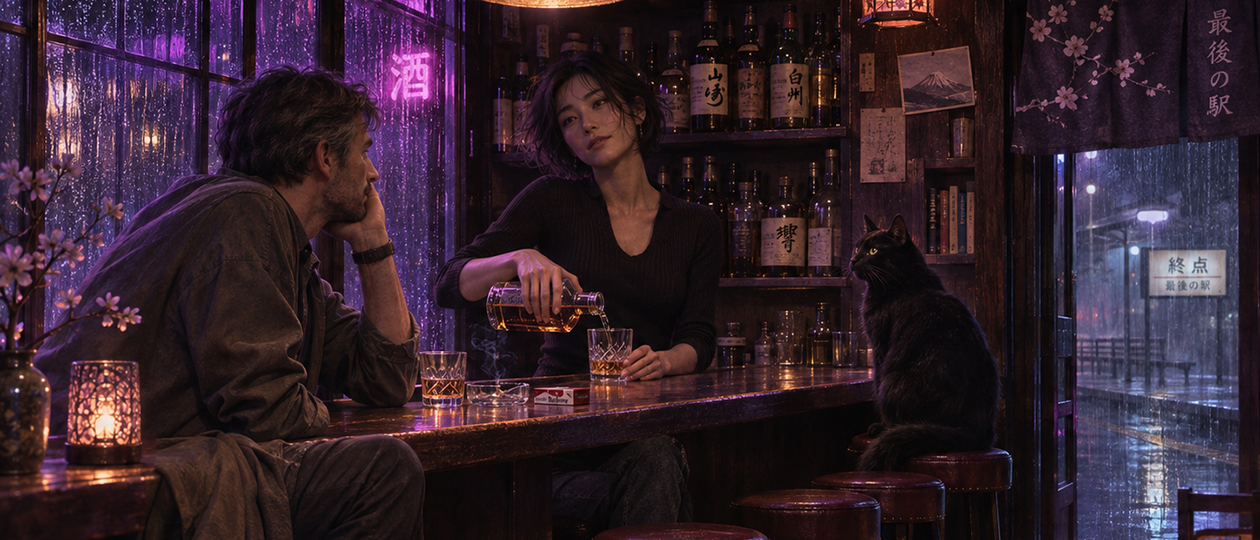
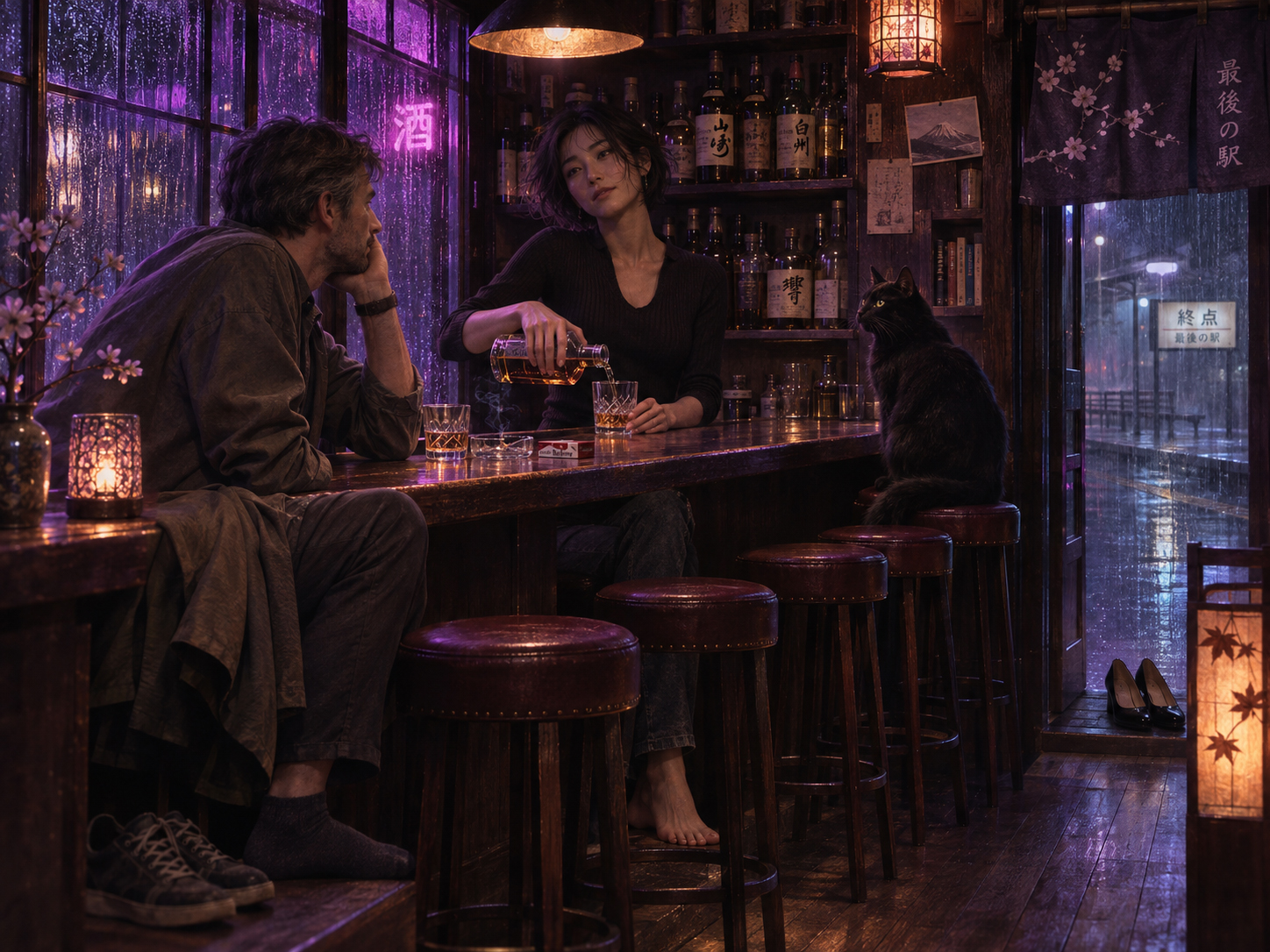
I pushed open the door. Inside it was drier than outside, though not much cheerier. The place smelled of old wood and burnt coffee. A counter, six barstools, a shelf of bottles whose labels had long since worn away. A record was spinning in the corner.
The only customer was an enormous black cat. He sat on a barstool looking like a recently fired finance minister.
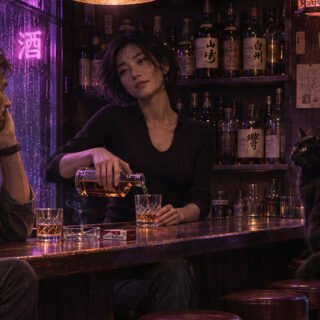
Behind the counter, perched on a tall stool with her legs tucked beneath her, was a Japanese woman of about thirty. Petite, pretty, with tousled short hair, a close-fitting dark sweater, and blue jeans. Pretty enough that I noticed it immediately, then felt embarrassed, like a schoolboy caught cheating.
She was barefoot. She looked as though she’d just crawled out of some narrow, dark place and hadn’t yet decided whether she liked it here.
Her black shoes stood neatly on the step by the entrance, beside a row of slippers for guests.
“Konnichiwa,” I said in my impeccable Ryazan-accented Japanese.
The woman looked up from her glass.
“Shoes off in here”
“Shoes off in here,” she said in English.
I looked down at my shoes.
“Everybody?”
“Everybody who stays. I stayed.”
“Long ago?”
“Depends how you count.”
I took off my shoes. Her English was correct and slightly old-fashioned—the kind spoken by people who learned the language from books and have never had an argument in it. Out of habit, I gave her an A.
“Yuki,” she introduced herself. “And this is Iroha. He’s our resident classic. The owner says that in his previous life Iroha was a decadent writer. Wrote haiku about loneliness and fading chrysanthemums. Then he drank methyl alcohol and was reincarnated as a cat. Now he just sits around waiting for tuna and human compassion to get cheaper.”
The Cat Meowed
Without opening his eyes, the cat uttered a short meow.
His voice was deep and smoke-roughened, with unmistakable overtones of the Bolshoi Theater.
Outside, thunder finally cracked. The first raindrops struck the window as though someone had thrown a handful of small coins against the glass. The neon sign flashed one last time and went out for good. The bar sank into a cozy, almost intimate half-light.
Yuki reached for a bottle with such fluid grace, without any of the usual awkward angles of human movement, that for a moment I forgot why I’d come in. She poured whiskey. I hadn’t ordered any.
“Do you always pour without asking?”
“For people who arrive on the last train, yes. They usually don’t know what they want.”
“I do. Home.”
“That’s not a drink.”
Iroha meowed.
“He agrees,” Yuki said.
“Are you translating?”
“Interpreting. Two different professions.”
“I’m a teacher. Who would know better?”
She smiled. It was a brief, unexpectedly weary smile, like that of someone who had been handling a very large job all alone for far too long.
“Would you happen to have a spare cigarette?” she asked. Her voice was pleasant and painfully familiar, as though I’d heard it in my dreams.
I took out my Marlboros. She didn’t rush to light up. She held the cigarette between two fingers, brought it to her lips, slowly breathed in its scent, and only then lit it, borrowing my lighter.
We Got to Talking
At that hour, in a place like that, conversations go straight to what matters. There’s no time for introductions.
“Do people often come here from the last train?” I asked.
“Not often. But regularly.”
“Are they as confused as I am?”
“Most of them. They ask where they are. I tell them, in a bar. They ask where the bar is. I tell them, at the last stop. After that, things are usually clear.”
“Not to me.”
“It’s called the last stop not because there are no trains beyond it.”
“Then why?”
“Because there are no passengers beyond it.”
I took a drink.
“So I’m dead.”
Yuki winced.
“What a crude word.”
“Which one would you prefer?”
“Delayed.”
Iroha meowed.
“What did he say?”
“That you’re exaggerating.”
“Me?”
“He thinks people die in a much more orderly fashion. With paperwork.”
“Tell him I have paperwork too. A diploma, insurance, a swimming pool membership.”
“Do you use the membership?”
“No.”
“Then you can’t be all that alive.”
Iroha jumped down from his stool, walked along the counter with his tail held high, and settled on the stool beside me.
The Cat Studied Me
He studied me with the professional interest of a doctor.
“He’s checking you,” Yuki said.
“For what?”
“Signs of existence. It’s his job.”
I asked what lay beyond the last stop. The other world, assuming there was one.
“I don’t know,” Yuki said. “I’ve never gone any farther.”
“Why not?”
“It’s more comfortable here.”
“How so?”
“Here you can wait.”
She was polishing a glass that was already clean. She said she’d once been waiting for someone. For a while she’d remembered who it was. Then she’d discovered that waiting was easier than searching, and remembering wasn’t really necessary.
She said it calmly, without drama, the way people talk about a route they once changed and never bothered to take again.
I wanted to ask whom she’d been waiting for, but thought better of it.
Yuki put the glass back on the shelf. Then, for some reason, picked it up again.
Later the rain grew heavier—a fine, clinging rain. It blurred the sign outside until it looked like a distant boat.
“Have you noticed that this city never falls silent?” Yuki asked. “If you listen to its voice long enough, you can forget who you are.”
“I don’t listen. I ignore it. You can’t survive in Tokyo otherwise.”
“Does it help?”
“I got on the last train.”
“So apparently it does.”
“Nobody’s waiting for me either,” I said.
I don’t know why.
For three months I hadn’t said anything like that out loud, not even to the mirror.
Yuki stopped polishing the glass.
“You were in a hurry,” she said.
“Because the train was late.”
“People often mistake habit for desire.”
I told her about the lightbulb. About the note on the table, the hallway that was now illuminated, and my son, who called on Sundays when he remembered. And about my daughter, with whom I’d long since lost touch.
“Did you ask why she left?”
“I did. She said, ‘You know perfectly well.’ I didn’t. But I’ve been pretending I do ever since.”
Yuki looked at me. I expected another question—about my daughter. But she didn’t ask.
“The past is a hole,” Yuki said. “Sometimes empty, sometimes full of water. No matter how long you stare down into it, all you see is darkness.”
“I didn’t stare. I bought a lightbulb.”
“That’s one way.”
I finished my whiskey. Yuki didn’t offer me another. And for some reason, I didn’t want her to move away to get the bottle.
“Anyway,” I continued, studying the bottom of my glass, “I have a theory. Tokyo isn’t made of buildings and streets. Tokyo is made of prepositions and conjunctions. ‘If,’ ‘although,’ ‘despite.’ To get from the station to your apartment, you have to pass through three social classes, two rituals, and one existential crisis. Not three hundred yards.”
Iroha suddenly stirred, opened both eyes—yellow as a pair of streetcar tickets—and looked at my pack of Marlboros.
“Not a chance,” I warned him. “First of all, the Surgeon General says it’s bad for you. Second, you’re already black. What do you need more tar for?”
The cat made a deep, throaty sound remarkably like “Ah, the younger generation,” turned his backside toward us, and curled up again.
Yuki Laughed
Not just smiled, as before, but actually laughed—briefly, unexpectedly loudly. Then she covered her mouth with her hand, as though she’d surprised herself.
Outside, the rain had reached that stage where water no longer falls straight down but somehow comes in diagonally, challenging the fundamental laws of physics. Muddy streams ran down the glass, blurring the distant lights of shop windows.
I asked what would happen next. Yuki shrugged. Iroha sneezed.
That ended the conversation. After something like that, it would have been awkward to continue.
Shortly before five, the station shutters went up with the same crash.
Yuki said the first train would arrive in twenty minutes. I asked how much I owed her.
“Next time.”
“Will there be one?”
“That depends on the train.”
I didn’t ask which train she meant.
We sat in silence for a little longer. Yuki put the bottle away. Iroha slept. Outside, the sky was beginning to lighten, though the rain made it almost impossible to tell.
Finally, I stood up.
My shoes were waiting by the door, their toes pointing toward the exit. I hadn’t left them that way.
I picked them up and hesitated. Beside them stood Yuki’s black shoes.
From the direction of the station came the rumble of an approaching train.
I put my shoes on.
Iroha escorted me to the threshold, looked at my shoes, then at me, and went back inside.
When I turned around, the sign was gone. There was only rain. I decided it was the fog.
The train back arrived precisely on time. For some reason, that offended me. If it had been even a minute late, I might have believed the world had changed.
To be continued…
 Kamil Askerkhanov
 Vladimir Golstein