 Kamil Askerkhanov
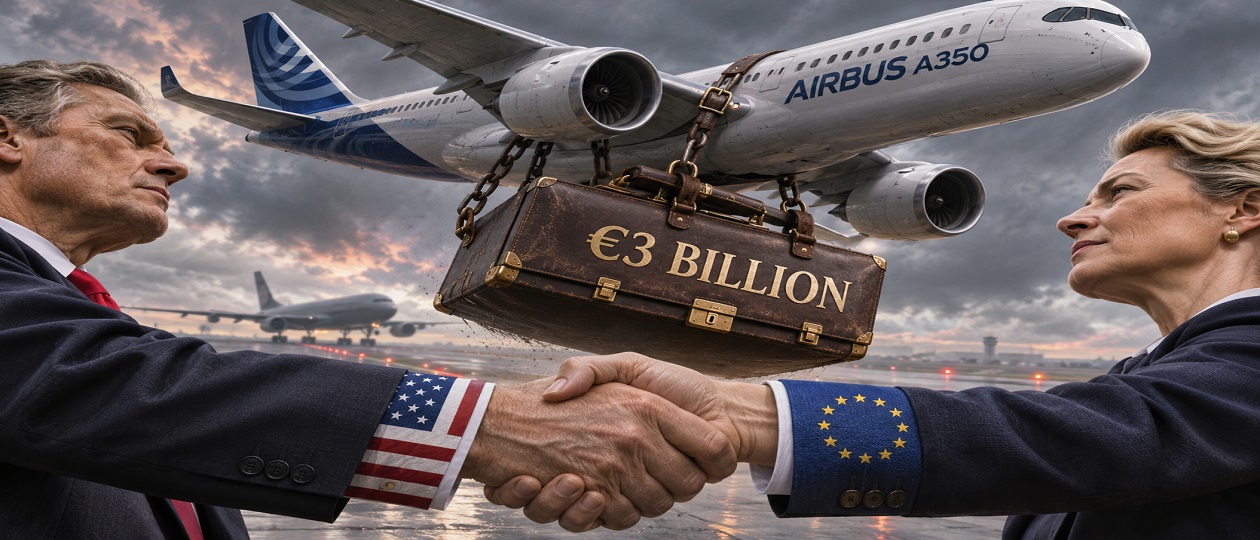
Washington warns that record European financing for Airbus could undermine the longstanding US–EU agreement on aircraft subsidies.
A record $3.4 billion European financing package for Airbus threatens to unravel a fragile trade truce between Washington and Brussels, potentially reigniting one of the longest-running trade disputes between the two economic powers, President Donald Trump’s top trade official has warned.
U.S. Trade Representative Jamieson Greer accused the European Investment Bank (EIB) of failing to disclose details of the financing arrangement announced in June, despite repeated requests from Washington. He expressed concern that the funds could distort competition in the aerospace industry and breach the terms of the hard-won US–EU agreement.
The financing involves a distinction that is central to the dispute. On June 29, the EIB announced a record €3 billion ($3.4 billion) financing commitment to Airbus, but only an initial €1 billion loan was signed at the time. The remaining €2 billion formed part of a broader approved financing package rather than a single loan already disbursed. The funds are intended to support research and development through 2030, including projects in commercial aviation, defense and advanced aerospace technologies in France, Germany and Spain.
“I had sincerely hoped that trade-distorting European subsidies to Airbus were a thing of the past,” Greer said.
He accused France, Germany and Spain of spending decades supporting Airbus as their national aerospace champion, giving the European manufacturer an unfair competitive advantage over American aerospace companies and workers.
The dispute over government subsidies to Airbus and its American rival Boeing was formally suspended in 2021 under President Joe Biden, ending a 17-year confrontation that had led Washington and Brussels to impose billions of dollars in retaliatory tariffs on each other’s goods.
The agreement was initially intended to last five years. Although that period expired this summer, neither side reinstated the suspended tariffs. The EU described the arrangement as having been extended indefinitely under a broader transatlantic trade deal designed to avert the steepest tariffs threatened by the Trump administration.
The EIB’s financing commitment, the largest corporate lending package ever approved by the institution, has now emerged as another source of friction between Washington and Brussels.
It adds to a growing list of American grievances over European economic policies, including efforts to tax and regulate U.S. technology companies, as well as EU rules governing corporate sustainability and global supply chains.
The European Commission rejected Washington’s concerns, describing the EIB financing as a standard loan issued on market terms and fully consistent with the 2021 transatlantic agreement.
A Commission spokesperson said the EU remained committed to ensuring transparency, predictability and stability for businesses operating in the transatlantic aerospace industry.
Airbus also defended the arrangement, describing the EIB loan as a conventional corporate financing instrument.
The company said such financing was necessary to manage the complexities of its global manufacturing operations and extensive supply chains.
Airbus added that it was working with the relevant authorities and was prepared to provide governments with further information about the loan.
Brussels has been seeking to contain trade tensions with Washington while diversifying European supply chains and reducing strategic dependencies. At the same time, European leaders are eager to preserve American engagement in efforts to address the war in Ukraine.
In July 2025, the United States and the EU reached a broader trade agreement at Trump’s Turnberry golf resort in Scotland, avoiding the most punitive measures associated with his so-called “Liberation Day” tariffs.
Following a U.S. Supreme Court ruling in February 2026 that invalidated much of the administration’s emergency tariff regime, Washington introduced new duties under separate trade laws. By October, many EU goods faced a total tariff of 10 percent, while cars and auto parts generally faced duties of 15 percent. Steel and aluminum remained subject to tariffs of up to 50 percent.
Despite these agreements, the transatlantic trade relationship remains vulnerable to renewed confrontation.
Tensions have been compounded by a growing push among European policymakers to reduce the continent’s dependence on American technology, driven in part by concerns over the unpredictability of the Trump administration.
The Airbus financing dispute now threatens to reopen one of the most contentious chapters in transatlantic trade relations, raising fresh questions about how durable the US–EU economic truce really is.
 Robert Reich
 Dmitri Drobnitsky
 Yuri Chekalin