 Andrey Vedyaev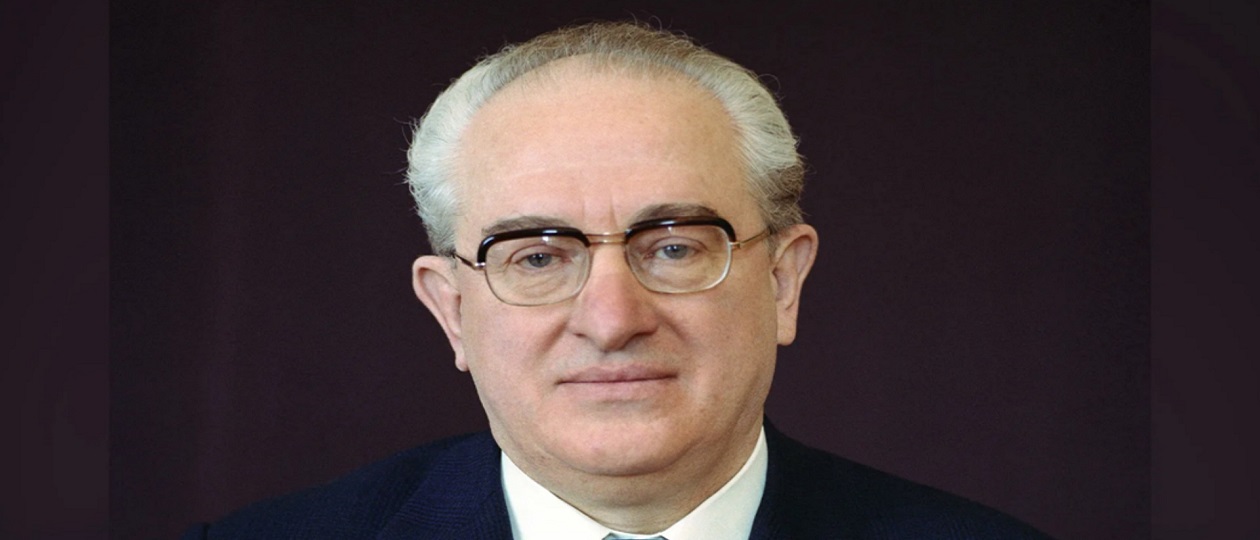
June 15, 2026, marks the 112th anniversary of the birth of Yuri Vladimirovich Andropov, one of the most remarkable figures of the Soviet political elite and the only head of the Soviet security services ever to rise to the leadership of both the Communist Party and the state.
The circumstances surrounding the birth of the future Soviet leader are themselves shrouded in mystery—a fitting beginning for a figure who would later acquire an almost biblical aura, rather like the prophets and patriarchs of old, or, in the Russian revolutionary tradition, Lenin and Stalin. His father came from the Don Cossacks and was the son of a court councillor. His mother, Evgenia Karlovna Fleckenstein, was the adopted daughter of a wealthy merchant family whose ancestors had come from Finland and had Swedish roots. According to the 1915 Moscow address directory, her father, Karl Fleckenstein, was listed as “a German of the Lutheran faith.” Indeed, the surname itself is unmistakably German: Flecken—“spot” or “stain”—and Stein—“stone,” hence “spotted stone.” Even Andropov’s later attraction to the northern regions of the Soviet Union has been interpreted by some as evidence of Nordic rather than Semitic ancestry.
The myths and mysteries would follow Andropov throughout his life. Most of them, however, are nothing more than gossip, unable to withstand even the most superficial scrutiny.
Take, for example, the oft-repeated story that in 1936 the 22-year-old Yuri Andropov was “noticed by the prominent Bolshevik Otto Kuusinen, thanks to whom the young man’s rapid rise up the career ladder began.” In reality, in 1936 Andropov was merely a full-time Komsomol secretary at the Rybinsk Water Transport Technical School, while Kuusinen was a member of the Presidium of the Comintern Executive Committee and a man who had personally known Lenin. Andropov’s meteoric rise must therefore have had very different causes.
Chief among them was his acquaintance with Nikolai Semyonovich Patolichev, later twice awarded the title Hero of Socialist Labour and decorated with no fewer than eleven Orders of Lenin. Even as a young man, Patolichev enjoyed Stalin’s patronage and was steadily climbing the party hierarchy.
There was a reason for this. His father, a full holder of the Cross of St. George, had been a hero of the Civil War. He had fought in Vasily Ivanovich Chapaev’s Special Shock Group and taken part in the liberation of Kazan, Simbirsk, Samara and Ufa. From the autumn of 1919 he commanded the 2nd Cavalry Brigade of the 11th Cavalry Division of the First Cavalry Army. On July 19, 1920, he was killed in battle against the Polish forces near Dubno in Ukraine.
The head of the political department of the 11th Cavalry Division was Andrei Vasilyevich Khrulyov, who by 1939 had become head of the Red Army Supply Directorate and, from August 1, 1941, Stalin’s deputy People’s Commissar of Defence. Khrulyov knew the son of his former comrade-in-arms and followed his career closely.
In August 1938, Patolichev was appointed party organiser at the Yaroslavl Rubber-Asbestos Combine, one of the largest industrial projects of the First Five-Year Plan. In 1940, Khrulyov introduced Patolichev to Stalin. The meeting proved decisive not only for Patolichev’s meteoric career but also, indirectly, for Andropov’s. At the time, Andropov was First Secretary of the Yaroslavl Regional Komsomol Committee and lived in the same building in Yaroslavl as Patolichev.
Stalin offered Patolichev the post of First Secretary of the Central Committee of the Komsomol. Although Patolichev declined, he nevertheless became firmly established within Stalin’s circle. It was on Patolichev’s recommendation that the young Andropov became First Secretary of the Central Committee of the Komsomol of the newly created Karelo-Finnish Soviet Socialist Republic. Patolichev himself was appointed First Secretary of the Yaroslavl Regional and City Party Committees.
The archival record leaves little doubt about Andropov’s active role in organising underground, intelligence, sabotage and partisan resistance against the Finnish occupation. Two-thirds of the Karelo-Finnish SSR, including Petrozavodsk, had been occupied by Finnish forces under Marshal Carl Gustaf Emil Mannerheim.
Andropov joined the headquarters of the partisan movement attached to the Military Council of the Karelian Front. He wore military boots and a greatcoat and lived in the same dugout as Major General Sergei Yakovlevich Vershinin, chief of staff of the partisan movement and a member of the Military Council of the Karelian Front.
The National Archives of the Republic of Karelia contains a wartime file marked “Top Secret,” compiling documents on the Komsomol underground movement in 1942. Only recently have these materials become available to researchers. They provide substantial evidence of Andropov’s active participation in organising underground Komsomol committees and training their personnel. The documents include plans for underground structures, their missions, locations and personnel rosters. All of these materials bear Andropov’s signature or approval.
Andropov’s experience in the partisan movement would prove invaluable during the suppression of the Hungarian uprising in 1956—the first “colour revolution,” as it has since been described by its critics as a Western intelligence operation under “Operation Focus.”
As Soviet ambassador to Hungary, Andropov worked closely with Colonel Grigory Fyodorovich Grigorenko, a veteran of the legendary SMERSH military counterintelligence service who had been sent to Hungary as deputy senior KGB adviser. Grigorenko immediately noticed that Andropov possessed an unusually high level of culture, impeccable manners, refined speech and an excellent command of English.
Their subsequent professional contacts, particularly during the deterioration of Hungary’s internal political situation, when Grigorenko was required to report operational intelligence to Andropov, confirmed his first impression: Andropov was indeed an unusually perceptive and thoughtful man.
Andropov saw with his own eyes—not in photographs—the bodies of Hungarian Communists and state-security officers hanging from trees and telegraph poles. He saw mutilated bodies lying in the streets, subjected to abuse and desecration. His wife and son witnessed the brutal executions as well.
The Hungarian events left a profound mark on Andropov and his family. His wife, Tatyana Filippovna, and his son Igor never fully recovered from what they had seen.
Moscow duly recognised Andropov’s role in the Hungarian crisis. In February 1957, he was appointed head of a newly created department of the CPSU Central Committee responsible for relations with the Communist and workers’ parties of the socialist countries.
On May 19, 1967, at Leonid Brezhnev’s proposal, the Politburo unanimously decided to remove Vladimir Yefimovich Semichastny as Chairman of the KGB and appoint Yuri Vladimirovich Andropov in his place.
KGB officers greeted Andropov’s appointment with undisguised satisfaction and hope. They knew of his wartime partisan service and his conduct during the Hungarian events of 1956.
Major General Nikolai Vladimirovich Gubernatorov, Andropov’s aide and a man very close to the author of these lines, later recalled his first meeting with the new Chairman:
“When I entered the office and sat down, Andropov spoke first, looking intently into my eyes. From forensic science and my own investigative experience, I knew that a person’s eyes can provide additional information about him. We judge a person first of all by his eyes when we meet him and form our initial impression. The eyes can tell us a great deal about their owner—their emotional disposition, openness, nationality, and mental characteristics such as willpower, kindness, tenderness, hostility, cowardice and so on.
“Unexpectedly, Andropov asked me:
“‘Which fronts did you fight on? Did you happen to serve on the Karelian Front?’
“‘No,’ I replied. ‘I began fighting at Stalingrad, then continued on the Fourth Ukrainian Front and finished the war with the First Baltic Front.’
“‘And where was it hardest?’
“‘Probably crossing the Sivash in November 1943. I couldn’t swim at the time. And then there was the assault on Sapun Mountain during the liberation of Sevastopol. I was wounded and concussed there.’
“Andropov smiled.
“‘Well then. I’m glad to have met a fellow front-line soldier. I wish you success as a member of our team.’
“I left Yuri Vladimirovich deeply moved and went to work charged with his positive energy.”
Soon another telephone call came, this time to the office of Major General Grigory Fyodorovich Grigorenko.
“Why don’t you come over?” Andropov began.
He offered Grigorenko the post of head of the Second Chief Directorate—the KGB’s counterintelligence arm.
During their conversation, Andropov said:
“It is time to move from passive, defensive methods of using agents to more active ones—to recruit and position agents where the enemy is aiming. From my wartime experience, I can say that counterintelligence must not trail behind enemy intelligence. That axiom remains valid today, whether we are dealing with the powerful CIA, the BND or any other Western intelligence service. I hope you have every opportunity to stay one step ahead of the enemy. How are things with personnel?”
Grigorenko replied that after the purge associated with Alexander Shelepin, when many of the most experienced intelligence officers had been convicted or dismissed, few veterans remained. The best counterintelligence professionals were now “few and far between,” particularly his deputies Alexei Mikhailovich Gorbatenko and Fyodor Alexeyevich Shcherbak.
That conversation marked the beginning of a remarkable revival of Soviet counterintelligence. The period from the mid-1970s to the mid-1980s would later be described by some as the “golden decade” of Soviet counterintelligence.
In private life, Yuri Vladimirovich was known for an almost extraordinary asceticism. He was undemanding, self-effacing and honest. He would order a list of books from his reception office in advance and then read them rapidly. It was a constant habit, almost a ritual. He read so quickly that it astonished everyone around him. His average reading quota was said to be at least 600 pages a day.
His interests were extraordinarily broad, ranging from economics and politics to theatre, painting and poetry.
Yet the daily intelligence reports from the hidden war revealed to Andropov a horrifying level of corruption behind the polished façade of “developed socialism.” The cancer of economic criminalisation that had emerged during the Khrushchev era was no longer confined to several southern republics such as Uzbekistan, Azerbaijan and Georgia. Its tentacles had spread into parts of Russia—and from there upward, into the highest levels of the ruling party of the supposedly victorious socialist state.
Nikolai Tregubov, the head of Moscow’s trade system through whom major “tranches” of bribes passed, was sentenced to death, later commuted to fifteen years in prison. Once a brilliant middle-aged man who had begun his working life as a cook’s apprentice, he emerged from prison a broken old man.
Official reports of arrests among the trade and party mafias—high-ranking officials who had become immersed in luxury and privilege—were greeted by much of the population with jubilation. It was clear that people had grown desperately hungry for order. Even mass police raids targeting citizens accused of idling on the streets of Soviet cities could not destroy public confidence in the new General Secretary, Yuri Vladimirovich Andropov.
People saw that when it came to discipline and restoring order, the new leader demanded accountability from everyone, regardless of past achievements or official rank. Numerous senior officials were removed from ministerial positions, including those responsible for transport, ferrous metallurgy and construction.
The same fate befell Ignaty Trofimovich Novikov, Brezhnev’s immensely powerful Deputy Chairman of the Council of Ministers. On July 20, 1983, he was removed from all his posts.
For many Soviet citizens, corruption and nepotism had become synonymous with the name of Sharaf Rashidov, First Secretary of the Communist Party of Uzbekistan and the godfather of the infamous “cotton mafia.”
Andropov called Rashidov and asked how much of the cotton-production plan would actually be fulfilled. Rashidov began with the usual triumphant assurances, but Andropov cut him short:
“And how much of those figures is inflated?”
That conversation marked the beginning of the end of the Rashidov era. On October 31, 1983, Rashidov shot himself.
As part of Andropov’s campaign against corruption, Sergei Medunov, First Secretary of the Krasnodar Regional Party Committee, a close friend of Brezhnev and master of the so-called “Kremlin beaches,” was removed from office.
Interior Minister Nikolai Shchelokov and his family were implicated in massive embezzlement and violations of official and financial discipline. Shchelokov was forced to return 124,000 rubles to the ministry and surrender cars appropriated after the Moscow Olympics.
As for the results of the financial investigation, the new Interior Minister, Army General Vitaly Vasilyevich Fedorchuk, followed established procedure and forwarded the materials to the Main Military Prosecutor’s Office.
On December 13, 1984, Nikolai Anisimovich Shchelokov shot himself with a hunting rifle. According to his daughter, his brains were scattered across the walls.
In 1981, the United States brought to power what the author regards as its most reactionary forces, led by President Ronald Reagan. Reagan intensified his contacts with Pope John Paul II, viewing both the Pope and Poland as keys to destroying the “evil empire”—or, in contemporary language, Russia.
In June 1982, Reagan personally visited the Pope, who, according to this account, blessed him to launch a “crusade” against the Soviet Union until its complete destruction.
Reagan soon signed a secret directive giving this “crusade” concrete material form. In covert cooperation with the Vatican, and through Vatican channels, money, fax machines, computers, photocopiers, vehicles, printing equipment and radio transmitters were smuggled to the Polish trade union Solidarity. The possibility of supplying weapons to Polish insurgents was also seriously considered.
The Soviet Union found itself in an increasingly difficult position.
An analysis of Andropov’s recently published working notes suggests that a sharp change in his circle of contacts was already visible during the first half of 1982. International affairs became his principal area of work: he held eleven meetings with Konstantin Rusakov, head of the CPSU Central Committee department responsible for relations with socialist countries; five with Boris Ponomarev, head of the International Department; and six with Georgy Arbatov, a leading adviser on international affairs.
As General Secretary, Andropov also intensified his work with the heads of the Central Committee’s economic departments—Viktor Dolgikh, Nikolai Ryzhkov and Mikhail Gorbachev.
The strategic picture was becoming clear. The Soviet economy was finding it increasingly difficult to bear the burden of the arms race. Somehow, an accommodation with the West had to be found.
Andropov himself had never travelled to the capitalist countries. The choice fell on Gorbachev.
Yet Andropov did not envision Gorbachev as the future leader of the party and state, nor did he ever entrust him with chairing Politburo meetings. This was told to the author of these lines by Viktor Vasilyevich Sharapov, Andropov’s senior aide.
The rumours that Andropov was preparing Gorbachev to lead the country—and was somehow the intellectual architect of Gorbachev’s perestroika—are therefore nothing more than a myth.
In reality, Yuri Vladimirovich’s death on February 9, 1984, was so unexpected that debate over what actually happened has never entirely subsided. In any event, according to his recently published medical records, he did not die from kidney disease but from a blood infection whose origin remains unclear.
This becomes all the more troubling when considered alongside the succession of unexplained deaths that occurred among the highest-ranking leaders of the Soviet Union and the socialist bloc.
John Paul II returned to Poland in 1987 and celebrated a solemn Mass in Gdańsk before an ecstatic crowd of 750,000 people. A year later came the “Round Table” negotiations, which resulted in the legalisation of Solidarity and parliamentary elections in June 1989. Solidarity won 99 of the 100 seats in the Senate.
In December of that same year, Gorbachev travelled to the Vatican to establish diplomatic relations. During his meeting with Karol Wojtyła, he delivered an almost penitential speech interspersed with praise and deferential remarks addressed to the Polish Pope.
Thus ended the “crusade” against the Soviet Union.
In 1992, Gorbachev himself declared:“Everything that happened in Eastern Europe in recent years would not have been possible without the Pope’s presence in all of this, without the great role—even the political role—that he played on the world stage.”
And yet the country built by generations of Russians and other fraternal peoples proved too formidable even for the infernal forces described above. It has survived, despite all the Western curs arrayed against it, to this very day.
And in that survival, the author believes, Yuri Vladimirovich Andropov deserves no small share of the credit.
 Kirill Benediktov
 Robert Reich