 Yuri Chekalin
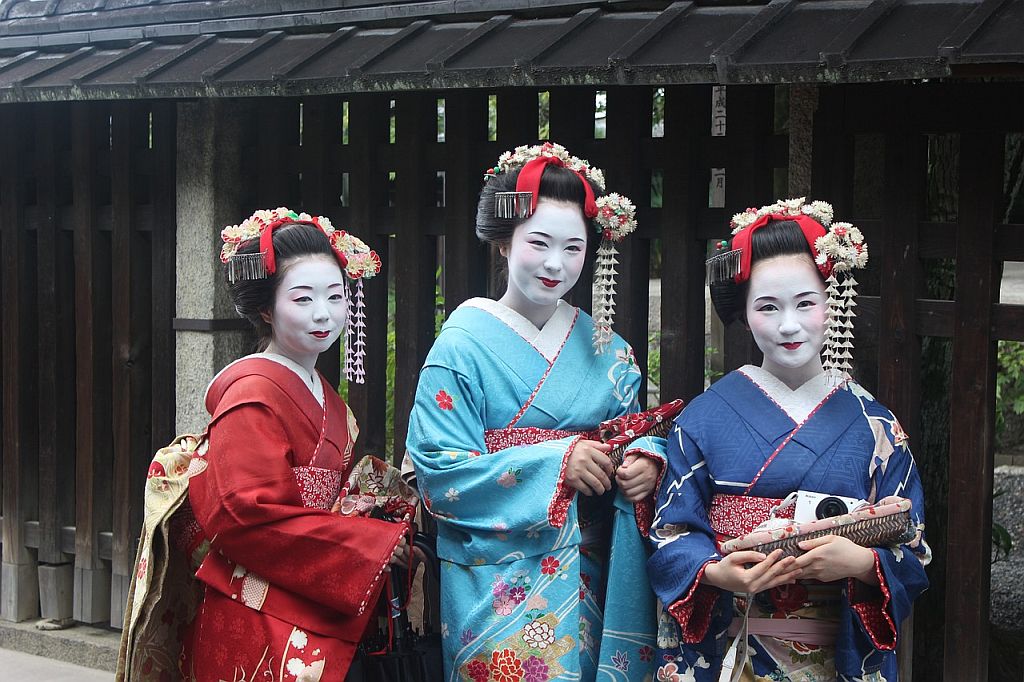
Of all the languages I know, the Japanese word baishun—meaning prostitution—seems to me among the most evocative.
There is something strangely melancholy and gentle in its sound, an echo of the feeling that sometimes overtakes us on a rainy day, when the damp scent of the earth makes us pause and think about eternal questions.
Incidentally, have you ever noticed that rain smells different in different places?
The word baishun is composed of two characters. The first, bai or uru, means “to sell.” The second, shun or haru, means “spring.” Literally translated, then, baishun means “the selling of spring.”
In the age of Japan’s licensed pleasure quarters, such districts were often described as karyūkai—“the world of flowers and willows.”
A World Behind Walls
Licensed prostitution in Japan can be traced back to the late 12th century, with official regulation emerging as early as 1193. In one form or another, the system survived until 1958.
As in many societies throughout history, the birth of a daughter into a poor family could be regarded as an economic burden. A daughter required a dowry to marry, while her opportunities to contribute economically were limited compared with those available to sons. Some families therefore sold their daughters into brothels.
The girls received meagre wages and often had little hope of ever escaping. Yet the social attitude toward them was complicated. They could be pitied, but they could also be respected for what was perceived as a sacrifice made for the survival of their families.
Brothels were generally concentrated in specially designated districts, surrounded by high walls or moats. They were, in effect, small towns within larger cities, complete with shops, restaurants, and entertainment.
The most famous of these districts was Yoshiwara in Edo—modern Tokyo.
Its gates officially closed at midnight. Yet the district’s visitors often continued their pleasures until morning.
The women who lived inside these enclosed worlds had remarkably little freedom of movement. They could generally leave only under exceptional circumstances: to visit dying parents, or occasionally in organized groups to view the cherry blossoms.
The pleasure quarter was therefore both a world of entertainment and a kind of prison.
Education in the Arts of Pleasure
One of the most striking differences between Japan’s courtesan culture and the popular Western image of prostitution was the emphasis placed on education.
From an early age, girls destined for the higher ranks were trained in dancing, poetry, music and singing, as well as the arts of courtship and erotic sophistication. Before the age of seventeen, however, instruction in sexual matters was traditionally theoretical.
At the age of twelve, girls underwent an examination. Those who passed continued their education until they were seventeen. Those who failed were generally assigned to domestic service.
At seventeen, they were examined again and divided into three categories according to their accomplishments.
The most successful entered the highest ranks of the pleasure quarters: the oiran.
The Oiran
According to population figures from 1689, Yoshiwara contained approximately 2,300 prostitutes of the lower ranks and around 500 oiran.
Even among the oiran, however, there existed a strict hierarchy. They were divided into three ranks, the highest of which was known as tayū. In 1689, there were reportedly only three tayū in Yoshiwara.
These women occupied a position very different from that suggested by the modern understanding of prostitution.
A tayū was not necessarily required to enter into a sexual relationship with a client at all. Even when such a relationship was contemplated, convention dictated an elaborate ritual of introductions and meetings. Traditionally, intimacy could occur only after the third meeting.
Famous poets dedicated verses to them. Powerful warriors and influential statesmen sought their favor.
The highest-ranking courtesans were not simply sex workers in the modern sense. They were cultural figures—highly trained women whose accomplishments included poetry, music, dance, conversation, calligraphy and etiquette.
Their world occupied a curious position between luxury and captivity, admiration and exploitation.
The End of the Licensed Pleasure Quarters
The end of the Second World War brought dramatic changes to Japanese society—and the country’s system of licensed prostitution was among the institutions soon challenged.
In 1946, the Allied occupation authorities attempted to dismantle Japan’s system of legal prostitution.
The proposal, however, encountered considerable resistance. Even the sweeping political and constitutional reforms of the occupation did not immediately bring the system to an end.
The decisive pressure came instead from Japan’s newly empowered women.
Women elected to the Japanese parliament became outspoken opponents of legal prostitution and helped organize a nationwide movement demanding its abolition.
Victory did not come quickly.
The campaign lasted eleven years.
Only in April 1958 did Yoshiwara in Asakusa finally close its doors for good. The former pleasure quarter was gradually transformed into an ordinary urban neighborhood of small cafés, shops and narrow streets.
An institution that had existed, in one form or another, for centuries had formally disappeared.
The Old World in Modern Japan
Yet prostitution is among humanity’s oldest institutions, and laws rarely eliminate such phenomena entirely.
It continues to exist in contemporary Japan, though often under different names and within legal grey areas.
Among the best-known examples are establishments commonly referred to as soaplands, where female employees bathe male customers. Japanese cities also contain a wide variety of strip clubs, hostess bars and other forms of adult entertainment.
As with Japan’s famous “love hotels,” the variations are almost endless.
The old karyūkai—the “world of flowers and willows”—has disappeared.
But the world it represented has not vanished entirely. It has merely changed its names, its forms and its appearance.
And perhaps that is the final irony of baishun.
The ancient word—“the selling of spring”—still carries within it something more complicated than a simple economic transaction: beauty and melancholy, desire and loneliness, freedom and captivity.
The gates of Yoshiwara have long been closed.
But history, as so often happens, did not end when the gates did.
 Kamil Askerkhanov
 Kirill Benediktov