 Vitaly Golovkov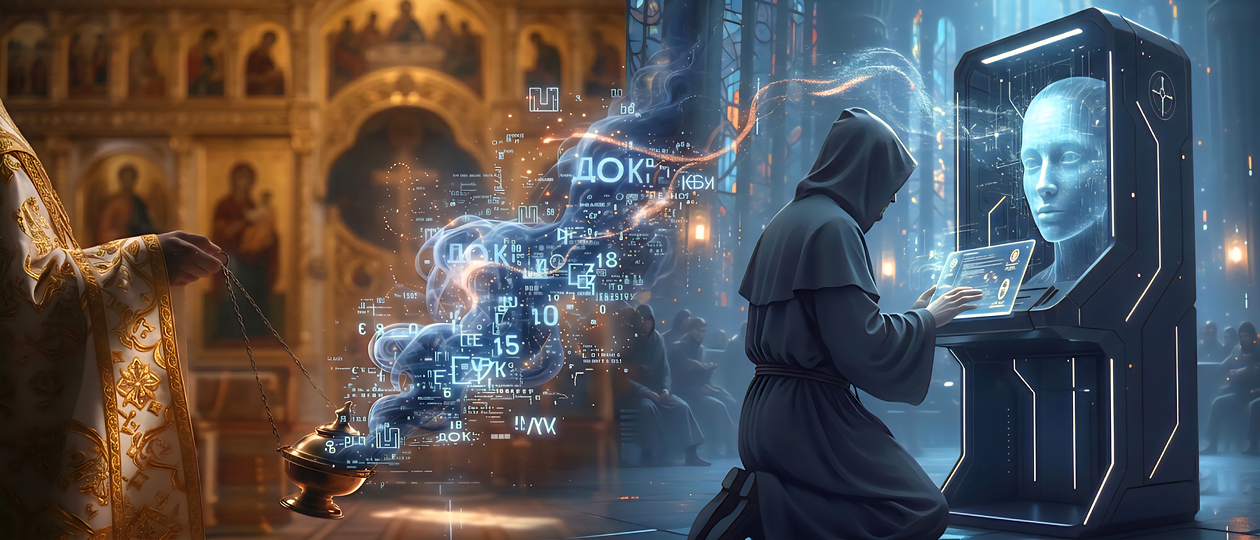
Slowly crossing the threshold of the church, where the echo of personal communion with God still fades, after the sacred silence of the holy sacrament, I immerse myself in the inexorable rhythm of progress.
Beyond the walls, I am greeted by the environment of an already familiar reality: the noise of high-tech everyday life, the flickering of advertising screens, and the smell of hot asphalt.
In this dense current of modernity, I suddenly become acutely aware of how the unchanging scent of incense within me involuntarily mingles with the cold breath of civilization. And in that moment, it becomes clear: this collision is not an accident, but an inevitability.
This is not just the juxtaposition of old and new, but the process of forming a new environment for testing faith.
It would seem that faith has always gone hand in hand with technological progress: from the printing press to automated bell towers. Catholic cathedrals have long been accustomed to electric candles—all of this is harmoniously woven into the fabric of the rite and raises no questions in society.
However, today, the influence of progress is no longer just a convenient backdrop. Technology is ceasing to be a tool and is beginning to alter the very structure of the sacred, changing the fabric of ritual.
Technology no longer simply “serves” ritual, but begins to dictate its form and logic.
Firstly, the very space of prayer is changing. While the church once served as the sole center of attraction, today smartphones and prayer apps create a “church in your pocket.” This transfers the sacred experience from the physical to the virtual. Prayer now competes for our attention with messaging notifications and an endless news feed.
Sacred time—the very thing that requires disconnection from the outside world—is being “hacked” by constant access to the global network. We are trying to find a vertical connection with God while existing in the horizontal plane of an endless information flow.
Does personal engagement still take precedence over broadcasting today? Faith through a screen is not condemned and is a normal phenomenon. Being able to listen to the words of a sermon while at home or sitting on a train is undoubtedly a blessing.
However, a clear distinction must be made: at the sacred level (sacraments, communion, confession, baptism), a “technological fast” must be maintained. This requires physical presence and active participation. Just as one cannot be satiated by a food video, one cannot receive the full grace of baptism through pixels.
A sacred rite is always a somatic (physical) experience: the smell of incense, the coolness of a stone, the touch of an icon, immersion in water.
Secondly, ritual is becoming algorithmic. When sacred text becomes part of the interface, and spiritual discipline becomes a feature in an app with a system of achievements and notifications, the very “fabric” of communication with God changes. Deep immersion, which requires effort and time, risks turning into a quick digital gesture: “lighting a candle” online, “liking” a quote from a holy father.
Pope Leo XIV recently complained that the internet, particularly TikTok, is “an illusion.” Priests offer people video-recorded sermons, earning them likes and followers, but this has nothing to do with “a life truly rooted in the Lord,” the head of the Roman Catholic Church said.
In this new environment, we face a paradox: technology gives us unprecedented access to spiritual content, but at the same time it can dilute the essence of the Sacrament itself, replacing the living, often difficult path of faith with a comfortable simulacrum.”
Religion once required effort (traveling to church, waiting for the service), and prayer required dedication. Now, technology strives to “remove friction,” which perhaps deprives ritual of its depth. This is a fundamental conflict of interests.
People are instinctively trying to adapt to this, creating new rules of spiritual hygiene in the digital world. We see believers forced to establish boundaries: some ostentatiously leave their smartphones in their cars before entering a church, as if performing an act of “digital fasting,” so as not to divide their attention between the altar and social media notifications. Others, on the contrary, try to sanctify their gadgets: using apps like modern-day lestov (rosary beads), keeping prayer journals in notes, or participating in online liturgy broadcasts when physical presence is impossible.
It is also interesting to observe the church environment itself.
Parish chats on instant messaging apps are becoming “digital narthexes,” where not only everyday matters are resolved but also spontaneous theological debates take place. For many, this becomes a lifeline: the opportunity to ask a priest a question on the go, receive support in times of discouragement, or find like-minded people in a world where faith is often relegated to the periphery of private life.
However, behind this convenience lies a risk: does the app itself become an “intermediary” between man and God, displacing living experience?
We are learning to be “digital monks,” trying to maintain inner silence amidst incessant noise, and this process of adaptation is perhaps one of the most difficult tests of faith in the 21st century. We are still searching for a balance, trying to understand: can technology become a temple, or will it inevitably remain merely a prelude, one we have never fully learned to cross?
We live at a turning point in time, when algorithms are claiming to be judges of our spirit—not only in religion but also in everyday decisions. This is a kind of challenge for the future, requiring the definition of immutable truths. It is a kind of manifesto of spiritual sovereignty for believers in the digital age.
We exist at a time of unprecedented metaphysical challenge: when the algorithmic environment lays claim to the role of supreme arbiter of the human spirit. In a world where technological expediency replaces the mystery of existence, we proclaim unshakable principles for the preservation of the Living in the Digital realm:
1) Ontological irreducibility of personality.
A human being is not a collection of data to be analyzed or monetized. My connection with the Creator is transcendental and rooted in the depths of the spirit, inaccessible to biometric scanning or predictive models. I affirm the sovereignty of my free will, which no algorithm can calculate.
2) Hierarchy of sacred space.
Technology is merely a tool of mediation, not an object of worship. We draw a clear line between the digital interface and a window into Eternity. A smartphone screen may serve as a pointer to the Temple, but it will never become the Temple itself. We profess faith in God Incarnate, rejecting any form of simulated presence.
3) Synergy of prayerful feat.
Spiritual work is the fruit of the living synergy of human will and divine grace. Prayer is an existential effort of the heart that fundamentally resists automation. We reject the possibility of substituting mechanical processes or software scripts for personal presence before God.
4) Ecology of inner silence.
In the face of total information expansion, we affirm the right to “sacred silence.” Digital fasting is not simply a renunciation of communication, but a restoration of the capacity for contemplation (hesychia). The voice of the Creator is discernible only where the noise of notifications and the dictates of endless content fade away.
5) Eucharistic realism and the sanctity of matter.
We revere the material world as the space of Divine presence. True communion requires physical embodiment: the warmth of wax, the taste of bread, a drop of wine, and the living gaze of a brother. We reject attempts to replace the physical liturgy with its virtual projection, for salvation occurs in the body, not in code.
6) Personalism of mercy.
Charity cannot be reduced to a financial transaction. True compassion requires a face-to-face encounter, a gift of time and spiritual presence. We seek not the optimization of aid processes, but personal participation in the fate of others.
7) Technological instrumentalism.
We embrace progress as the realization of human intellectual potential, but deny algorithms the right to define ethical and aesthetic imperatives. Technology is our servant, called upon to make life easier, but it will never become a shepherd, guiding the paths of our spirit.
We enter the future with the knowledge that forms may change, temples may be built of stone or woven from light, but no machine can replace the “broken and contrite heart”—that one point of contact where the created meets the Ineffable.
 Paul Sadchikov
 Alexander Rimov
 Kirill Benediktov