 Dmitri Drobnitsky
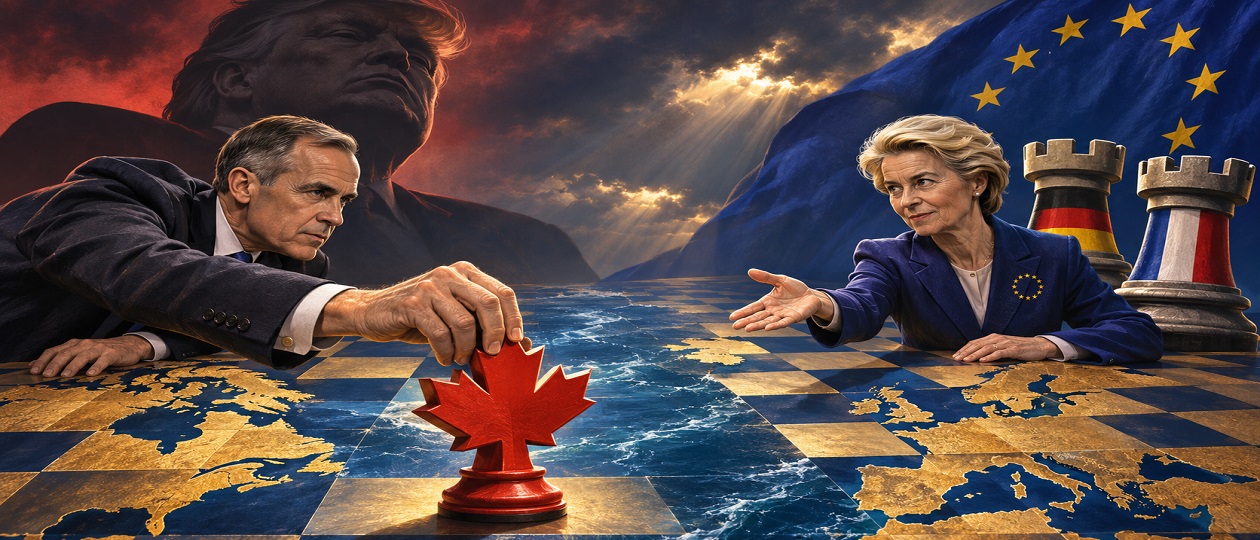
Ottawa and Brussels are building a new transatlantic alliance. But the question of what to call it — and how far it should go — remains unresolved.
Canada and the European Union have taken another step toward closer economic, political and defense integration.
At a two-day summit in Montreal on October 29–30, Canadian Prime Minister Mark Carney welcomed European Commission President Ursula von der Leyen and European Council President António Costa for talks aimed at building what both sides call an “Alliance for the Future.”
The meeting followed Carney’s visit to the European Parliament in Strasbourg, where von der Leyen had proposed making Canada the EU’s first “associate member.” The Montreal summit was supposed to move that ambitious idea closer to reality. Instead, it demonstrated just how complicated such an arrangement might be.
Canada, of course, is not about to become a full member of the European Union. Geographical considerations alone rule that out under the EU’s existing treaties. Nor would full membership necessarily serve either side’s interests.
Over decades, Brussels has accumulated an enormous body of laws, regulations and bureaucratic requirements. Bringing Canada into that system would be a formidable undertaking, potentially creating more problems than it solves.
But perhaps that misses the point.
When the United States and the EU negotiated the proposed Transatlantic Trade and Investment Partnership under Barack Obama, neither side expected the two economies to adopt identical regulatory systems. The objective was to make their markets work more closely together without eliminating their differences. A Canada-EU arrangement could pursue much the same goal.
The Political Question
The political logic has become increasingly compelling. With Washington’s trade policies growing less predictable under Donald Trump, both Ottawa and Brussels have strong incentives to reduce their dependence on the United States, diversify supply chains and strengthen cooperation in defense and advanced technologies.
For Carney, the precise legal label matters less than the practical benefits.
The Canadian prime minister has emphasized the opportunities that closer integration could create for young Canadians seeking to study or work abroad, businesses looking for new markets and researchers hoping to collaborate with European institutions. He also sees the partnership as a means of strengthening Canada’s economic independence and national sovereignty.
In other words, the substance comes first. The legal architecture can follow.
And, indeed, the Montreal summit produced tangible results. The two sides announced the conclusion of negotiations on a digital trade agreement, expanded cooperation on critical minerals and advanced computing, and plans to deepen Canada’s participation in European educational and research programs.
Canada’s Associate Membership in the EU?
But the question of associate membership proved considerably more contentious.
Germany objected to the terminology, arguing that the substance of the proposed relationship needed to be defined before a new category of EU association could be introduced. France, Italy and Greece also raised concerns during negotiations over the summit declaration.
As a result, the final document abandoned the phrase “associate membership” in favor of the considerably more cautious “ever closer association.”
The two sides now intend to define the scope of that relationship by their next summit in 2027.
The distinction is not merely semantic. Associate membership has no established legal status under existing EU treaties, and creating a new institutional arrangement would require agreement among member states.
There is also a broader political question. France and Germany have traditionally played a central role in shaping the European project. A new partnership that draws a major North American economy into the EU’s political and economic orbit could eventually affect the balance of influence between Brussels, the leading European capitals and their external partners.
That does not mean Canada would acquire a formal voice in EU decision-making. But it could give Brussels another powerful partner in negotiations over trade, technology, energy and security.
For now, the arrangement remains an ambitious political project rather than a clearly defined institutional framework.
The Montreal summit has given the project momentum, but many of its most consequential details remain unsettled.
The banquet, it seems, is far from over.
Whether Canada and Europe are preparing a lasting strategic partnership or merely adding another elaborate course to the diplomatic menu remains to be seen.
 Yuri Chekalin
 Robert Reich
 Yaroslav Listov