 Yuri Chekalin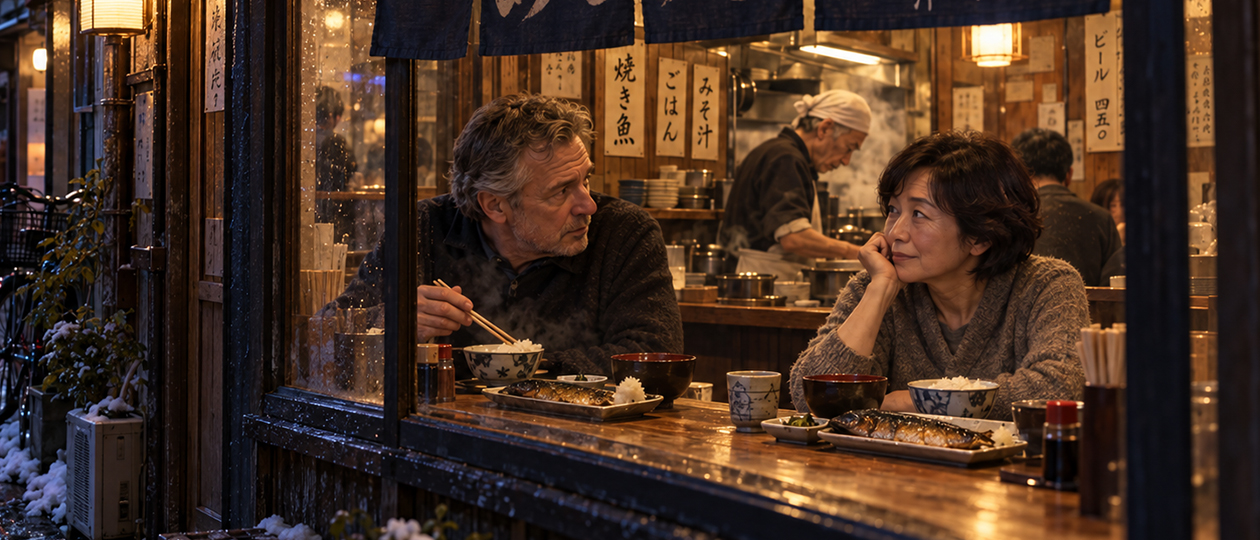
That winter I turned fifty-four, and I’d just about stopped expecting anything to happen to me.
It wasn’t despair. It was more like the way you stop hearing your refrigerator. It hums somewhere in the background. You know it’s humming, but after a while you no longer notice.
I translated articles from Russian into English for an online magazine, sitting at a little desk in my apartment in Koenji. Economics, politics, and assorted other nonsense. A good job for a man with nothing to say.
You passed along other people’s words without adding any of your own, and the world remained in balance.
The damn refrigerator broke down on a Tuesday.
It was the first thing that had happened to me in quite some time, and I have to admit I’d expected a little more from fate.
Still, it wasn’t exactly an insignificant event. It promised a considerable amount of trouble and expense, two things I hated with all my heart.
I discovered the problem around noon, when I took out a carton of milk and found that it had developed properties the manufacturer had never intended.
The refrigerator stood silent.
I knocked on it.
No response.
I unplugged it and plugged it back in.
Nothing.
I called an appliance repair service. They told me someone could come on Sunday.
Five days without a refrigerator.
I reflected that people had managed perfectly well without such inventions in the old days. Then I remembered that people in the old days had also been considerably more likely to die of food poisoning.
I poured out the milk.
I threw away everything else.
By evening, I discovered I had nothing to eat for dinner.
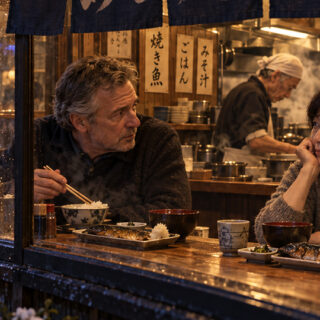
Not far from my apartment was a little restaurant I walked past almost every day. Eight stools at the counter, a handful of tables, and short fabric curtains hanging over the entrance.
The owner, an elderly man named Ogawa, had a menu consisting of three dishes that practically never changed: grilled fish, rice, and miso soup.
For a man who disliked surprises, it was an ideal establishment.
It was around seven when I walked in.
There was one empty stool at the counter. A woman’s scarf lay across the seat.
“Is this taken?” I asked.
The woman looked up.
She was in her early fifties. Short dark hair, a gray sweater, tired eyes. A cup of green tea stood in front of her.
“No, please. Go ahead.”
She moved the scarf.
I sat down and ordered mackerel.
Ten minutes later, Ogawa set a tray in front of me.
There was salmon on the plate.
“I’m sorry,” he said. “I seem to have mixed up the orders.”
“Don’t worry about it,” I said. “Fish is fish, after all.”
Ogawa gave me an apologetic smile and returned to the stove.
The woman beside me turned to look at me.
“You didn’t have to say it like that.”
“Like what?”
“You sounded like an emperor graciously pardoning one of his subjects.”
“I said fish is fish.”
“Exactly.”
I looked at her.
“Is that considered an offensive statement now?”
She was quiet for a moment.
“His wife is having surgery. He’s been running this place by himself for three days. He’s barely slept.”
I glanced at Ogawa.
He stood at the stove, his shoulders slumped, watching a pot with the intense concentration of a man who suspected it was about to commit a crime.
“I didn’t know,” I said.
“Of course you didn’t. How could you?”
She turned back to her tea.
That was the end of our conversation.
I ate my salmon.
It was delicious.
For some reason, that made me feel even worse.
The following evening, I went back.
The woman was sitting in the same place.
When she saw me, she gave a barely perceptible nod.
I ordered mackerel.
“I’ll make sure they get it right tonight,” she said.
“Thank you. Although yesterday’s salmon was excellent.”
She gave me a slightly suspicious look.
“Do you always talk like that?”
“In Japanese? Not always. Sometimes in Russian.”
To my surprise, she smiled.
Just a little.
But it changed her entire face.
“I meant the jokes.”
“Oh. Yes. Pretty much all the time. It’s cheaper than therapy.”
“Does it help?”
“Not particularly. But at least you can do it in public.”
She let out a quiet laugh.
I decided to count that as a diplomatic victory.
Her name was Keiko Hirano. She was fifty-two and worked in the accounting department of a small printing company near the station. She lived alone, a few streets away.
She asked what I did for a living.
“I translate articles.”
“Books?”
“No. Mostly economics and politics.”
“That must be interesting.”
“Absolutely. Especially when the same cabinet minister spends an entire week explaining, three different times, why nothing has happened when absolutely everything has.”
Keiko laughed.
This time, she really laughed.
Ogawa set a plate of mackerel in front of me.
“Got it right tonight,” he announced.
“My faith in the stability of our society is beginning to return.”
“Don’t listen to him,” Keiko told Ogawa. “He turns everything into a joke.”
“I’ve noticed,” Ogawa replied.
I wondered when exactly those two had found the time to form an alliance against me.
On Sunday, the refrigerator was repaired.
The technician replaced some part, collected his money, and informed me that the appliance still had plenty of life left in it.
I thanked him and went out to buy milk, eggs, and vegetables.
By all reasonable expectations, that should have been the end of the story.
Except that on Monday, I went back to Ogawa’s.
I had perfectly sensible reasons.
First, the fish really was excellent.
Second, cooking for one person was rather dull.
Third…
Well, the third reason isn’t important.
Keiko was already sitting at the counter.
“How’s your refrigerator?” she asked.
“Fixed.”
“Congratulations.”
“Thank you.”
She took a sip of tea.
“Then why are you here?”
“Probably for the same reason you are.”
“I always have dinner here.”
“And I thought I’d follow your excellent example.”
She shook her head.
“You’re impossible.”
“So I’ve been told.”
“And you haven’t done anything about it?”
“I’ve cut back on meeting new people.”
She laughed.
I noticed that I was beginning to recognize her laugh.
It was soft, a little unexpected, as though she first tried to suppress it and then decided there was no point.
We began seeing each other almost every evening.
We never made plans. We simply turned up at roughly the same time.
Sometimes we talked a great deal. Sometimes we sat in silence, which suited me perfectly.
I learned that Keiko loved old movies, couldn’t stand sweet red bean paste, and had once spent an entire Saturday trying to save a potted basil plant.
“Did you succeed?” I asked.
“No.”
“So it died heroically.”
“There you go again.”
“Sorry. What killed it?”
“I watered it too often.”
“A serious offense. Death by excessive care.”
She laughed, but then said:
“I really did feel sorry for it, though.”
There was something in her eyes when she said that.
Something that made me swallow the next joke.
That was happening more and more often.
One evening, Keiko told me that once a month, usually on a Sunday, she took a train and got off at a station she’d never visited before.
“Why?” I asked.
“Just to walk around. See what’s there. Maybe stop at a café.”
“And what if there’s nothing to see?”
“Then I walk around somewhere there’s nothing to see.”
I considered this.
“A remarkably ambitious itinerary.”
“Last time, I found a little bakery. The rolls were terrible, but the owner had a wonderful old cat.”
“And?”
“I sat with him for about twenty minutes.”
“With the owner?”
“With the cat. The owner was working.”
“I hope the cat was at least a good conversationalist.”
“Much better than certain people I know.”
She looked at me with an expression of perfect innocence.
I decided not to pursue the matter.
On another evening, she told me about an elderly woman who had come into the print shop and ordered fifty business cards.
The cards were to have her name and a single word beneath it:
Artist.
The woman was seventy-two.
“Can you imagine?” Keiko said. “She’d been painting all her life, but she’d never shown her work to anyone. And now she’d decided to put on a little exhibition at her neighborhood community center. She even brought in her own watercolor for the card. It was beautiful…”
She smiled.
“And when she came to pick up the order, she said it was the first time in her life she’d ever called herself an artist.”
“At seventy-two?” I asked.
“Yes.”
“Good thing she didn’t wait until eighty.”
Keiko stopped smiling.
I didn’t understand what had happened.
“You know,” she said, “sometimes I think it actually bothers you when someone is happy about something.”
“Why?”
“Because you immediately find something to make fun of.”
“I didn’t say anything terrible.”
“That’s just it. You never say anything terrible. But somehow, after one of your remarks, everything feels a little worse.”
She took out some money, placed it on the counter, and stood up.
“Good night.”
I wanted to say something.
But she was already gone.
Ogawa silently removed her teacup.
“What?” I asked.
“Nothing.”
“You have the look of a man who’s about to say something.”
“I learned a long time ago not to interfere in other people’s business.”
“A wise policy.”
“I think so too.”
I looked at the door.
Then at my plate.
I’d lost my appetite.
Which was particularly annoying, because the mackerel was excellent again.
The next evening, Keiko didn’t come.
I ordered dinner and pretended her absence was of absolutely no interest to me.
She didn’t appear the following evening either.
Ogawa said nothing.
But several times he gave me a look I didn’t care for at all.
By Thursday, I caught myself staring at the door.
I’d been doing it for ten minutes.
It was an unpleasant discovery.
The last time I’d waited for someone, I think, had been about fifteen years earlier.
Lately I’d been getting along just fine without that particular pastime.
Ogawa set a cup of tea in front of me.
“Mackerel again tonight?”
“Yes.”
“Wouldn’t you like something different?”
“Why?”
“For a change.”
I looked at him.
“Is there something wrong with the mackerel?”
“The fish is fresh today,” he said.
And disappeared into the kitchen.
On Friday, I arrived later than usual.
Keiko was sitting at the counter.
The sight of her filled me with an utterly ridiculous sense of relief.
She nodded.
“Good evening.”
“Evening.”
I sat down beside her.
For a while, neither of us spoke.
“You disappeared,” I finally said.
“I’ve been working late. We have a big order to finish.”
“Oh.”
“Is something wrong?”
“No.”
She looked at me.
“Was there something you wanted to say?”
I sighed.
The Russian language has a great many beautiful ways to apologize.
English has even more. In twenty years of translating, I’d probably translated several hundred apologies, ranging from diplomatic to marital.
And now it turned out that not one of them was any use to me.
“I wanted to apologize,” I said.
Keiko put down her cup.
“For what?”
“For what I said about that woman and her business cards.”
“But you didn’t say anything terrible.”
I winced.
“Exactly.”
She studied me.
“Are you making fun of me?”
“No. Not this time.”
I was quiet for a moment.
“You see, I’m fifty-four years old. I spend all day translating other people’s words. Politicians, economists, analysts. They’re all convinced they understand how the world works, and they’re all constantly wrong.”
“And?”
“I suppose I’ve gotten too used to noticing the absurdity of things. Even when there’s no reason to look for it.”
Keiko said nothing.
“And that woman…” I continued. “I thought about her afterward. What she did really was wonderful.”
“You think so?”
“Of course. Seventy-two years old, and she finally found the courage to do something she’d wanted to do her whole life. And here I am at fifty-four, and I don’t even know what I want.”
I hadn’t intended to say that last part.
It had somehow slipped out on its own.
Keiko looked at me differently.
“You really don’t know?”
“Until recently, I was absolutely certain I did.”
“And what did you want?”
“To be left alone.”
She smiled.
“A very convenient wish.”
“Extremely.”
“And now?”
I looked at her.
I could have made a joke.
About the broken refrigerator. About mackerel. About being too old to invite new complications into my life.
I had at least five perfectly good options.
Instead, I said:
“And now, for some reason, I’ve spent three evenings in a row waiting for you to walk through that door.”
Keiko lowered her eyes.
Then she laughed softly.
“There, you see? You can talk like a normal person.”
“Don’t get used to it. That was an accident.”
“Of course.”
She was smiling.
And I suddenly realized how happy I was to see her.
Not because she could entertain me. Not because I’d grown accustomed to her company.
I was simply happy.
Apparently, that could still happen.
A week later, I invited her to dinner.
Not at Ogawa’s.
At a real restaurant.
That was precisely how I phrased the invitation, and naturally, it ruined everything.
“Isn’t Ogawa’s a real restaurant?” Keiko asked.
“Of course it is.”
“Then why go somewhere else?”
“I wanted to…”
I stopped.
She waited patiently.
“You see,” I finally said, “at Ogawa’s, we always run into each other by accident.”
“For three weeks?”
“Technically, yes.”
“That’s a very persistent accident.”
“Exactly. So I thought perhaps, just once, we could arrange to meet on purpose.”
Keiko looked at me.
Then she laughed.
“Is that how you always ask women out?”
“No.”
“How do you usually do it?”
“Usually, I don’t.”
She stopped laughing.
And then, quite unexpectedly, she blushed.
Just a little.
I probably wouldn’t have noticed if I hadn’t been watching her so closely.
“All right,” she said. “Saturday.”
“Seven o’clock?”
“Seven.”
“It’s a date.”
We sat quietly for a while.
Then she asked:
“Are you sure you can get through an entire evening without making jokes?”
“No.”
“Then why should I agree to go?”
I considered this.
“Possibly because sometimes you actually find me funny.”
There was a mischievous sparkle in her eyes.
“Sometimes.”
On Saturday, for the first time in several years, I spent fifteen minutes choosing a shirt.
It turned out I owned quite a few shirts, but almost none of them were suitable.
I even considered buying a new one.
Then I decided that, at my age, such extravagance bordered on recklessness.
We had dinner at a small Italian restaurant near the station.
Keiko ordered pasta.
I ordered fish.
“Again?” she asked.
“Habits are a terrible thing.”
“Well, at least you didn’t order mackerel.”
“I’m demonstrating remarkable flexibility.”
She couldn’t help laughing.
We talked about books, about Tokyo, about the time she’d gotten lost in Kyoto despite having been there ten times before. I told her about my first visit to Japan, and how I’d spent an entire week trying to figure
out why my neighbors left their umbrellas outside the door even when the sun was shining.
It turned out Keiko had never been to Russia.
“I’d like to go someday,” she said.
“It’s cold.”
“I know.”
“And people don’t always smile.”
“You don’t always smile either.”
“Then you’ve already had some experience.”
She laughed again.
When we stepped outside, a light rain had begun to fall.
Keiko had an umbrella.
I, naturally, did not.
She opened it and looked at me.
“Come on.”
“It’s small.”
“We’ll have to walk close together.”
I was about to make a joke.
But I thought better of it.
We walked toward her apartment, trying to stay beneath the umbrella.
Our shoulders touched.
Nothing remarkable.
A perfectly ordinary occurrence.
Two people walking under one umbrella.
Millions of people do it every day.
And yet I discovered that I didn’t want to reach her apartment.
At an intersection, Keiko suddenly stopped.
“What is it?” I asked.
“Can I ask you something?”
“Of course.”
“Have you been trying especially hard to be polite to me all evening?”
I was caught off guard.
“I suppose I have.”
“Don’t.”
“Why not?”
“I like your jokes.”
I looked at her.
“Seriously?”
“Not all of them, of course.”
“That’s reassuring.”
“Sometimes you’re absolutely unbearable.”
“So I’ve heard.”
“But when you’re constantly watching what you say, you don’t seem like yourself anymore.”
I said nothing.
Keiko sighed.
“I don’t want you pretending to be someone else. It’s just that sometimes your jokes hurt my feelings. When they do, I’ll tell you.”
“Agreed.”
“And you won’t laugh at me?”
“I’ll try not to.”
She smiled.
“Good.”
The light turned green.
We crossed the street.
Outside her building, Keiko stopped and folded her umbrella.
“Thank you for dinner.”
“Thank you for coming.”
“I had a lovely time.”
“So did I.”
We stood facing each other.
Suddenly I felt like a sixteen-year-old boy with absolutely no idea what he was supposed to do next.
The difference was that at sixteen, I’d still had some hope of growing wiser with age.
Keiko looked at me.
Then she stepped closer and kissed me on the cheek.
Very quickly.
Almost shyly.
“See you tomorrow?” she asked.
I nodded.
“Tomorrow.”
She opened the door and disappeared inside.
I remained standing by the entrance.
Then, for no particular reason, I touched my cheek.
How ridiculous.
At fifty-four.
At home, silence greeted me.
Or rather, almost silence.
The refrigerator was humming dutifully in the kitchen.
I hung up my jacket, washed my hands, and put the kettle on.
My phone buzzed.
A message from Keiko.
Thank you for tonight. And thank you for not making any jokes about my age.
I smiled.
I typed:
I was actually planning to. I just ran out of time.
Her reply came almost immediately.
Then I suppose I was lucky.
I thought for a moment and wrote:
Maybe next time?
She answered:
You can try next time. But remember, I’m fifty-two, and I’m a professional when it comes to taking offense.
I laughed.
Then I wrote another message.
No jokes this time.
Keiko, I’m really glad we met.
This time, she didn’t reply right away.
I had time to pour myself some tea, sit down at my desk, and even open another article about the state of the global economy.
Then my phone buzzed again.
So am I. Just please don’t tell me it was all because of your refrigerator.
I looked toward the kitchen.
The refrigerator hummed quietly, as though it had done nothing out of the ordinary.
I won’t, I wrote.
And after a moment’s thought, I added:
But if it breaks down again, I don’t think I’ll bother getting it fixed.
She sent a laughing emoji.
Then another message appeared.
You’d better get it fixed. After all, now you can just invite me over.
I stared at the screen for a long time.
Then I slowly closed the article I hadn’t even begun to translate.
For the first time in years, I had something more important to do.
I needed to figure out what to make for dinner.
And perhaps buy a new shirt.
 Kamil Askerkhanov
 Kirill Benediktov
 Robert Reich