 Yuri Chekalin
The Robots Are Already Here — a CommentaTHOR series on AI and the machines that do the work.
Part One: Construction
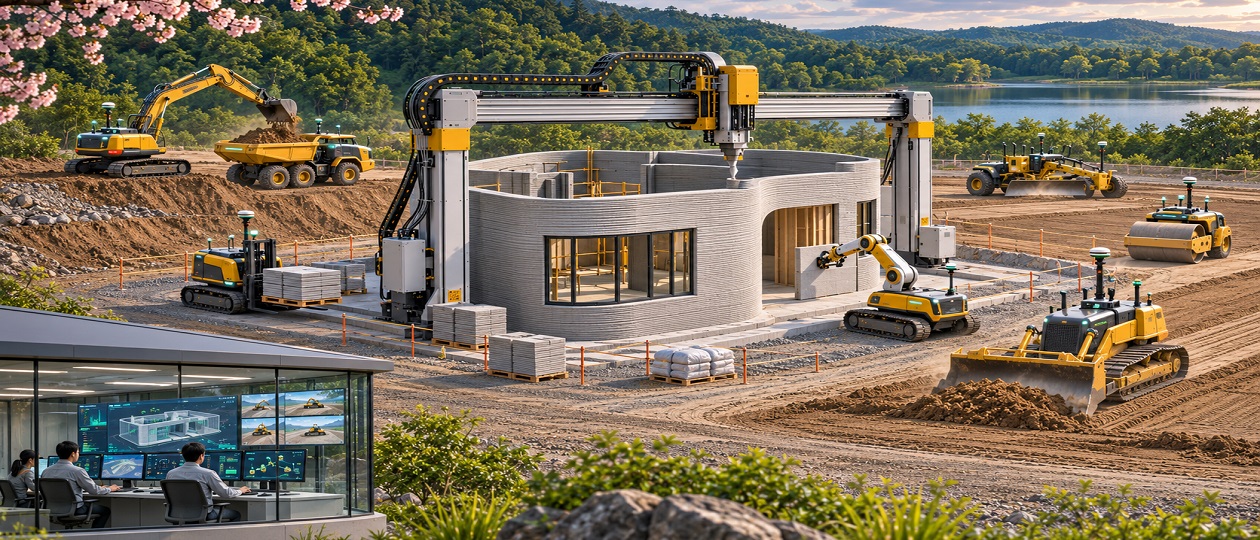
In the mountains of Akita Prefecture, in a village of 2,300 people, a dam is rising — and almost nobody is building it. Up to fourteen bulldozers, dump trucks and rollers move across the embankment of the Naruse Dam in coordinated patterns, laying down layer upon layer of material, seventy-five centimetres at a time. There is no one at the wheel of any of them. The nearest thing to a construction crew sits some 400 kilometres away in Odawara, where three employees of the contractor Kajima watch the machines on monitors in a control room.
The system is called A4CSEL, and Kajima has been developing it since 2009. An artificial intelligence breaks the work into thousands of micro-tasks — some 7,000 of them, by the company’s account — works out the most efficient way for the fleet to share the ground without colliding or duplicating effort, and sends the plan to the machines. They can run around the clock, in the dark and in weather that would stop a human crew. Kajima reports that at Naruse the fleet broke a Japanese monthly output record for dam construction that had stood for six decades.
This is not a demonstration for investors. It is a response to arithmetic.
The Workers are Leaving
Japan’s construction workforce peaked at 6.85 million in 1997. By 2025 it had fallen to 4.78 million, and it is old: about 37 per cent of Japanese construction workers are 55 or older, while only about 12 per cent are under 30. Since April 2024, overtime caps that other industries already lived under have applied to construction as well, so each remaining worker also has fewer legal hours. The industry is not short of projects. It is short of people, and the people it has are retiring.
America’s version of the same problem arrives from a different direction. The Associated Builders and Contractors estimates that the United States needed 439,000 additional construction workers in 2025, needs 349,000 more in 2026, and will need some 456,000 in 2027 — with most of the demand driven not by growth but by retirements. Two rich countries, two different economies, one conclusion: the builders are leaving faster than they can be replaced.
That, more than any breakthrough in artificial intelligence, is why the robots are on the building site.
Machines that Grade the Earth
Komatsu, the world’s second-largest maker of construction equipment, launched its Smart Construction programme in 2015, and its logic is instructive.
The revolution did not begin with a robot. It began with a survey. Drones map a site in three dimensions in a day or less — work that once took a team of surveyors about two weeks — and feed the model to bulldozers whose blades adjust themselves to the plan with centimetre precision. The operator increasingly supervises rather than drives.
The next step is now commercial. This year Komatsu and the American firm AIM Intelligent Machines moved autonomous bulldozers and excavators into paid deployment at customer sites in the United States, with Japan to follow in 2027; the autonomy can be retrofitted to machines customers already own. Komatsu is separately working with TIER IV, a Japanese autonomous-driving company, on self-driving dump trucks for quarries and civil engineering, aimed at practical use by fiscal 2027. Note the pattern: not humanoid robots with hard hats, but familiar yellow machines that have quietly stopped needing a driver.
The House from a Printer
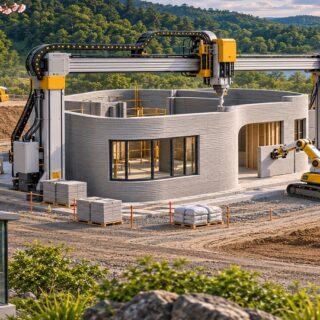
If autonomous earthworks are the industry’s present, the printed house is its most photographed future. In Georgetown, Texas, the Austin company ICON and the homebuilder Lennar have completed Wolf Ranch, a community of one hundred 3D-printed homes co-designed by the Bjarke Ingels Group — the largest such development in the world. A gantry printer called Vulcan, some fourteen metres wide, lays down ropes of a proprietary concrete mix, wall by wall, roughly three weeks of printing per house. The homes are full-sized, between about 1,570 and 2,110 square feet, and by early 2026 ICON said ninety-eight of the hundred had been sold.
Japan’s answer is smaller, cheaper and arguably more radical. The start-up Serendix prints the Fujitsubo, a fifty-square-metre house designed with Keio University for couples in their sixties looking for a final home.
It is assembled in 44 hours and 30 minutes and sells for 5.5 million yen — about $37,000, the price of a car, which is precisely the company’s pitch: a house without a mortgage.
The first commercial unit went not to a technology fair but to Suzu, on the Noto Peninsula, as reconstruction housing after the 2024 earthquake. In 2025 Serendix and JR West built the world’s first 3D-printed railway station, at Hatsushima; this year the company says it is moving from research to mass production.
What the Robots Cannot do Yet
A CommentaTHOR reader deserves the other half of the ledger.
The printer prints walls. At Wolf Ranch, as everywhere else, the foundations, roofs, windows, plumbing, wiring and finishing were done by people in the usual way — which is why the printed houses were not cheap: they sold from the mid-$400,000s, roughly the price of conventional construction in the area.
ICON now plans to sell its next-generation printer, Titan, to builders from 2027 at $899,000 a unit, on the argument that costs fall when the machines multiply.
Perhaps. They have not yet.
Robots excel where the task is repetitive, the environment is fenced and the plan can be reduced to data: moving earth on a dam, grading a pad, extruding a wall. Construction, however, is mostly the opposite — thousands of different tasks, in places that change daily, performed by trades that still work by eye and by hand. Renovation, the largest part of the industry in ageing countries, barely features in the automation brochures at all. And in Japan, for all the headlines, the printed-house industry has produced dozens of buildings, not thousands, while the country’s housing stock numbers in the tens of millions.
None of this makes the trend a mirage. It makes it a gradient. Automation is arriving the way it arrived in factories — task by task, starting where labour is scarcest and the work most mechanical — except that this factory has no roof, moves every few months, and is being automated in the open air.
Not Coming for the Jobs
The standard fear is that the robots are coming for the builders’ jobs. The numbers suggest something closer to the opposite. At Naruse, the machines did not replace a crew; they made it possible to build a dam in a depopulating mountain village at all, supervised by three people in suits 400 kilometres away. In Texas, the printer did not abolish the building trades; it printed walls for them to roof, wire and plumb. In Japan, the printed house is marketed not to young families competing with builders, but to pensioners in earthquake country whom the conventional industry, at conventional prices, was failing to serve.
The robots are not coming for the builders. They are coming because the builders are going — retiring in Akita and in Ohio alike — and something has to hold the dam, grade the road and raise the wall. The only real question the industry faces is whether the machines will multiply fast enough to meet the arithmetic. On the evidence of Naruse, Wolf Ranch and a fifty-square-metre house that costs as much as a car, the answer is: faster than anyone expected, and slower than the brochures say. Which is to say, at exactly the speed of the real world.
 Vladimir Golstein
 Dmitri Drobnitsky
 Sergey Stankevich