 Yuri Chekalin
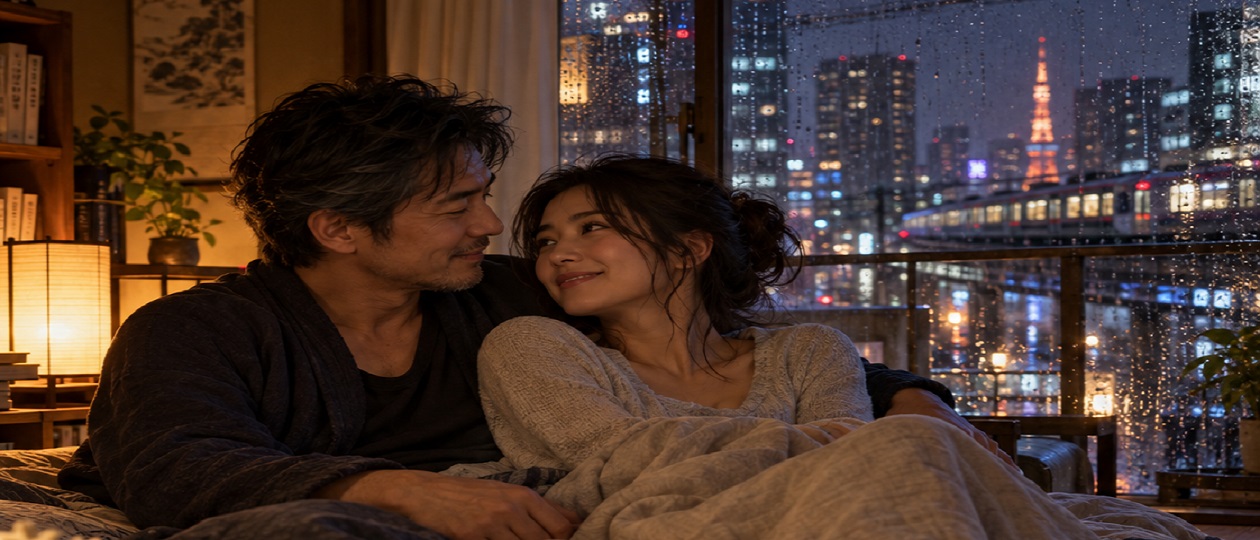
That November in Tokyo was unusually cold and rainy.
Every morning I got up at six, made coffee in an old Italian moka pot, and watched the gray Tokyo sky grow lighter beyond the window of my rented apartment in Gotanda.
My contract was ending in December. Soon I’d have to pack my things, say goodbye to the few people I knew, and head off somewhere else again.
I’d done it so many times over the past few years that I’d learned to fit my entire life into two suitcases.
The second one, admittedly, was usually full of books.
Yumi came into my life as unexpectedly as a tune you happen to hear on the radio one day and then can’t get out of your head.
We met in a laundromat.
The washing machine in my apartment had broken down, so I went to the nearest twenty-four-hour laundromat with a bag of dirty clothes and a volume of Dostoevsky I’d been meaning to finish.
Yumi was sitting beside a dryer. On her lap was a jazz record in a worn sleeve.
“You’re not planning to wash that, I hope,” I said.
She looked up.
“Why? Can’t I?”
“I’m not sure. But I definitely wouldn’t recommend the spin cycle.”
Yumi laughed.
She told me she’d bought the record at a little secondhand shop. She knew nothing about the musician, but she’d liked the cover.
“So you buy music for the pictures?”
“Sometimes. Haven’t you ever bought a book just because you liked the cover?”
I glanced at Dostoevsky.
“I have. Though I usually regretted it afterward.”
We talked for nearly an hour.
In that time, my clothes had been washed and dried, while hers, for reasons I couldn’t understand, were still tumbling around in the machine.
I found out later she’d simply started the dryer again.
Three days later, we met in Jimbocho.
Yumi said she knew a café there that made excellent coffee and had absolutely no idea how to make pastries.
“Then why are we going?”
“Because the pastries are beautiful.”
The coffee really was excellent. The pastries were almost inedible.
Yumi ate hers down to the last crumb.
“I thought you said they weren’t any good.”
“They aren’t. But they tried so hard.”
I couldn’t think of a reply.
Afterward, we wandered among the bookstores, browsed little shops, and argued about music and literature.
She maintained that Dostoevsky knew far too much about human suffering.
“Don’t you?”
“I do. But sometimes I’d rather forget about it.”
The next time, we went walking through Kanda.
In a narrow alley, Yumi stopped beside a white cat sitting on a wooden crate.
“Meet the Professor.”
“Why the Professor?”
“Look at his face. He obviously knows more than he’s willing to tell.”
The cat regarded me with an expression of profound academic disappointment.
“I don’t think he approves of me.”
“Don’t worry. He doesn’t approve of anyone.”
Nearby, in the courtyard of a small temple, we discovered a pond full of enormous carp.
One of them, particularly fat, hovered motionless just below the surface, staring at us with round eyes.
“And who’s that?” I asked.
Yumi considered the question.
“The president of the University of Tokyo.”
“Why?”
“He’s terribly important. And I don’t think he has the faintest idea what’s going on around him.”
I laughed so loudly that an elderly woman passing by turned to give me a disapproving look.
After that, we went back several times to check on the Professor and the university president.
One day, the Professor was gone.
Yumi noticed immediately. We searched the entire alley, peering behind crates and under parked cars.
“Maybe he just went somewhere,” I suggested.
“Of course he went somewhere. But where?”
The question seemed serious enough to warrant further investigation.
It started raining. We got soaked, searched the neighboring streets, and finally found the Professor beneath the awning of a closed shop.
He was asleep.
“The little rascal!” Yumi said in relief.
The cat opened one eye, established that we were people of no academic interest, and promptly went back to sleep.
We stood in the rain laughing.
Yumi laughed with her head thrown back, and a few unruly curls immediately escaped her carefully arranged hair.
I began to notice how much I looked forward to hearing that laugh.
And how the days when we didn’t see each other somehow grew longer.
One afternoon, we were caught in the rain at Shinjuku Gyoen.
We took shelter beneath the roof of a small pavilion and watched water drip from the trees onto the wet paths.
The park was almost deserted.
“I wonder,” Yumi said, “if there are still ghosts from the Edo period around here.”
“Why Edo?”
“Well, they lived here before we did. Surely some of them didn’t want to leave.”
“Possibly. Though if I were one of them, I’d choose a warmer neighborhood.”
“You have absolutely no romance in you.”
“I’m a realist.”
“That’s even worse.”
We fell silent.
Then she told me that her father lived in Nagano and grew orchids. He talked to them, occasionally scolded them, and whenever a particularly beautiful flower bloomed, he always called his daughter.
“He thinks every orchid has its own personality.”
“And you believe him?”
“Of course. Haven’t you noticed that things can be alive, too?”
“Such as?”
“Your coffeepot.”
I was surprised.
“You’ve never even seen it.”
“But you talk about it as though it’s an elderly Italian relative who demands to be treated with respect every morning.”
I had to admit she had a point.
The rain was gradually easing.
“Are you really leaving soon?” Yumi asked.
“My contract ends in December.”
“And where will you go after that?”
I shrugged.
“I don’t know yet.”
She nodded, as though the answer suited her perfectly well.
But she was a little quieter for the rest of our walk.
That evening, I walked her home.
The rain had almost stopped. The pavement gleamed beneath the streetlights, and music and the smell of grilled fish drifted from an open restaurant window.
We stood outside her building for another ten minutes.
In that time, we managed to discuss the weather, the following day, and various utterly unimportant things I can no longer remember.
I think we were both a little embarrassed by the fact that the conversation had ended long ago, but neither of us had any intention of leaving.
“Well, I should go,” I said.
“You’ve already said that.”
“Have I?”
“About five minutes ago.”
“Then I really should have gone by now.”
She smiled.
I looked at her, at those stubborn curls that had escaped her hair again, and suddenly I wanted to kiss her.
I leaned toward her.
At precisely the same moment, Yumi decided to straighten the collar of my coat.
Our noses collided. Quite painfully.
“Ow!” Yumi jumped back and grabbed her nose.
“Sorry! I didn’t mean to…”
“What were you trying to do?”
I was at a loss.
She looked at me and suddenly burst out laughing. I couldn’t help laughing, too.
“I don’t think that went very well,” she said.
“I’m out of practice.”
“So am I.”
She took hold of my coat collar again and didn’t let go.
“Want to try again?” I suggested.
“Just be careful. I’ve only got one nose.”
This time, I didn’t rush. She tilted her face up slightly, and at last we kissed.
It was a very brief kiss. A little shy, as though we were both afraid of doing something wrong.
Yumi drew back, looked at me, and smiled.
“That’s better.”
“You think?”
Instead of answering, she pulled me toward her by the collar again.
The second kiss lasted considerably longer.
Somewhere behind us, a car drove past. Water that had collected on a neighboring roof came cascading down with a splash. I felt Yumi gently rest her palm against my cheek.
When we finally drew apart, she was still smiling.
“Well, now you really should go,” she said.
“Probably.”
But we stood there holding hands for a while longer.
“See you tomorrow?” Yumi asked.
“Of course.”
“Good.”
She released my hand and headed for the door. At the threshold, she turned around.
“And be careful on your way home!”
“Why?”
“Given your coordination, I’m starting to worry.”
I laughed.
So did she.
I couldn’t tell you exactly when we began living together.
Neither of us proposed it. We didn’t discuss the future, make plans, or decide whose apartment was more convenient.
One day, my toothbrush simply appeared in Yumi’s bathroom, and an extra bowl for her favorite green tea appeared in my kitchen.
After a while, we stopped making arrangements about whose place we’d spend the night at.
Yumi brought me a small orchid her father had grown.
“Just don’t overwater it,” she warned.
“What if it dies?”
“Then Dad will decide you’re not right for me.”
From then on, I treated that orchid with something approaching religious reverence.
We cooked dinner together, sometimes went to the movies, and sometimes just stayed home.
Yumi loved green tea, old jazz records, and watching the rain through the window.
Her feet were also always cold.
I discovered this the very first night she slipped under my blanket and pressed her icy feet against my legs.
“Good Lord!” I exclaimed. “Have you been walking barefoot in the snow?”
“No. Why?”
“Your feet are like ice.”
“Then warm them up.”
And she moved even closer.
So I did.
Eventually, it became our nightly ritual.
Sometimes Yumi fell asleep before I did. I’d pull the blanket up over her, and without even opening her eyes, she’d catch my hand.
“Don’t go.”
“I’m not going anywhere.”
“Good.”
And she’d fall asleep again.
I’d lie beside her, listening to the distant rumble of trains and thinking how strangely life worked.
Not long ago, it had seemed perfectly natural to wake up alone, eat breakfast alone, go for walks alone, and come home to an empty apartment.
And now, sometimes, I’d find myself buying groceries I would never have eaten myself.
On Sundays, we sometimes visited the Professor.
He still saw no reason to show me any respect.
One day, Yumi informed me that this was a good sign.
“Why?”
“He considers you one of his own.”
“That’s a strange way of showing affection.”
“You’re not much better yourself.”
I couldn’t argue with that.
December was drawing closer almost unnoticed.
Documents concerning the end of my contract began arriving in the mail. Several people called to ask about my plans.
I told them I was still thinking.
It was true.
For the first time in many years, I genuinely didn’t know where I wanted to go next.
One evening, we were lying on a futon in Yumi’s apartment.
Rain was falling outside. Trains passed somewhere nearby, and every so often the windowpanes trembled almost imperceptibly as they went by.
Yumi lay beside me with her head on my shoulder, absently tracing a finger along my arm.
“You’re leaving soon, aren’t you?” she asked.
I didn’t answer immediately.
“My contract’s ending.”
“I know.”
She was quiet for a moment.
“Do you really have to leave?”
“No.”
“Then why are you going to?”
I wanted to tell her I was used to it. That I’d spent my whole life going places, changing cities, apartments, countries. That I’d never given much thought to where I might eventually stay.
But for some reason, I said nothing.
Yumi propped herself up on one elbow and looked at me.
“You know, Tokyo used to seem like an awfully big city.”
“It is a big city.”
“No, that’s not what I mean.”
She rested her head on my shoulder again.
“There are so many people here. Millions. Everyone rushing somewhere, hurrying, meeting, saying goodbye. You can spend an entire day surrounded by people and never really talk to anyone.”
I said nothing.
“And then you came along. And suddenly there was this little laundromat where we met. A café with terrible pastries. An alley with a white cat. A pond with a carp that looks like a university president…”
I smiled.
“Poor president.”
“Don’t interrupt.”
She gave me a little poke in the side.
“And there are two apartments where, somehow, it feels equally good to be.”
A train passed outside.
Yumi was silent for a long time. Then she said softly:
“If you leave, the city will be very big again.”
I turned toward her.
She was looking off to one side, as though what she’d said wasn’t particularly important.
I gently brushed an unruly curl away from her face.
“You know, Yumi, I think I’ll stay in this little city. I like it here.”
She looked at me.
And smiled.
Then she leaned down and kissed me.
This time, our noses didn’t collide.
A little later, Yumi climbed out from under the blanket and went to the kitchen for green tea without bothering to get dressed.
“Aren’t you cold?” I asked.
“A little.”
“Then why did you get up?”
“Somebody has to bring the tea.”
She came back with two tea bowls, carefully set them beside the futon, and slipped under the blanket again.
Naturally, her feet were cold.
I drew them against my legs, as I always did.
Yumi sighed contentedly and snuggled up beside me.
Outside, the rain kept falling.
Somewhere in the vast city of Tokyo, trains were racing, millions of windows glowed, and people hurried about their business.
And I sat beside Yumi, holding a bowl of green tea in my hands until it had gone completely cold.
 Kamil Askerkhanov
 Dmitri Drobnitsky