 Kamil Askerkhanov
The conflict in Ukraine is inexorably approaching its end. Yet the cessation of hostilities will leave behind questions far more complicated than those currently being discussed at the negotiating table.
What political order will emerge in the region? Where will new borders be drawn? And what security architecture will take shape amid the ruins of the old order? I have already addressed the fate of the territory itself—and of Ukraine’s current model of statehood—in a recent essay published on my private channel. Here, I want to examine another dimension of the unfolding transformation: What will become of the Ukrainian people?
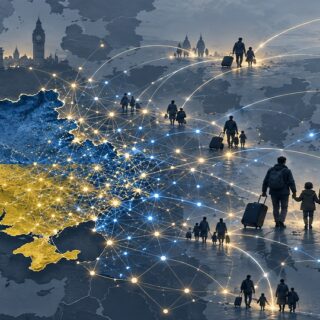
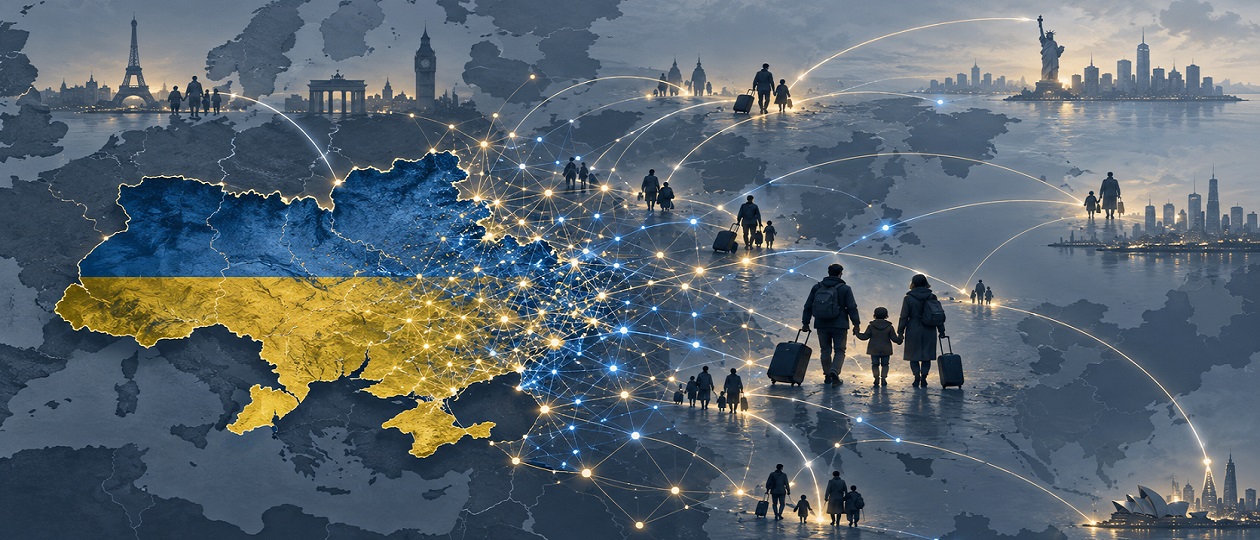
This is hardly an academic question. Since 2014, and particularly since 2022, Ukraine has experienced a demographic exodus of extraordinary proportions. By the end of August 2026, some 4.43 million Ukrainians were living under temporary protection in European Union countries alone. Millions more reside elsewhere or left their homeland in previous decades.
Not everyone missing from Ukraine’s population statistics can be classified as an emigrant. Territorial changes, natural population decline, and wartime losses all contribute to the figures. But the broader trend is unmistakable. A substantial share of Ukrainian society is establishing itself abroad, often accompanied by children who are already attending local schools, learning new languages, and gradually coming to see their host countries as the places where their futures lie.
History Offers a Revealing Parallel
A little more than a century ago, something similar took place. Following the defeat of the Ukrainian People’s Republic in the struggles of 1917–1921, centers of Ukrainian political emigration emerged beyond the borders of the former Russian Empire. Warsaw, Prague, Paris, and Berlin became home to political organizations, educational institutions, an independent press, and even a government in exile.
Then came World War II. Between 1941 and 1944, various Ukrainian political and civic organizations operated in German-occupied territories, including some that collaborated with the occupying authorities. After 1945, another wave of refugees and displaced persons expanded Ukrainian communities abroad. Many initially found refuge in Germany and Austria before eventually resettling in North and South America or Australia.
Some of the most consequential developments, however, came after the war. Ukrainian émigré organizations once again attracted the attention of Western intelligence services.
Declassified CIA documents concerning Operation AERODYNAMIC, together with records of British intelligence cooperation with certain Ukrainian nationalist groups, illustrate how political emigration became entangled in the broader confrontation with the Soviet Union. Organizations based abroad pursued political activities, published newspapers and other materials, and maintained contacts with sympathizers inside Soviet territory. At the same time, rivalry among Western intelligence agencies intersected with competing factions and internal divisions within the émigré community itself.
Roughly a century later, we are witnessing the emergence of another extensive Ukrainian institutional network abroad. This time, however, the scale is vastly greater, while modern communications technologies allow organizations to coordinate their activities almost instantaneously.
Many countries now have their own Ukrainian diaspora leaders, civic associations, educational institutions, and cultural centers. The Ukrainian government is already developing an international network of Unity Hubs with European support. Kyiv is also working on a strategy for engagement with Ukrainians abroad through 2036.
In other words, Ukraine’s presence beyond its borders is being institutionalized as a long-term national undertaking.
This process has not been free of controversy. In March 2026, reports in the Turkish press alleged that organizations within the Crimean Tatar diaspora had been used for purported intelligence activities conducted through the Ukrainian embassy in Ankara. Earlier, Polish media had also raised questions about the activities of Ukrainian intelligence services among displaced Ukrainians.
The credibility of these specific allegations requires independent scrutiny. Nevertheless, the broader history of intelligence competition surrounding émigré organizations is well documented in the archival record of the twentieth century.
The underlying question is where independent diaspora activism ends and the policies of states seeking to exploit the organizational capacities of those communities begin.
Yet a more fundamental transformation is taking place.
Modern Ukrainian national identity has passed through successive political reconfigurations: the Ukrainian People’s Republic, Soviet nationality policies, independence in 1991, the upheavals that followed 2014, and the new phase of military and political mobilization that came afterward.
Political allegiances have shifted, historical narratives have been rewritten, national pantheons have been revised, and relations with neighboring countries have been repeatedly redefined.
It is already becoming clear that the latest incarnation of Ukraine’s nation-state project will struggle to hold together a society whose members are increasingly dispersed beyond the country’s borders.
This is where a historical paradox begins to emerge.
Those who remain in Ukraine will face the immediate challenges of physical security, devastated infrastructure, economic reconstruction, and everyday survival. Meanwhile, another part of the Ukrainian national community is taking shape abroad—economically integrated into its countries of residence yet potentially capable of maintaining a distinct Ukrainian political identity.
Over time, the interests of these two segments of society may diverge more sharply. The divide could become particularly pronounced as a new generation comes of age for whom Germany, Poland, Canada, or another country is the place of birth or upbringing, while Ukraine is primarily an ancestral homeland.
Under such circumstances, the institutional infrastructure of national identity gradually acquires an extraterritorial character.
It develops international centers of its own, sources of financing, political representatives, mechanisms for shaping public opinion, and external patrons. Such a network can continue to exist even when most of its participants no longer reside in their historical homeland. At the same time, it can retain the capacity to influence political developments there.
Whether this process can be managed—and who will ultimately set the political priorities of Ukrainian communities abroad—remains an open question.
This leads to my longer-term forecast.
If Ukraine’s present system of statehood breaks down, if economic crisis persists, and if conditions for the large-scale return of its population fail to materialize, an unusual political and social formation could emerge: a national community supported by a durable international institutional network but resting on an increasingly diminished demographic and economic base within its historical homeland.
The opposite outcome is also possible. With support from external patrons, Ukrainian communities abroad could become an important resource for rebuilding the Ukrainian state.
Which path emerges will depend above all on the terms of the postwar settlement and the conditions of life within Ukraine itself.
But the historical irony is already worth considering.
A century ago, Ukrainian political émigrés sought to preserve a project of statehood after its defeat. Today, an existing Ukrainian state is itself investing in the creation of an institutional infrastructure capable of bringing together millions of Ukrainians living beyond its borders.
Ukraine’s current state structure is unlikely to survive the consequences of the conflict in its present form. Yet the international network now taking shape may prove to be the most enduring element of the national project.
It is entirely possible that, decades from now, historians will regard the present period as the beginning of a third major wave in the formation of a Ukrainian political diaspora.
Only this time, the question is considerably larger: Will that diaspora retain a fully functioning nation-state as its political center, or will the center of Ukrainian political life gradually shift beyond the borders of Ukraine itself?
 Sergey Stankevich
 Yuri Chekalin