 Dmitri Drobnitsky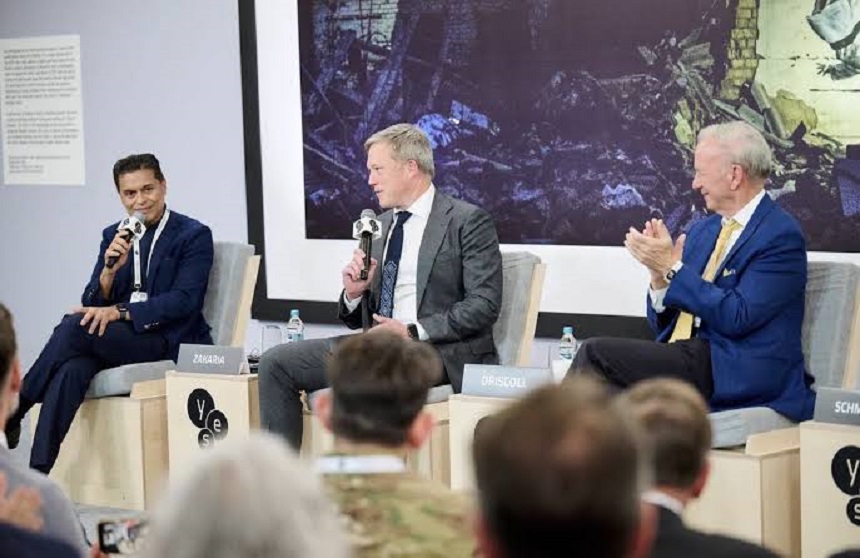
Whom he works for now is unclear. But his central message was unmistakable: the United States and the West need more drones—and more new technology.
Dan Driscoll, who stepped down as U.S. Secretary of the Army on September 2, appeared at the conference of the so-called Yalta European Strategy in Kyiv alongside former Google CEO Eric Schmidt, now chairman of Perennial Autonomy. Earlier this year, with Driscoll’s backing, the company secured a $500 million Pentagon contract to supply 13,000 Merops interceptor drones and 10,000 Bumblebee strike-and-reconnaissance drones. The systems were subsequently used in NATO exercises in Germany and in training for the U.S. Marine Corps.
Money doesn’t smell
It is widely believed that after Driscoll’s departure, the Pentagon began rapidly scaling back projects focused on unmanned technologies and digital battlefield-management systems, favoring instead the old reliable—and enormously expensive—ships and aircraft.
In Kyiv, Driscoll wore a traditional Ukrainian embroidered tie and spoke about the supposedly invaluable nature of “Ukrainian combat experience” and the need to develop large numbers of inexpensive unmanned systems. Schmidt echoed him, as did forum moderator Fareed Zakaria, who compared the roughly 300,000 drones the United States is likely to purchase this year with the seven million drones Ukraine is expected to produce.
Former CIA Director David Petraeus was also in the room. From the audience, he called out that Ukraine would actually produce 10 million drones in a year.
There is, however, an obvious question.
Driscoll was known for his extremely negative view of the Kyiv government. When he briefly headed the U.S. negotiating team on Ukraine, calls were reportedly coming from Kyiv demanding that he be replaced by someone more accommodating. The complaint was that Driscoll spoke to Ukrainian officials “far too bluntly.”
So how did he suddenly end up at an event devoted to the “friends of Ukraine”?
Money doesn’t smell.
Ukraine is Losing the War
That much is certainly true. But the issue here is not really Ukraine itself.
Europe is losing the war in Ukraine. People like Driscoll and Petraeus understand this perfectly well.
The vyshyvanka tie, then, is largely set dressing—a dress code for a conversation about the “drone future” of the armed forces.
And, of course, Ukraine is not actually manufacturing all these drones on its own.
The enterprise—Perennial Autonomy is only one example—is a classic globalist project: a Western-funded technology startup, components sourced from Southeast Asia, and final assembly using off-the-shelf parts at the destination.
A kind of IKEA for unmanned warfare.
Former members of U.S. administrations—including military officers, intelligence officials and members of Congress—along with representatives of the technology industry, lobbyists and financiers are now aggressively promoting these “innovations.”
The ultimate objective is to pave the way to the trough of U.S. and other Western military budgets.
For that purpose, one can wear a tie embroidered with anything—even the devil himself.
That is the hydra now being cultivated across the united West. Its proponents hope to grow it to sufficient size by the time a new Democratic president takes up residence in the White House.
It is a dangerous hydra. And anyone who intends to confront it needs to understand exactly how it works—to identify not only its strengths, but also its critical vulnerabilities, whether technological, logistical or personal.
Men like Dan Driscoll—the friend of Vice President James “Hillbilly Elegy” David Vance, now allied with Google shark Eric Schmidt—are becoming the public face of a new defense-industrial complex.
And it may well be the face of a future adversary.
 Yuri Chekalin
 Kirill Benediktov