 Dmitri Drobnitsky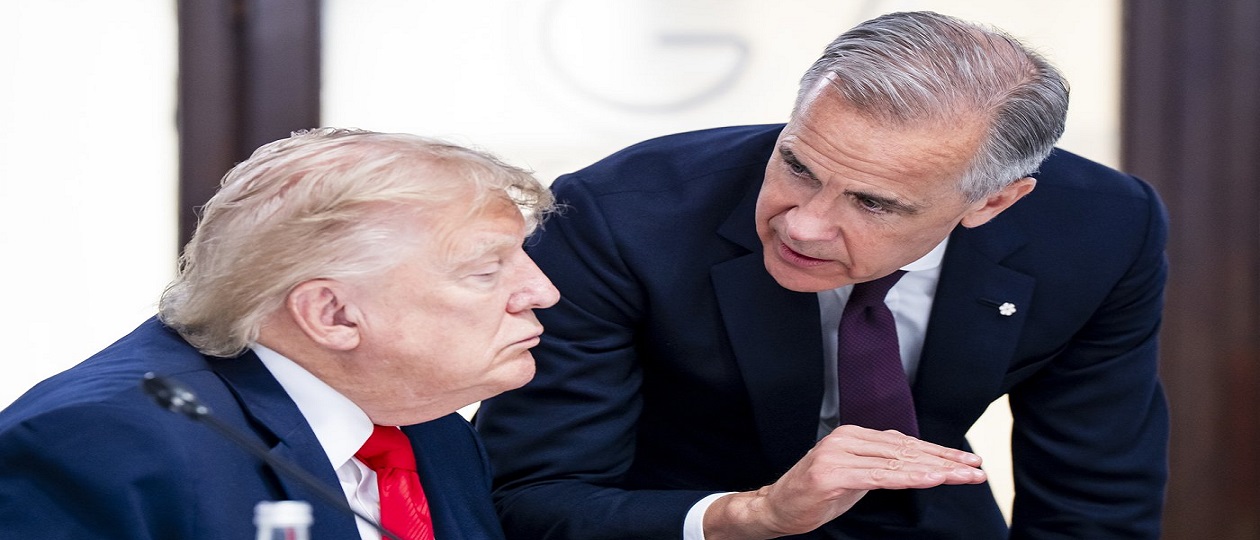
The United States and Canada—Donald Trump and Mark Carney—have failed to agree on new terms for their trade and tariff arrangements. Both sides are now blaming the other.
Mr Trump says Canada is demanding “privileges like those of a US state without actually being one”.
Mr Carney, Canada’s prime minister, argues that the new terms proposed by America are “non-economic and unfair”, and that “the United States is asking for much more than it is giving”.
Both claims contain some truth. But that is not the point.
United States-Mexico-Canada Agreement (USMCA)
Canada is indeed behaving, if viewed through Mr Trump’s particular lens, rather unfairly. It has become an important conduit for goods from South-East Asia entering the American market, with some of those products being re-exported to the United States as Canadian goods.
Yet this was already the case in 2018, when the United States-Mexico-Canada Agreement (USMCA) was negotiated. Mr Trump nevertheless hailed the deal and promoted it as a triumph. He is now changing the rules halfway through the game.
Canada takes the view that its place in the so-called international division of labour gives it the right to re-export, repackage and otherwise handle goods as it sees fit. Mr Trump believes that this division of labour itself needs to be reconsidered. On that question, there is little prospect of Mr Trump and Mr Carney finding common ground.
But the more important issue is political rather than economic.
Mr Trump appears to have concluded that Canada is sufficiently vulnerable for him to extract another “victory”. Mr Carney has decided to stand his ground, evidently believing that Mr Trump himself is now unusually vulnerable.
There is some logic to that calculation. Those who have consistently rejected Mr Trump’s demands and answered them firmly have generally either won or managed to draw.
The president’s power has not disappeared, but the magic of his threats has weakened. He promises much and delivers fewer tangible results, while accumulating a long record of retreats and reversals. More importantly, what Mr Trump says today can quite easily be contradicted by what he says tomorrow—or the day after.
In other words, fewer people around the world take him at his word.
That has disappointed many, since considerable hopes were invested in a Trump presidency. But it has also encouraged a different conclusion: saying “no” to Mr Trump is possible—and may even be the safest strategy if the alternative is to accept ever more damaging terms.
So, more than two years before America’s next presidential election, people are already looking beyond Mr Trump towards his successor.
That would be a mistake.
The latest failure of the US-Canada negotiations is merely one of the more recent indications of why.
 Robert Reich
 Vladimir Golstein
 Paul Sadchikov