 Paul Sadchikov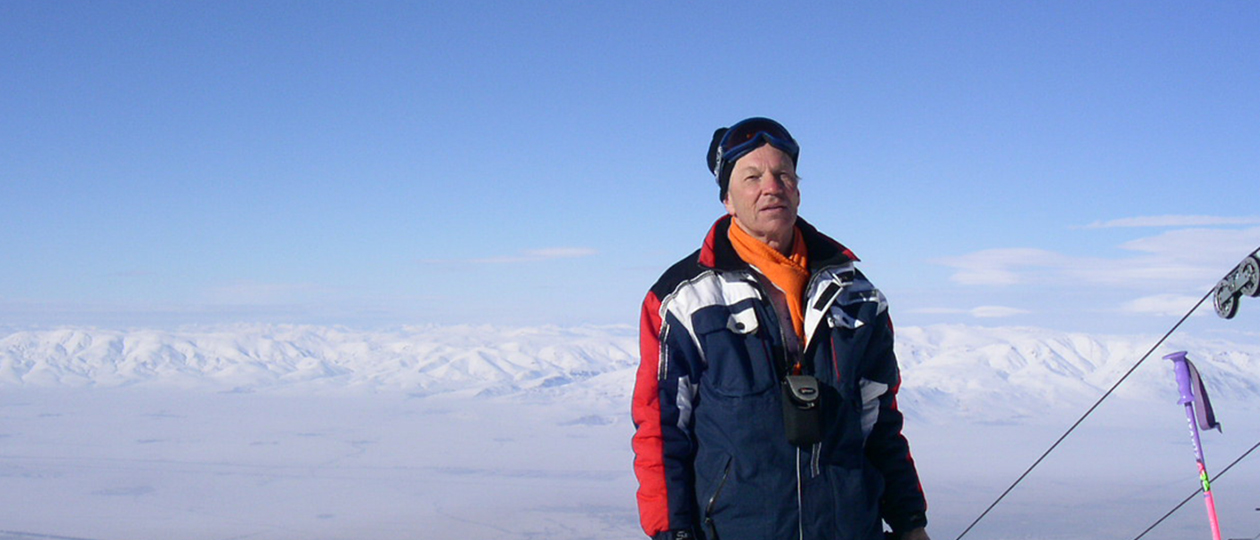
I’m pretty much like everyone else, with one small exception: I collect countries, roads, and people.
Because I’m a traveler.
To me, the ideal traveler is someone with an almost unreasonable sense of curiosity. Someone who doesn’t particularly care whether the next leg of the journey involves walking, driving, sailing, or flying.
What matters is seeing something you’ve never seen before. Going somewhere you’ve never been.
Better yet, somewhere very few people have been.
And if no one has ever been there at all — well, that’s practically irresistible.
I’ve been traveling for a long time, and I’ve done it just about every way you can imagine.
On foot, through mountains and valleys. By kayak and raft, down rivers and across lakes. On wheels, along the roads of my own country and many others.
Looking back, I doubt any of my later — and considerably more ambitious — adventures would have happened without the old Soviet tradition of independent trekking. You learned to plan your own route, organize an expedition, put together a team, judge your strength, and, when necessary, admit that the map was right and you were not.
When I was young, I wandered through mountains and valleys with a backpack and climbed peaks. I have three proper mountain ascents to my name.
But my first big journey on my own came even earlier, in the fall of 1959.
At the time, we were living in Kyrgyzstan, then part of the Soviet Union, while my older sister was working thousands of miles away in Karelia, in Russia’s far north.
So one day I decided to go there.
Why?
To see the Northern Lights.
Naturally.
To accomplish this modest goal, I crossed nearly the entire country and took a job at a logging operation near the Finnish border.
Today, if you want to see the aurora, you book a tour.
Back then, apparently, you got a job.
After that I went to Kaliningrad, where my oldest brother was serving, and then on to Riga, where another brother was working.
That was when I discovered an important principle of travel: relatives scattered across a very large country are an excellent excuse to explore it.
Eventually, my financial situation improved somewhat, and I graduated to a motorcycle.
On that motorcycle I crossed large stretches of the Soviet Union twice. I rode from Moscow all the way to Lake Issyk-Kul in Central Asia, and in 1967 I set off on a motorcycle tour through seven socialist countries.
The expedition was called The Banner of October and marked the 50th anniversary of the Soviet Revolution.
Seven countries, that is, by the geography of the time.
Today, the same route would take me through seventeen independent states. Yugoslavia alone eventually became several different countries.
Apparently geography likes to travel, too.
How I Graduated to a Car
Eventually I decided to improve my financial standing once again.
I had finished graduate school, after all.
So I bought a car.
Naturally, my first one was a Zaporozhets — the small Soviet automobile that taught several generations of drivers both patience and humility.
Later came the legendary VAZ-2101 Zhiguli.
With a car, the world suddenly seemed smaller and the possibilities much larger.
The Soviet Union’s external borders were still largely closed, so most of my driving was within the country itself: ancient Russian towns, far-flung Soviet republics, north and south, east and west across an enormous landmass.
From the cold forests of Karelia and the Baltic coast to the heat of Central Asia.
Back then, it was all one country. Today, many of those same routes cross international borders, and trips that once felt almost domestic have become journeys through separate nations.
But cars were never the whole story.
I flew in hot-air balloons. I explored enormous caves in the North Caucasus that, in those days, were classified, restricted, and very definitely not open to casual visitors. I paddled kayaks and rode rafts down wild spring rivers in the Caucasus and elsewhere.
For a time, I worked as a tour-group escort for Moscow’s Central Bureau of Tourism and Excursions.
And when I decided I wanted to see the Valley of Geysers in Kamchatka, I took the obvious approach: I signed on for the summer as a general laborer with an expedition of volcanologists from the Institute of Physics of the Earth.
That, I think, is one of the basic rules of being a traveler.
If you can’t buy a ticket to somewhere, find another way in.
Traveling by Car Is Better
Still, there’s something special about traveling by car.
Why?
Because everything is with you.
A car is always a little home on wheels, no matter what it happens to be — a tiny Oka, an old Zhiguli, or a proper motorhome.
Of course, the motorhome is better.
There is just one minor technical drawback:
It costs considerably more money.
And if you don’t have it?
No great tragedy.
You get into whatever you happen to have in the garage, start the engine, and go.
Because for a traveler, the car is never really the point.
The road is.
 Kamil Askerkhanov
 Dmitri Drobnitsky