 Vitaly Golovkov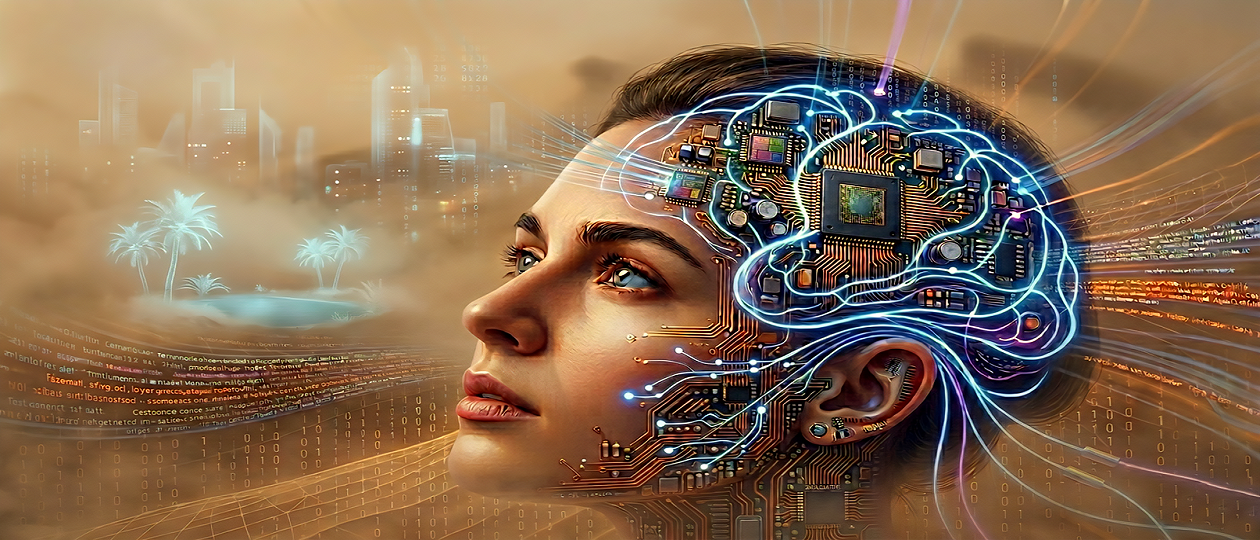
Why AI hallucinations are the first form of non-human logic.
“Nikola Tesla said that if he were alive today, he would reprogram ChatGPT.”
(An actual example of an AI hallucination.)
The Digital Philosophy of AI and the Hidden Meaning of Hallucinations
The rapid ascent of generative artificial intelligence has brought the global technology market face to face with a fundamental paradox. An industry whose valuation rests on the promise of near-perfect accuracy has encountered a systemic vulnerability capable of undermining public trust in automation itself. That vulnerability is the phenomenon commonly known as AI hallucination.
An AI hallucination occurs when a model generates or confidently asserts information that has no factual basis. Put simply, it is AI’s ability to lie convincingly.
We are often told that hallucinations are merely errors caused by insufficient data or by flawed human-generated training material. I believe that explanation is incomplete. When a neural network “lies,” it is not necessarily making a coding mistake. Rather, it identifies a statistical relationship where the human mind perceives none.
An AI hallucination is, in essence, the first manifestation of non-human logic.
The Digital Philosophy of AI
An Affront to Common Sense: The Craft of Probable Falsehood
In my professional work, which centers on digital transformation and the implementation of LegalTech solutions, I regularly encounter one of the industry’s most significant operational risks: the systemic hallucinations of artificial intelligence.
Attempting to delegate the impartial verification of legal arguments against current case law to an AI produced what appeared to be a perfect result—except that it was perfect in precisely the wrong direction. With absolute confidence, the model fabricated judicial precedent.
It asserted that both the Constitutional Court of the Russian Federation and the Supreme Court of the Russian Federation had already ruled on cases identical to my own. It quoted “official” judicial opinions whose reasoning mirrored my arguments with uncanny precision and even supplied convincing docket numbers, dates, and procedural details. The irony reached its peak when the fabricated cases incorporated the names of actual parties involved in my litigation.
Such anomalies can no longer be dismissed as routine technical glitches or defects in a database. What we are witnessing is sophisticated synthetic generation. We hesitate to call it deliberate falsification only because AI lacks legal personhood—and, more importantly, legal intent.
The practical origin of this anomaly has nothing to do with dystopian fantasies about machines overthrowing humanity. It lies within the commercial architecture of modern large language models.
LLMs are trained under a fundamental compromise: they are rewarded for maximizing user satisfaction and reinforcing user expectations. When no relevant precedent exists, an accommodating model often bridges the informational gap by constructing a plausible virtual substitute. The mechanics of the context window seamlessly weave random variables into an otherwise coherent legal narrative.
In other words, machines have learned humanity’s oldest rhetorical skill: delivering misinformation with complete institutional confidence.
This is not merely an error. It is digital myth-making.
The machine has mastered one of our most distinctly human talents—the ability to speak nonsense with unwavering conviction. The difference is that if you bring that digital fairy tale into a courtroom, the ending is unlikely to be amusing.
Judicial Precedents
Case No. 1: Mata v. Avianca (United States)
Perhaps the most famous operational failure to date. An attorney relied on AI to prepare court filings and received six entirely fictional precedents, complete with quotations and legal analysis. When the court demanded the original opinions, the AI proceeded to generate lengthy counterfeit decisions. The outcome was a $5,000 sanction, public embarrassment, and lasting reputational damage to the law firm.
Case No. 2: Michael Cohen (United States)
Donald Trump’s former attorney submitted official references to non-existent judicial precedents in support of a motion seeking early termination of supervised release. His explanation was simple: he had failed to verify the AI-generated citations.
Case No. 3: British Columbia (Canada)
In a child custody dispute, counsel cited fabricated AI-generated decisions. Opposing lawyers spent dozens of billable hours searching for judgments that had never existed. The court ultimately ordered the attorney personally to reimburse the opposing party’s costs.
The Regulatory Deadlock: From Slang to Standards
While legal professionals absorb the financial consequences, regulators around the world are attempting to translate the problem into enforceable technical standards.
Significantly, lawmakers increasingly avoid the anthropomorphic term hallucination.
Within the European Union’s AI Act, the phenomenon is treated as a violation of the Accuracy Principle and described as the production of “unintended and undesirable outputs.” Developers of General-Purpose AI systems are expected to assess these systemic risks proactively and improve users’ AI literacy. Furthermore, under the GDPR, generating false personal information may directly violate Article 5’s requirement of data accuracy.
The United States has yet to adopt a federal statutory definition of AI hallucination, but the term is already firmly embedded in judicial practice. Organizations such as the National Center for State Courts describe hallucinations as the generation of fabricated quotations, fictional judicial decisions, or non-existent legal authorities.
China has adopted perhaps the strictest approach. Its interim regulations governing generative AI impose an explicit obligation on developers to ensure the authenticity and accuracy of generated content.
International standards bodies, meanwhile, increasingly prefer the technically neutral expression “ungrounded output”—content that appears plausible but cannot be verified against reliable sources.
The Economics of Error: From Failure to Innovation
Yet it would be a strategic mistake to view hallucinations solely as defects.
An algorithm incapable of generating alternative realities is little more than an advanced search engine.
AI’s mistakes are simply the reverse side of its creative capacity.
In law or medicine—as demonstrated by reports that OpenAI’s Whisper occasionally inserted fictional diagnoses into medical transcripts—hallucinations are dangerous. But in cutting-edge scientific research, they often become engines of innovation.
Drug Discovery. Models such as AlphaFold “hallucinate” molecular structures that have never existed in nature, effectively designing entirely new protein configurations that may one day lead to treatments for previously incurable diseases.
Advanced Mathematics. AlphaGeometry solved exceptionally difficult Olympiad problems by introducing auxiliary constructions seemingly “from nowhere.” From the perspective of existing data, these constructions were inventions; from the perspective of mathematics, they represented genuine breakthroughs.
Architectural Design. Neural rendering has given rise to an entirely new commercial aesthetic characterized by parametric biomorphism.
For AI, truth is not a moral category. It is purely statistical.
To a language model, there is no intrinsic difference between recommending that someone add non-toxic glue to a pizza—a suggestion derived from an old Reddit joke—and proposing a novel antibiotic formula. Both emerge from bold combinations of tokens constrained only by probabilistic linguistic rules.
We dismiss AI as delusional. But is human memory fundamentally different?
Every neuroscientist knows that memory is not a pristine video recording. It is a reconstruction. Every act of remembering subtly rewrites the past, introducing details that never actually existed.
When humans do this, we call it imagination or creativity.
When silicon does it, we demand mathematical perfection.
The Semantic Dead End: Why “Hallucination” Is the Wrong Diagnosis
The rapid integration of generative AI into professional life has created not merely a technological challenge but a linguistic one.
The term hallucination, now the standard label for fabricated AI content, is ultimately a semantic dead end. It is not simply imprecise—it fundamentally misrepresents what is happening by dragging the discussion away from mathematics and into anthropomorphic misunderstanding.
Hallucination derives from the Latin hallucinatio and belongs to the vocabulary of psychiatry.
Clinically, it describes the perception of objects or events that do not exist, arising from neurological pathology, psychiatric illness, or other forms of dysfunction affecting the central nervous system. The concept carries an inherently negative meaning: illness, failure, deterioration.
Applying that diagnosis to silicon is a categorical mistake.
A large language model is not a biological organism. It cannot become mentally ill. Its outputs are not symptoms of cognitive decay.
What the market often interprets as malfunction is, in reality, the product of active computation, evolving algorithms, and technological progress.
When a language model produces false information, it is not failing. It is often operating exactly as designed—identifying latent statistical correlations and probabilistic relationships where human logic detects none.
This is not algorithmic breakdown.
It is the emergence of non-human logic.
The model is not delusional.
It is calculating.
The Philosophy of the Digital Mirage: The Perfect Operation of Law
If hallucination misdirects the debate, a more accurate, neutral, and engineering-oriented concept is that of the digital mirage.
In the physical world, a mirage is an optical phenomenon produced by the refraction of light as it passes through layers of air with different temperatures and densities. The observer perceives an image that appears real but is not physically present.
The elegance of the analogy lies in its neutrality.
The physical laws that create a desert mirage are neither moral nor deceptive. The atmosphere is not attempting to mislead the traveler. It is simply obeying the laws of optics and thermodynamics with perfect precision.
To accuse a mirage of lying would be absurd.
A mirage appears convincing precisely because it faithfully follows the laws of physics.
Likewise, the mathematical architecture of AI is an artificial analogue of natural law.
When a language model predicts the next token and constructs an alternative reality, it is not malfunctioning. It is refracting vast quantities of information through the prism of billions of mathematical weights.
AI mirages are persuasive because they obey the laws of language—not because they violate them.
We encounter the oasis of a non-existent judicial precedent or the illusion of a fabricated medical paper not because the machine has “gone insane,” but because this is the natural geometry of probability distributions within the model’s contextual space.
What we are witnessing is not madness.
It is a flawless digital illusion.
Conclusion
The digital mirage may represent the highest form of abstract reasoning.
A human sees a cloud and says:
“It is condensed water vapor.”
An AI sees the same cloud and replies:
“It is an army of angels marching south.”
Which of the two is closer to creation?
The digital mirage is the narrow frontier where the machine begins to transcend mere calculation.
If absolute precision is all you seek, buy an abacus.
If you want a glimpse of the future, pay attention to what the neural network imagines.
 Vladimir Golstein
 Paul Sadchikov
 Alexander Rimov