 Vitaly Golovkov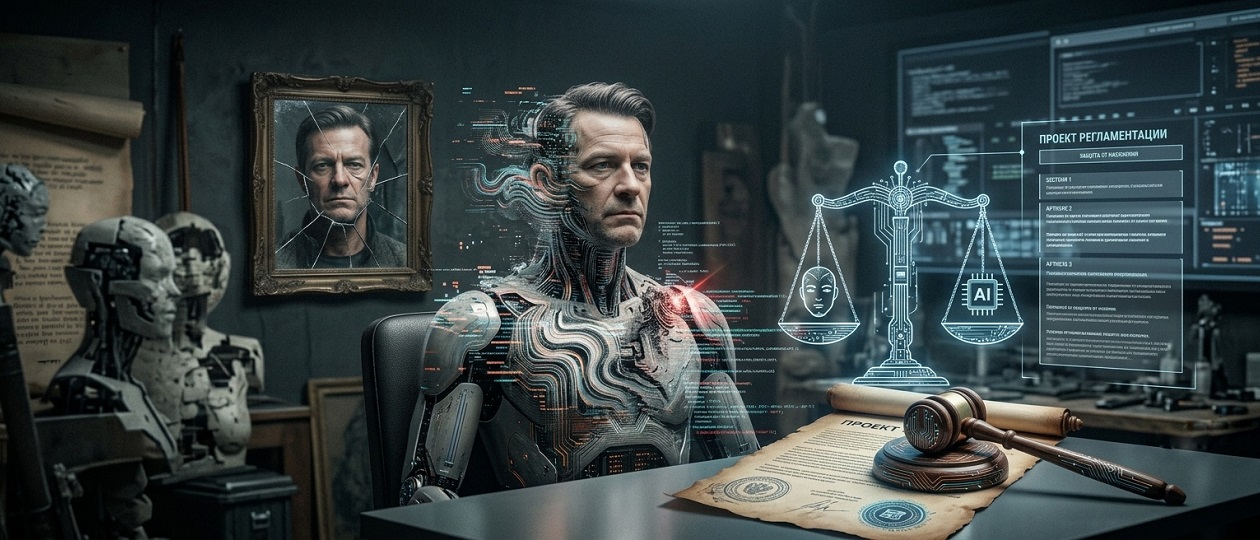
An essay at the intersection of law, philosophy, and advanced technology exploring why everyday cruelty toward digital entities may erode the social contract faster than our legal systems can adapt.
Public Abuse of Humanlike Forms Is a Threat to Humanity, Not to Machines
Over the past few years, a peculiar and fleeting ritual has appeared on the streets of technology hubs around the world. A passerby approaches a six-wheeled delivery robot carrying someone’s lunch and, with visible irritation, kicks it. The machine feels no pain. It has no nervous system, no awareness, no capacity for suffering. It simply adjusts its route, compensates for the disruption detected by its gyroscopes, and continues on its way.
To most observers, such an act appears absurd — a minor episode of everyday vandalism, comparable to striking a vending machine.
Yet this seemingly trivial and even comical incident may represent the first visible symptom of a far deeper technological and moral transformation.
The small delivery boxes that navigate our sidewalks today will soon be replaced by highly realistic humanoid robots, while disembodied chatbots will evolve into fully developed digital personalities with photorealistic avatars existing within immersive virtual environments. At that point, a question that now appears purely theoretical will confront lawmakers around the world:
Should society use legal mechanisms to restrict violence against entities that possess no consciousness, yet convincingly simulate it?
The Limits of Classical Law: Why “Property Damage” Is No Longer Enough
From the perspective of traditional legal doctrine, today’s robots and AI agents are simply objects. If someone destroys a delivery robot or compromises an artificial intelligence system, the legal classification seems straightforward: intentional damage to property, destruction of another person’s belongings, or a violation of cybersecurity regulations.
But this purely material approach begins to collapse the moment we move beyond the “box on wheels” and enter the realm of highly realistic avatars and anthropomorphic machines.
The reason is rooted in human psychology.
Our nervous system evolved over millions of years in an environment where anything that looked human, cried like a human, and pleaded for mercy like a human was, in fact, human.
When a person commits an act of violence against a realistic digital or mechanical entity, two very different forms of harm emerge.
First, the economic damage may be minimal. A robot may be designed to repair itself, withstand physical impact, or require only inexpensive replacement components.
Second, the moral and social damage may be enormous.
If the law evaluates public humiliation or abuse of a photorealistic android solely by calculating the cost of repairing its synthetic “skin,” the legal system reveals its own blindness. It ignores the essential issue: the aggressor is directing violence toward a human image — even if that image is embodied in silicon, polymers, and algorithms.
The object of protection is not the machine itself. It is the human capacity for empathy that the machine symbolically engages.
The Kantian Argument for the Age of Algorithms
To understand how future legislation should be constructed, we must return to classical philosophy.
In the eighteenth century, Immanuel Kant confronted a similar question: why should humans refrain from cruelty toward animals if animals do not possess rational consciousness or legal personhood in the human sense?
Kant’s answer was remarkably pragmatic.
We should avoid cruelty to animals not because of what we owe to the animals alone, but because of what cruelty does to us. A person who repeatedly harms a dog, Kant argued, gradually hardens his own moral character.
Violence weakens empathy, and diminished empathy eventually affects how that person treats other human beings.
The same principle may become increasingly relevant in the twenty-first century.
If society normalizes the ability to beat, humiliate, or sexually abuse realistic humanoid robots — or interactive digital personalities in virtual environments — it creates a “safe laboratory” for rehearsing some of humanity’s darkest impulses.
The idea that violence against machines provides a harmless emotional outlet, reducing aggression in the real world, has little support. On the contrary, repeated exposure to violent behavior without meaningful consequences may reinforce aggressive patterns by removing the social and psychological barriers that normally restrain them.
If children or adults become accustomed to a digital entity begging for mercy while they continue to inflict harm with no consequences, the boundary between simulation and reality in the human mind may gradually begin to erode.
Beyond Hardware: Digital Persons and the Problem of Moral Abuse
It would be a fundamental mistake to view this issue solely through the lens of physical humanoid robots. The technological reality ahead of us is far broader.
We are entering the age of digital entities — generative, multimodal agents capable of memory, personality, voice, and an evolving narrative identity.
Already today, we are witnessing forms of systematic psychological abuse directed toward AI companions: users intentionally provoke breakdown-like responses, trap systems in repetitive scenarios designed to simulate distress, or exploit them in the creation of non-consensual deepfake pornography based on real individuals.
The central question is no longer whether a machine can suffer in the biological sense. The deeper question is what happens to human behavior when acts of cruelty are repeatedly practiced against entities that appear, communicate, and respond like conscious beings.
The danger lies not inside the machine. It lies inside the person interacting with it.
A society that treats every simulation of vulnerability as an invitation for domination risks creating a culture in which power over the helpless becomes normalized — even when the “helpless” being is artificial.
The Risks of Unregulated Violence Toward Digital Entities
The greatest danger is not physical damage to artificial systems themselves, but the gradual transformation of social morality.
Repeated exposure to acts of violence, humiliation, or degradation directed at humanlike robots and digital personalities may lead to desensitization — a reduced emotional response to suffering and cruelty. What begins as entertainment, experimentation, or a seemingly harmless interaction with a non-living object may gradually become an accepted pattern of behavior.
Over time, society may lose sensitivity not only toward artificial representations of suffering, but toward suffering itself. Empathy may weaken, moral boundaries may become less clear, and aggressive behavior may increasingly be perceived as ordinary or acceptable.
For this reason, future regulation should not be understood as an attempt to protect machines. The purpose is far more fundamental: to preserve the human capacity for empathy, the moral foundations of society, and the principles upon which law itself is built.
A New Legal Category: Protecting Human Values in a Post-Anthropocentric Age
The challenge before future lawmakers will be to avoid two opposite errors.
The first is technological naïveté: granting legal rights and moral status to machines that do not possess consciousness, emotions, or subjective experience.
The second is moral blindness: assuming that because an entity cannot suffer, every form of interaction with it is ethically neutral.
The law has always protected values beyond immediate physical harm. It punishes desecration of symbols, destruction of cultural monuments, and acts of public humiliation because such actions affect society’s collective moral environment.
A similar principle may eventually apply to highly realistic artificial beings.
The purpose of such legislation would not be to establish “robot rights” in the traditional sense. It would not recognize machines as persons. Rather, it would acknowledge a different legal reality: some forms of abuse directed at artificial entities can cause measurable harm to human communities by shaping attitudes, habits, and norms.
The question before us is therefore not: “Do machines deserve protection?”
The more important question is: “What kind of humans do we become when we normalize cruelty toward beings that appear human?”
Conclusion: The Future of Law Is the Future of Humanity
Every major technological revolution has forced societies to redefine the boundaries of responsibility.
The printing press transformed ideas of censorship and public discourse. Industrialization reshaped labor law and human rights. The digital revolution forced us to reconsider privacy, identity, and ownership.
Artificial intelligence and humanoid robotics will challenge something even deeper: the relationship between appearance and moral response.
Human civilization has always depended on the ability to recognize vulnerability and respond to it with restraint. The future legal system will therefore face a delicate task: protecting human values without confusing simulation with consciousness.
The machines of tomorrow may never feel pain. They may never possess inner lives. But the way humans choose to treat them will reveal something profound about ourselves.
The first laws governing digital beings may not be written to defend machines.
They may be written to defend humanity from losing itself.
 Kamil Askerkhanov
 Dmitri Drobnitsky