 Yuri Chekalin
The rain went on all week
It didn’t come down in sheets. It hung in the air, blurring the signs and turning people into ghosts.
I went to work and explained to managers the difference between the Present Perfect and the Past Simple. One describes something that’s over but still matters. The other describes something that’s simply over. I used to think this was grammar.
I came home later than usual. I peered into the alleys of Nakano, as though another bar might be hiding somewhere. The alleys were just alleys: a garage, a vending machine, somebody’s wet bicycle parking area. In the evenings I cooked rice, turned on the television, and didn’t watch it.
I thought about Yuki. And about the cat, which was the stupidest part. I’m forty-three years old. I have a degree, a mortgage, and a swimming pool membership, and I miss a cat.
Sometimes I thought about my shoes. About standing at the door, holding them in my hands and looking at Yuki’s black shoes. At the time, I thought I was being sensible. I wasn’t so sure anymore.
I could go back. Nothing was stopping me. Except common sense, which over the past two years had become my most reliable conversational partner. It advised me to leave things as they were.
I took its advice
On Monday.
On Tuesday, too.
By Saturday, we had practically stopped speaking.
On Sunday, I couldn’t stand it any longer. I boarded an express train and rode it to the end of the line. The trip took almost two hours. Outside the window there were houses at first, then fields, then something in between that could only be described as not quite a city.
A light rain was falling.
The station turned out to be perfectly ordinary: a ticket office, a kiosk, a pharmacy, a flower shop, a café with plastic tables. There were no shutters.
I found the alley quickly. It was a passage between the pharmacy and a laundromat, barely wide enough for two people. At the far end stood a vending machine selling hot tea.
It was glowing
I stood in front of the machine as though it might explain something to me. It explained nothing. It didn’t even offer me a free cup of tea.
I asked at the kiosk. The clerk bowed politely and said there were no bars near the station and never had been. The woman at the flower shop confirmed it: people around here weren’t in the habit of drinking near the trains.
An old man feeding pigeons beneath an awning took the longest to think about it.
“If there were a bar, I’d know. I’ve been sitting here for sixty years.”
“What about a cat? A big black one.”
“Plenty of cats around. Only one black one, though. On the next street, near the butcher shop. Very bad-tempered.”
I thanked the old man and headed for the butcher shop.
Under the canvas awning of the closed shop sat a black cat.
I came closer. The cat was sitting exactly as he had on the barstool—calmly, as though he’d been waiting for me all along. His yellow eyes looked straight into mine. Something tightened in my chest. Not fear, but a strange, almost embarrassing sense of relief.
“Iroha,” I said.
The cat blinked. Then turned away and began meticulously washing his hind leg.
I waited. For some reason, it never occurred to me to hurry him.
When he had finished his grooming, Iroha stood up, arched his back, and set off along the wall at a leisurely pace. After a few steps, he glanced back at me with the expression of someone who had already managed to mess something up.
I followed him
Two turns later, past the laundromat and the wet bicycles, he stopped in front of a narrow passage. Where a minute earlier there had been a blank fence, the familiar lilac-colored neon now glowed faintly.
I froze.
Iroha sat down, looked at the sign, then at me, and gave a short meow. In that same deep, smoke-roughened bass.
I assumed he was demanding gratitude. Unfortunately, I hadn’t brought any tuna.
The bar door stood slightly ajar.
I suddenly realized how terrified I’d been that this time there would be nothing there.
I took off my shoes before I even crossed the threshold.
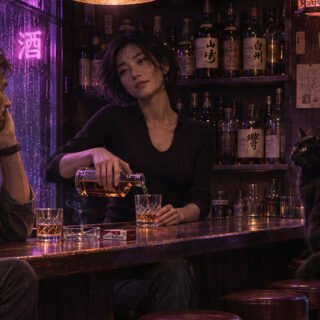
Inside, the smell was the same—old wood and burnt coffee. The same six barstools, the same shelf of bottles without labels. A record was spinning in the corner.
Yuki sat behind the counter, barefoot, wearing the same dark sweater. A glass stood in front of her, with an empty tumbler beside it.
She looked up and smiled a little.
“You’re back”
“The train was late again,” I said. “Or maybe I was.”
Iroha jumped onto the neighboring barstool, curled up, and closed his eyes. But the tip of his tail kept moving. Apparently, the presence of an audience obliged him to at least pretend to be interested.
Yuki poured whiskey. Without asking.
“Last time, you could have stayed,” she said.
“I could have.”
“Why did you leave?”
“I was afraid I’d have to leave alone afterward.”
She looked at me more closely.
“And now?”
“I’m still afraid”
Yuki lowered her eyes to her glass.
“Then why did you come back?”
“Good question. I’ve been asking myself that all week.”
“And what did you decide?”
“That I could have spent the week asking myself something more interesting.”
She laughed. Quietly, but with complete sincerity.
Iroha opened one eye. Having established that nobody was laughing at him, he closed it again.
“This time I know what I want,” I said.
“Home?”
“No. Here. Or with you. Just so I don’t have to wait alone”
Yuki said nothing. She looked at me for a while, then picked up the empty glass from the counter and began polishing it with a napkin.
I recognized that glass. At least I wanted to believe I did.
“What if it doesn’t work out?” she asked.
“What doesn’t?”
“Whatever you’re hoping for.”
I looked at Iroha. He was asleep, leaving us to sort out our human problems for ourselves.
“Then at least I’ll have something to remember,” I said.
Yuki put the glass down on the counter. Then, quite suddenly, she climbed off her stool and came over to me.
She stopped very close. Her bare feet made almost no sound on the wooden floor.
“I’m tired of waiting, too,” she said. “I just never knew how to stop.”
I took out a cigarette and offered it to her. Yuki took it, brought it to her lips, breathed in the scent of the tobacco, and handed it back without lighting it.
“And now you do?” I asked
“I don’t know.”
She turned away and looked toward the door.
By the threshold stood her black shoes. The same ones beside which I’d stood a week earlier, holding my own shoes and unable to make myself put them on.
Yuki walked over to them and stopped.
I didn’t move. Suddenly, it seemed to me that any words would be unnecessary.
She bent down, picked up her shoes, and looked at them for several seconds.
Iroha raised his head.
“Let’s go,” Yuki said. “While the light is still on.”
I put my shoes on.
Iroha jumped down from his stool and escorted us to the door. First he rubbed against Yuki’s leg, then against mine. He looked at the door, at us, and gave a short meow.
I decided he was saying goodbye. Though it would have been just like him to be demanding dinner.
We stepped outside
When I looked back, the lilac-colored sign was still glowing.
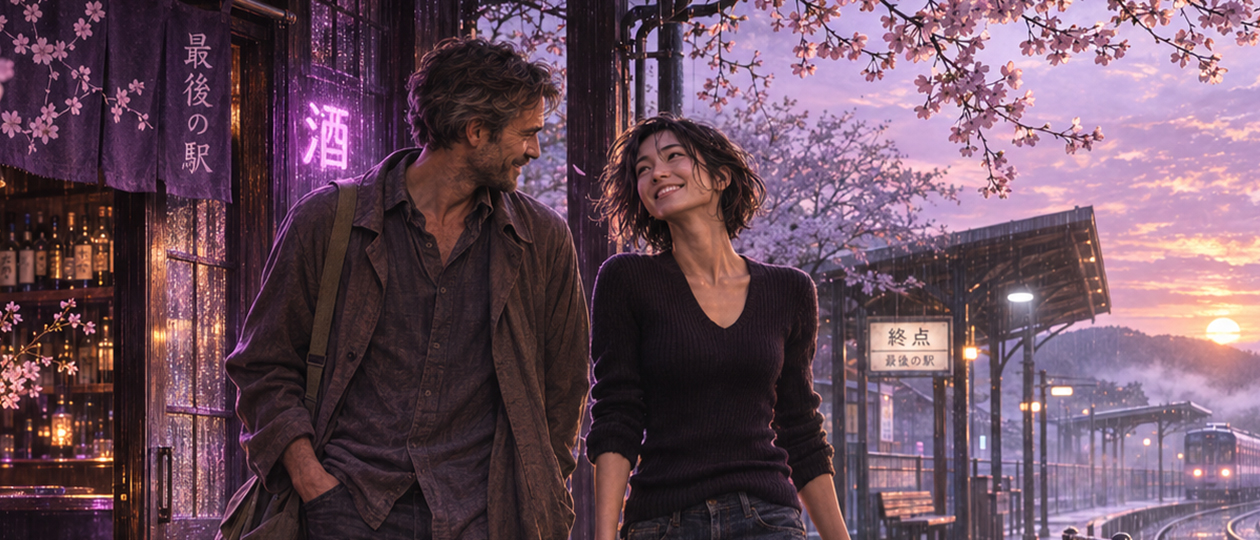
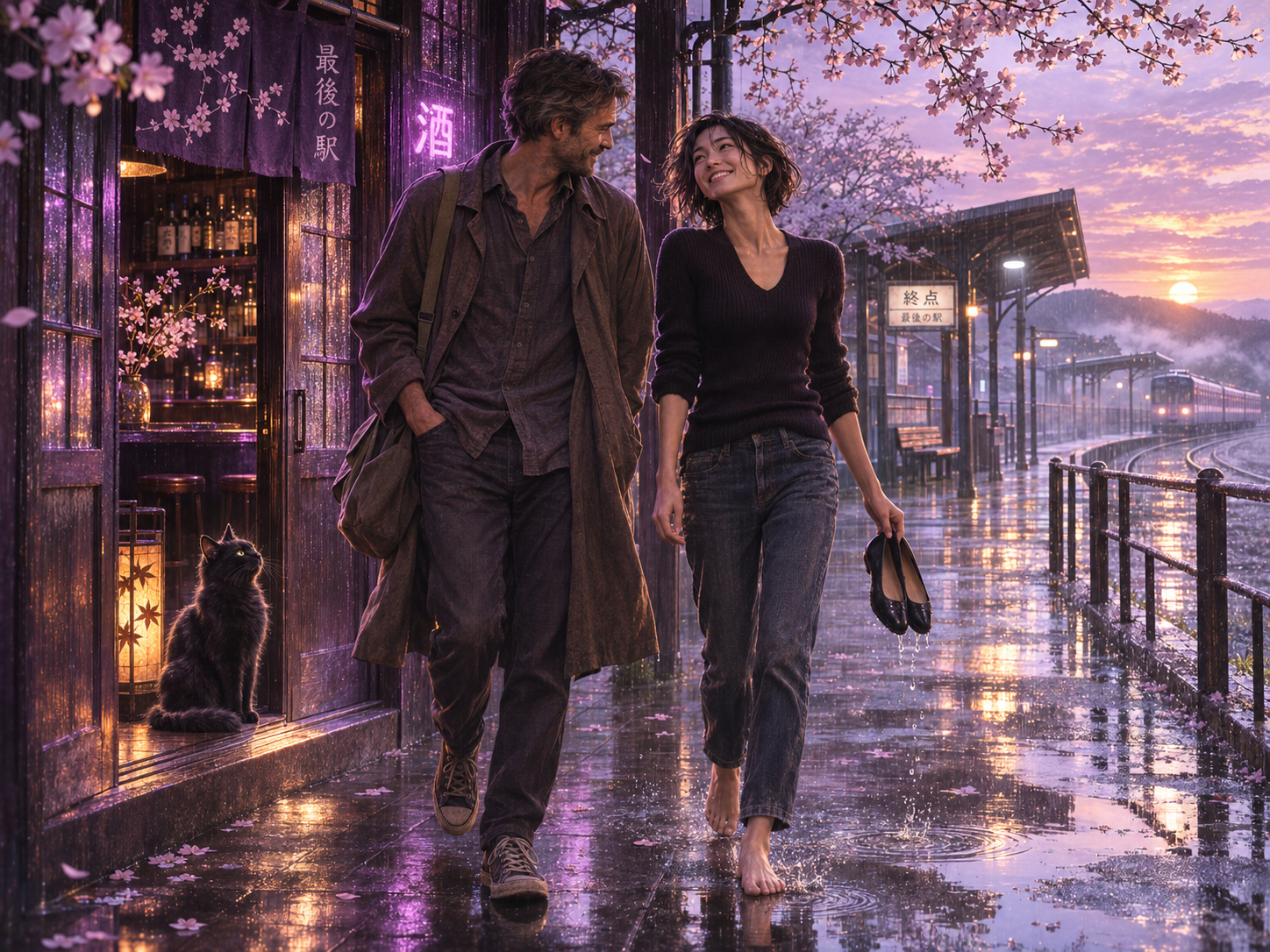
Outside, the rain had almost stopped. We walked side by side along the wet alley. Yuki carried her shoes in one hand and walked barefoot, paying little attention to the puddles.
At the first one, she stopped as though considering her options. Then she stepped right into the middle of it. Water splashed onto her jeans. Yuki laughed.
“Isn’t it cold?” I asked.
“A little. But it’s all right. It’s a living kind of cold.”
She took a few more steps, carefully placing her bare feet on the wet pavement. Then she suddenly stopped and looked at me.
“Are you always this serious?”
“No. Sometimes I’m asleep.”
She laughed again
At the station, we sat on a bench under the awning. Yuki rested her head against my shoulder—tentatively, as though testing whether she was allowed to. I moved a little closer.
“What about the cat?” I asked.
“He’ll stay. He likes it here. And we can try going farther.”
“Won’t he be offended?”
“Iroha? Only if we forget to send him tuna.”
I looked at her. She was smiling, and there was none of the old weariness in her smile.
The train arrived on time. Yuki put on her shoes, and we boarded an almost empty car.
Outside the window, wet fields slipped past, then houses, then fields again. Yuki watched everything with such interest that she might have been seeing it all for the first time. Every now and then she turned toward me and smiled.
I smiled back. I was already trying to figure out where we might go the following weekend. Apparently, something had gone wrong with my system of short-term planning.
When they announced Nakano, Yuki was the first to stand up.
“Is this our stop?”
“Yes. We’re here.”
“So this isn’t the last stop?”
“I hope not”
In Nakano, the rain had stopped.
I unlocked the apartment door, took off my shoes, and let Yuki go in first.
The hallway light was on.
Yuki stopped and looked at it.
“The same one?” she asked.
“The same one.”
She took off her shoes and placed them beside mine.
I closed the door
 Kamil Askerkhanov
 Vladimir Golstein