 Yuri Chekalin
The rain had not stopped in Tokyo for four days.
It did not fall in sheets. It simply hung in the air—a fine, sticky mist that blurred the neon signs of Shibuya and turned pedestrians beneath transparent umbrellas into slow-moving, sexless half-ghosts. In weather like this, the city lost its depth. It became flat, like an unfinished sketch.
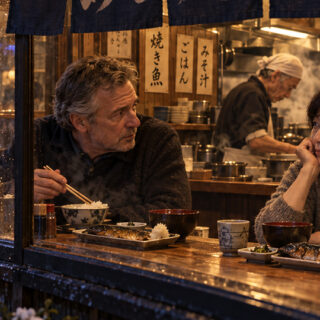
I went down into a semi-basement bar in a working-class part of town. The air was thick with the smell of old wood, dampness, and burnt coffee. Behind the counter, an old bartender with the face of a man exhausted beyond death played the same record over and over again. The needle hissed against the vinyl as though trying to force its way through the thickness of time, only to collide with its own memory.
She appeared without the bell above the door making a sound.
The space beside me simply changed its density, and I realized someone was sitting on the stool next to mine.
She wore an oversized sweater of coarse, dark wool. Her hair was short and disheveled, as if she had just crawled out of some narrow, lightless passage. But it was her eyes that mattered.
Clear. Amber-honey.
Without a single dark fleck in them.
They reflected none of the light from the lamps. It seemed instead that they gave off a faint phosphorescent warmth of their own.
“Do you have a spare cigarette?” she asked.
Her voice was dry and brittle, as though it had not been used for a long time.
I took a Marlboro from the pack.
She did not light it.
She held it between two fingers, brought it to her lips, slowly drew in the smell of tobacco, and placed it on the counter.
“You don’t smoke?” I asked.
“I like to think that inside this paper, the smoke of another year has been trapped,” she said without looking at me. “Satoru, have you ever noticed how many wires there are in this city? They stretch between rooftops like strings. And if you listen for too long to the electricity running through them, you can forget who you really are.”
I did not ask how she knew my name.
There was nothing mystical in the way she said it. It sounded more like a strange and perfectly natural fact—something one did not argue with.
“And what’s your name?”
She leaned forward slightly and shifted her weight from one elbow to the other. The movement was so fluid, so entirely free of human awkwardness, that for a moment I forgot to breathe.
“People always want to know your name. If you like, you can simply call me Cat.”
The next day, she was gone.
Not the day after that. Not a week later.
When I asked about her, the bartender merely polished a crystal glass with a rag and looked straight through me.
“A lot of people come through here,” he said. “Most of them never come back.”
But a month later, she was in my apartment.
I don’t remember how she got in.
One evening, I came out of the bathroom and found her sitting on the windowsill. Her bare feet were tucked beneath her as she watched the Tokyo rain sink into the wires and twilight over Nakano.
That was how two years, cut out of time, began.
We lived on the fifth floor of an old building marked for demolition. There was almost nothing in the apartment: a mattress, a low table, stacks of yellowing books, and an open window.
She always kept it open.
Even during the January storms, when an icy wind carried the smell of salt and wet concrete from the direction of Roppongi.
Her presence did not crowd the room. If anything, it seemed to make the space around her thinner.
Objects lost their weight when she was near.
She could spend hours lying on the floor, watching dust drift through a shaft of light, or tracing invisible shapes on the dusty windowpane with her finger.
Sometimes, while she slept, I had the strange impression that her breathing did not follow the rhythm of a human heart.
It was too infrequent.
Too deep.
She never spoke about what had come before.
“The past is a dry well, Satoru,” she told me once, gently running her fingers through my hair. “You can stare into the darkness at the bottom for as long as you like. You still won’t find anything there. There’s no reason to look.”
And then she disappeared.
It happened in the middle of April.
There were no scenes. No explanation. No obvious trace that another person had ever lived there.
Only her dark sweater was gone, along with a few small things.
On the kitchen table, she had left a key and a cigarette.
The same cigarette from the bar.
At first, there was only a deafening silence.
I did not search for her through addresses or acquaintances. She had neither.
I searched for her in the geometry of the city.
I climbed onto flat rooftops where the wind from the bay smelled of old wells. I descended into forgotten alleys and stared into the narrow gaps between buildings. I walked through parks at night, where dry grass whispered in the darkness.
I became a man searching for the very possibility that she had ever existed.
Three years passed.
The pain subsided, becoming something smooth, cold, and transparent.
One autumn evening, beneath the same endless Tokyo rain, I was walking past a closed station in Nakano when I saw a black cat sitting beneath the canvas awning of a shuttered shop.
It was a compact, rain-soaked knot of black fur, trembling from the cold.
I stopped.
The cat raised its head.
Its eyes were amber.
Absolutely, unbearably amber.
It looked at me without fear and without recognition.
The way mountains look at passing trains.
I crouched down directly into a puddle. My jeans were soaked at once.
“Is that you?” I asked quietly.
The cat did not answer.
It merely blinked slowly, then stood, stretched, arching its back into a perfect curve, and walked unhurriedly into the darkness of an alley winding between the blank walls of warehouses.
I did not follow.
I stood in the rain and watched its dark silhouette dissolve into the dampness of the night.
And at that moment—for the first time in three years—I felt a deep and even peace.
She had never been mine.
She belonged to the rain, to the wires overhead, to the silence of the night, and to the dry bottom of time.
I returned to my apartment.
I opened the window wide and let the damp wind rush into the room.
Then I picked up the cigarette—the dry, brittle cigarette I had kept for three years like an anchor—and dropped it into the wastebasket.
Outside, Tokyo went on murmuring.
Millions of wires hummed in the darkness, carrying other people’s words, other people’s names, other people’s memories.
But I no longer needed to listen.
I simply closed my eyes and let the rain fill all the space that remained.
 Kamil Askerkhanov
 Kirill Benediktov