 Alexander Rimov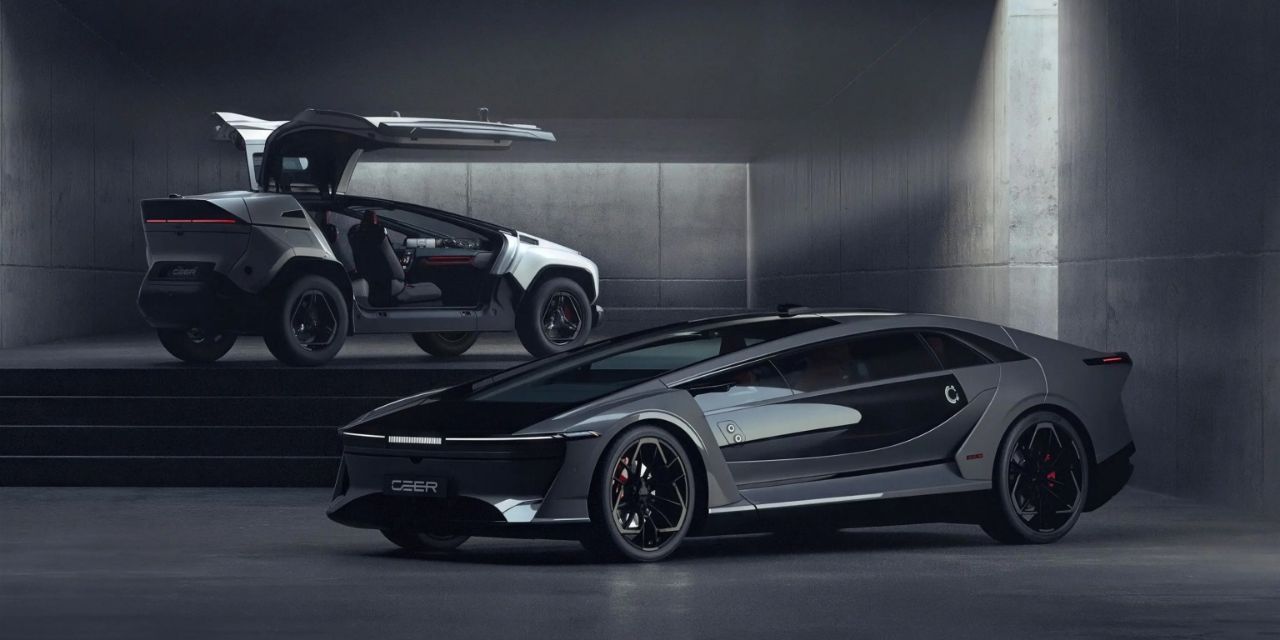
For decades, Saudi Arabia’s industrial identity has been inseparable from oil.
Now the kingdom wants to add automobiles to the list — and rather than begin with a cautious family sedan, its first homegrown car brand has produced something that looks as though it drove out of a science-fiction film.
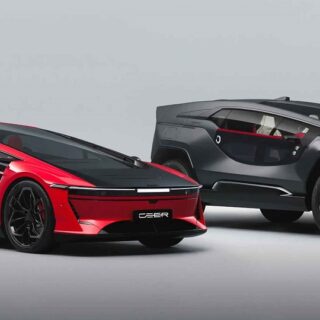
On September 21, 2026, Saudi automaker Ceer unveiled the Exobot, a pair of flagship electric vehicles offered as a sedan and an SUV.
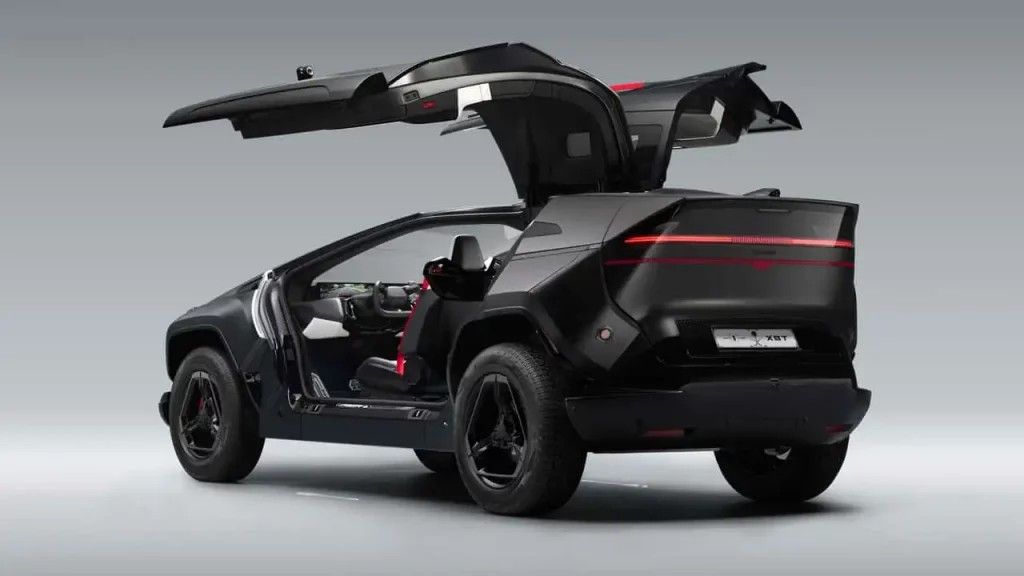
Their wedge-shaped bodies, enormous upward-opening doors, expansive glass surfaces and screen-heavy cabins immediately invited comparisons with the Tesla Cybertruck and cyberpunk design. The Verge went so far as to suggest that the Exobot makes the Cybertruck look almost conventional. (The Verge)
Yet the Exobot matters for reasons that go well beyond styling. It is the most visible product yet of Saudi Arabia’s effort to build a domestic automotive industry — one that encompasses vehicle engineering, manufacturing, suppliers and, eventually, exports.
A Car Company Built for Vision 2030
Ceer was created in 2022 as a joint venture between Saudi Arabia’s Public Investment Fund, or PIF, and Taiwan’s Foxconn. BMW supplies licensed component technology, while Foxconn contributes expertise in electrical and electronic architecture. The project sits squarely within Vision 2030, Riyadh’s broader effort to diversify the Saudi economy beyond hydrocarbons. (Public Investment Fund)
The distinction matters: the Exobot is not literally the first automobile to be assembled in Saudi Arabia. Lucid Motors, another PIF-backed company, opened an advanced vehicle manufacturing facility in King Abdullah Economic City in 2023. Ceer’s significance is different. It is Saudi Arabia’s first national automotive brand and OEM, developing vehicles under its own name. (Public Investment Fund)
Design is led by Rob Melville, the former McLaren design chief whose résumé includes work on the P1 and 720S. According to Autocar, Crown Prince Mohammed bin Salman personally pushed Ceer’s designers away from conventional proposals and toward something far more radical. (Autocar)
Cyberpunk With a Saudi Accent
The result is a vehicle that uses futurism as a form of national branding.
Its most theatrical feature is a pair of so-called Shahin Wing Doors. Each is nearly three meters long and opens upward through an arc of roughly 60 centimeters. “Shahin” refers to a falcon associated with Arabian culture, turning one of the car’s most exotic engineering features into a deliberate regional reference. (Ceer Motors)
The lighting carries another coded reference. Thirty-two signature light bars at the front and rear evoke 1932, the year the modern Kingdom of Saudi Arabia was unified. The forged-aluminum wheels use a triangular pattern inspired by Al-Lahuj architectural openings found across the country. (Ceer Motors)
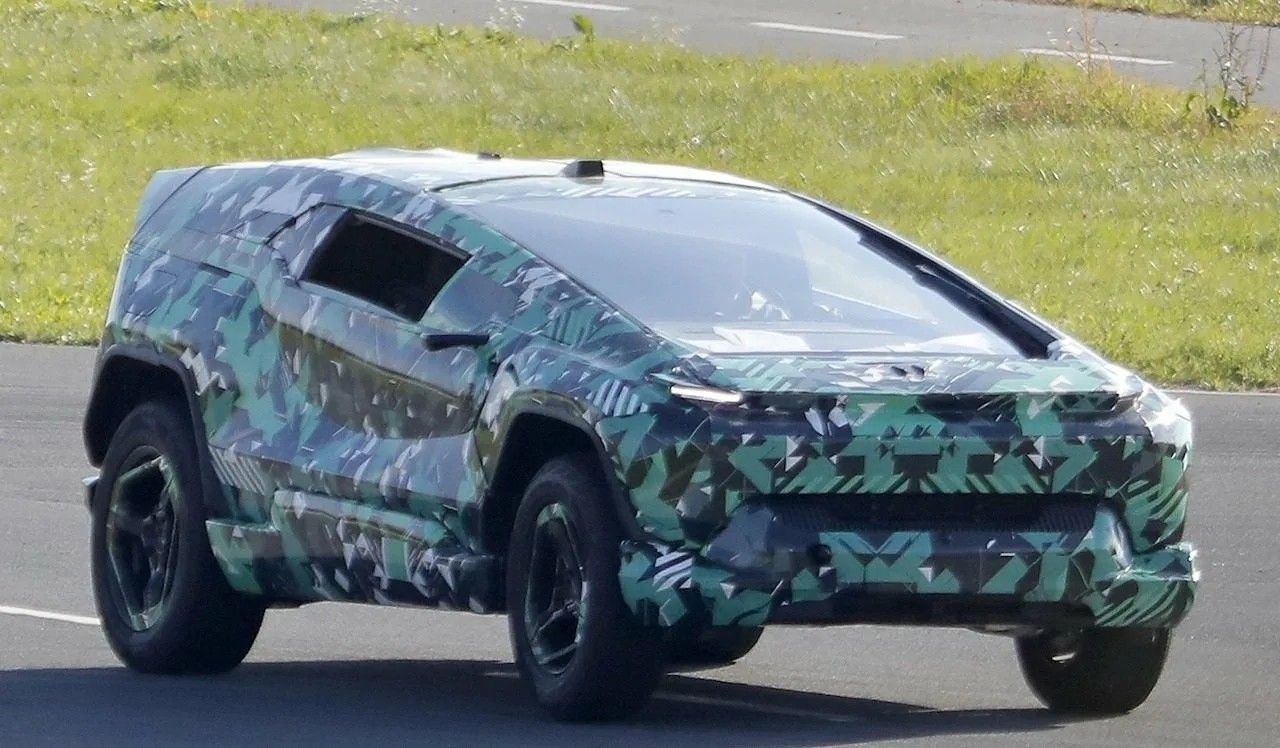
Even the windshield is unusual. At roughly 2.4 meters long and mounted at a dramatic 15-degree angle, it is one of the most visually dominant pieces of glass on the vehicle. Special coatings are designed to reduce solar heat gain — less a styling flourish than an engineering necessity in Gulf conditions. (Ceer Motors)
Inside, a curved 48-inch, 8K “Digital Horizon” display stretches almost pillar to pillar. A 10.4-inch central control screen and an 8-inch rear-passenger display supplement it. The conventional steering column is gone: Exobot uses steer-by-wire and a yoke-style steering control, while rear-wheel steering helps compensate for the cars’ considerable size. (Ceer Motors)
More Than a Design Exercise
The hardware underneath is just as ambitious.
The launch-spec Exobot First Edition uses three electric motors and all-wheel drive to produce 850 horsepower and 1,000 Nm, or about 738 pound-feet, of torque.
Ceer claims a 0–100 km/h time of 2.6 seconds for the sedan and 2.9 seconds for the SUV.
A 112-kWh battery operates on an 800-volt architecture. Claimed range reaches 670 kilometers for the sedan and 560 kilometers for the SUV, although those figures are based on the comparatively optimistic NEDC test cycle. A 10-to-80-percent DC fast charge is said to take less than 30 minutes. (Ceer Motors)
And that is not the platform’s ceiling. In its highest specification, Ceer says the Exobot can produce 1,111 horsepower and 1,500 Nm of torque. The sedan is claimed to reach 100 km/h in 2.1 seconds and 250 km/h at the top end; the SUV does the sprint in 2.4 seconds and tops out at 210 km/h. (Ceer Motors)
Keeping that performance manageable requires more than raw power. The chassis incorporates continuous torque vectoring, active suspension systems, steer-by-wire and rear-wheel steering. Steering movement is reduced from roughly 400 degrees in a conventional setup to just 160 degrees, giving the yoke a much quicker response. (Ceer Motors)
Ceer is equally aggressive on software. The company describes hands-free driving assistance, automated lane changes and navigation-based highway driving, along with over-the-air software updates capable of adding or modifying vehicle functions after delivery. (Ceer Motors)
Some of the more interesting engineering is less glamorous. The Exobot has been designed specifically for extreme heat. Ceer says its “Halo Cooling” system can reduce cabin temperature from 65 degrees Celsius — 149 Fahrenheit — to 32 degrees Celsius, or about 90 Fahrenheit, in ten minutes. Specialized glass coatings and separate front and rear climate-control systems are intended to reduce the thermal load. (Ceer Motors)
The Bigger Experiment
The Exobot is only the opening move. Ceer plans a seven-model portfolio by 2030. And despite its origins as an electric-vehicle project, the company is leaving room for plug-in hybrids and even internal-combustion models if market demand warrants them. Reuters reports that Ceer intends to begin with Saudi Arabia, then expand cautiously into neighboring markets. (Reuters)
Production will take place at Ceer’s manufacturing complex in King Abdullah Economic City. Sales in Saudi Arabia are expected to begin in early 2027; pricing has yet to be announced. Longer term, Ceer says it wants locally sourced materials to account for 45 percent of its vehicles by 2034. (Reuters)
That is what ultimately makes the Exobot more interesting than another very fast electric luxury car.
Saudi Arabia is trying to compress decades of automotive industrial development into a much shorter period: importing technology and expertise at first, while gradually building local engineering capabilities, suppliers and manufacturing infrastructure.
Whether Ceer can compete with established European, American and Korean automakers — not to mention increasingly formidable Chinese EV manufacturers — remains an open question. New car companies have an unforgiving history, regardless of how deep their investors’ pockets may be.
But Ceer has already made one strategic choice clear: it does not intend to enter the market quietly.
For a country trying to reinvent its industrial identity, a conservative first car might have been the more surprising decision.
 Kirill Benediktov
 Andrey Vedyaev
 Kamil Askerkhanov