 Andrey Vedyaev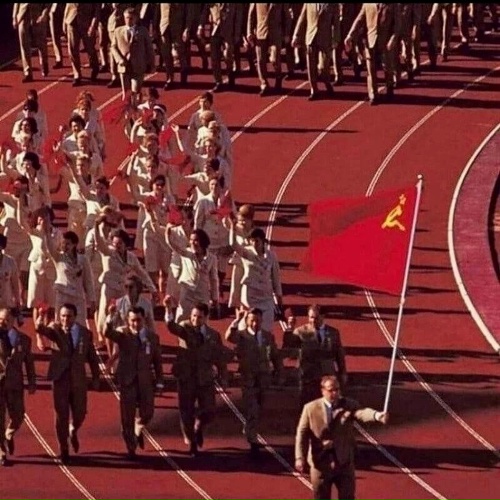
On December 5, 2025, Yuri Petrovich Vlasov would have turned 90.
To generations of sports fans, he was simply the strongest man on Earth – the 1960 Olympic champion, a four-time world champion, six-time European champion and five-time Soviet champion. He set 29 world records during his career.
But Vlasov represented something bigger than physical strength. He embodied a combination of discipline, intellect, creativity and inner strength that became deeply associated with the Russian ideal of the bogatyr – the legendary strongman-hero of Russian folklore.
Vlasov was not only a champion. He became a celebrated writer and a member of the Soviet parliament. At the opening ceremonies of the 1960 and 1964 Olympic Games, he carried the Soviet flag, reportedly holding it at arm’s length for at least 20 minutes.
The image was unforgettable: a massive athlete carrying a flag as effortlessly as if it weighed nothing.
A Father Who Lived Behind Enemy Lines
Yuri Vlasov was born in 1935 in Makiivka, in what was then Ukraine’s Soviet republic, into a remarkable family.
His father, Pyotr Parfyonovich Vlasov, was a professional intelligence officer from Voronezh Province. He had worked in a factory as a young man before joining the Red Army in 1931. In 1935, he graduated from Moscow’s Institute of Oriental Studies, specializing in Chinese, and two years later joined the Red Army’s intelligence directorate with the rank of brigade commander.
From 1938 until his death in 1953, he carried out some of the Soviet Union’s most difficult intelligence assignments in China under the operational name “Vladimirov.”
During World War II, he served as a liaison to the Central Committee of the Chinese Communist Party and headed a special intelligence group gathering information on Japan’s powerful Kwantung Army.
From 1948 to 1951, he was the Soviet consul general in Shanghai. In 1952, he was appointed Soviet ambassador to Burma.
But years of working under extreme conditions in China had taken a devastating toll on his health. He never managed to take up his ambassadorial post.
In 1973, Yuri Vlasov published his father’s wartime diaries under the title China’s Special Region, 1942–1945.
The book was the product of years of painstaking work in archives, as well as conversations with his father’s relatives, friends and former colleagues.
In many ways, Vlasov spent his life carrying not only his father’s name, but also his father’s legacy.
Strength Beyond the Barbell
From childhood, Yuri absorbed his father’s extraordinary toughness and sense of duty — qualities that would sustain him through some of the hardest moments of his own life, including a devastating injury he suffered during a competition in Lviv.
As the years passed, particularly under the influence of his writing, Vlasov developed an increasingly critical view of many aspects of the Soviet past.
Yet he remained deeply attached to what he regarded as the Russian spiritual and historical tradition, as well as to the Soviet ideal of the harmonious development of the human personality.
Capitalism, however, was something he never embraced.
“It is no longer man, no longer the center of the universe, no longer ‘man — that sounds proud,’ and certainly no longer a creation of God,” he wrote. “It is merely… a creature — a device for work and the satisfaction of instincts, and nothing more.”
He went on to warn that a society organized around selfishness and material accumulation would ultimately destroy the very human spirit on which civilization depends.
“Life without a soul,” he wrote, “with a murdered soul, will repay humanity with self-destruction.”
These were not the words of a man who saw strength simply as the ability to lift more weight than anyone else.
For Vlasov, physical strength was only one part of a much larger idea of what a human being could become.
The Other Russian Strongman
During the turbulent years of Mikhail Gorbachev’s perestroika, Vlasov became close friends with Viktor Ivanovich Idolenko, another extraordinarily strong man.
Idolenko was also known for his involvement in Soviet research into alleged human “extrasensory” abilities. He was associated with the team of Lt. Gen. Alexei Savin, who headed the Soviet military unit known as 10003.
Idolenko later recalled meeting Vlasov in the late 1980s.
At the time, Idolenko was heading the headquarters of the largest investigative team led by Telman Gdlyan and Nikolai Ivanov. Through a film crew from Sverdlovsk Film Studio, he became involved in the production of a movie about the investigators.
When Idolenko resigned in protest over actions by Soviet Prosecutor General Nikolai Sukharev, he and his colleagues founded a cultural association called Iceberg.
One of its founders was Yuri Vlasov.
“The very first meeting filled me with excitement,” Idolenko recalled. “The force of personality that Yuri Petrovich generated with his velvet bass voice, his powerful handshake and his appearance as a Russian bogatyr turned our business meetings into celebrations.”
Idolenko joked that he, too, could handle a two-pood kettlebell — roughly 72 pounds — without difficulty.
Soon he and his son, Lev, began visiting Vlasov at home, where Vlasov’s wife, Larisa Sergeyevna, welcomed them with tea and homemade Russian pastries.
The country was going through an extraordinarily difficult period.
The Soviet Union seemed to be sliding toward collapse, and both men — Vlasov was by then a member of the Soviet parliament and later served in the Russian State Duma — were trying to think their way out of the crisis.
Their friendship became so close that, half joking and half seriously, they even discussed the possibility of their children marrying.
Idolenko’s friendship with Vlasov’s daughter, Irina, continues to this day.
As a kind of inheritance, Vlasov eventually gave Idolenko’s son his own French-made barbell with colored weight plates.
Lev proved worthy of his mentor’s trust.
He became a Russian bogatyr in his own right — a champion of Russia, Moscow and the Kemerovo region, where his family came from, in powerlifting.
The Strength of the Mind
Idolenko believes the most important ingredient in their success was not muscle.
It was the spiritual and intellectual environment around them.
Their circle included Alexei Savin, Anatoly Akimov, Pyotr Garyaev and, of course, Yuri Vlasov.
At one point, Idolenko says, he was even sent to Bulgaria to meet the famous mystic Vanga. Natalia Bekhtereva, the renowned Soviet neuroscientist, had visited Vanga shortly before him.
Lev eventually graduated from law school while continuing to train.
According to Idolenko, he drew inspiration from the remarkable people around him and went on to achieve extraordinary results.
Lev was physically larger than even Vlasov.
Vlasov became the first man in the world to lift 200 kilograms in the clean and jerk. Lev — known as “Lev the Siberian” — became the first powerlifter to reach a 300-kilogram mark.
But Idolenko says the most important thing these two men shared had nothing to do with their size.
Both were intellectuals.
Vlasov liked to repeat a simple principle: “The strength of the body is nothing compared with the strength of the mind.”
It may be the best way to understand the legacy of both men.
Remembering the Bogatyri
Yuri Vlasov died in 2021.
Two years later, Lev the Siberian died in a swimming pool under circumstances that Idolenko describes as mysterious and deliberately kept from public attention.
Lev would have turned 50 on December 4, 2025.
The following day, December 5, would have marked Yuri Vlasov’s 90th birthday.
To honor the two men he regarded as true Russian bogatyri, Viktor Idolenko created a children’s sports playground in Moscow’s Chertanovo district and named it “Lev the Siberian — Sport.”
Even on his modest pension, Idolenko continues to purchase specially commissioned medals bearing Yuri Vlasov’s name for young champions.
It is a small memorial to two very large men.
Not simply men who could lift enormous weights, but men who believed that strength without character is incomplete — and that the greatest human strength begins in the mind.
 Kamil Askerkhanov
 Kirill Benediktov
 Robert Reich