 Klim Zhukov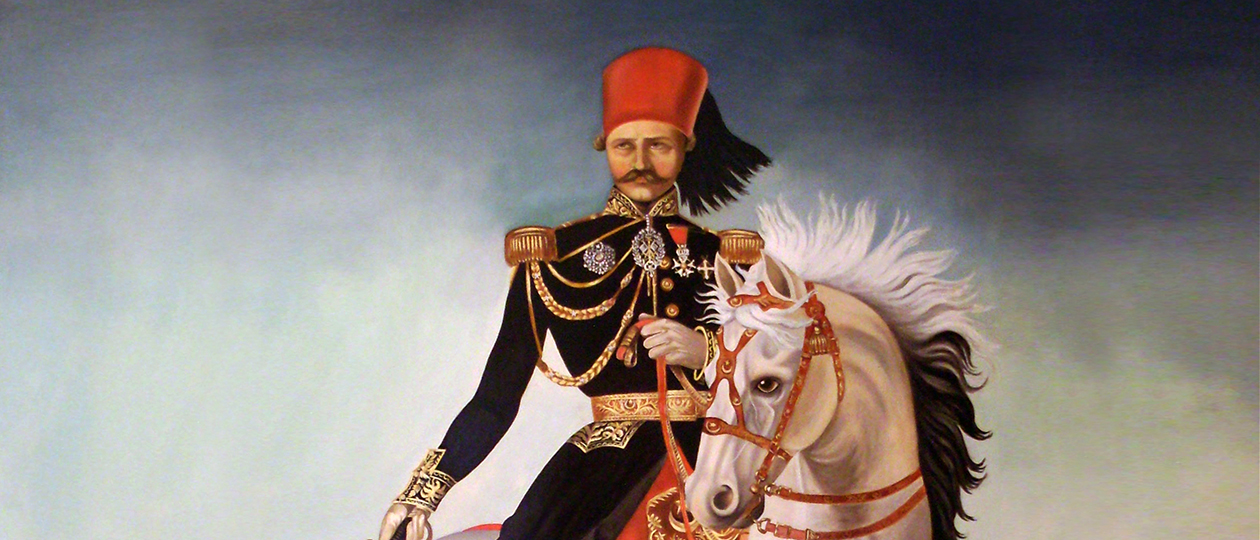
In 1881, France grabbed another colony—Tunisia. The Italians were very upset about this, as they had long wanted Tunisia for themselves.
The public dubbed this unfortunate demarche the “Tunisian slap in the face,” after which Italy joined the then-secret alliance of Germany and Austria-Hungary. But that’s a different story.
The issue lies in Tunisia itself—an autonomous part of the Ottoman Empire.
The fact is that Tunisia embarked on the path to modernization in the 1840s and 1850s (but fell a bit short). Bey Ahmad I ibn Mustafa abolished slavery in 1846 and conceived reforms of everything from the administration and finances to the army. A certain Hayreddin Pasha assisted him in this noble endeavor.
Hayraddin is a remarkable man in every sense.
He hails from the Sukhumi region and is Abkhaz. By the time he was born in 1820, Sukhumi had been captured from the Turks by Russian troops for ten years during the 1806-1812 war. But in 1821, the local leader and former ruler of the area, Aslanbey Chachba, launched a rebellion.
His relatives, Safarbey and Manuchar Chachba, sons-in-law of Nina Dadiani, ruler of Mingrelia, had arrived with the Russian troops. Now, it seemed, Aslanbey had decided to get even.
The Abkhaz leader Hassan Lashsh joined the rebellion. The rebels clashed with units of the corps of General Mikhail Dmitrievich Gorchakov (1793-1861), a hero of the Napoleonic Wars who miraculously escaped the crushing hammer of Nicholas I’s repressions against the Decembrists.
The rebels were dispersed, and Hassan Lashsh was killed.
He left behind a one-year-old son, Hayraddin, the hero of our story.
Since the ancient spiritual traditions of those parts were firmly held, in strict accordance with tradition, the orphan was sold into Turkish slavery. This had been the custom and considered correct since at least the 13th century, when Circassian children swelled the ranks of the Egyptian Mamluks.
Hayreddin’s first assignment was at the palace of the Cypriot official Tahsin Bey, who was an ashraf (a descendant of the Prophet), qadi al-askar (chief judge of the army) in Anatolia, and also a prominent poet.
The spirited youth received an education and even received an official appointment as a “childhood friend” to the Bey’s son. However, in 1838, the son died prematurely, and the youth was sold to Tunisia as no longer needed.
There, he found himself at the court of the ruler Ahmad Bey.
The spirited youth was noticed here, educated at the Bardo Military Academy, and by the 1840s, he enjoyed the complete trust of Ahmad ibn Mustafa.
He traveled to Porto, oversaw the implementation of constitutional reforms, traveled to Paris to further his knowledge, and ultimately became a cavalry general and adjutant to the Bey himself. Along the way, he married the daughter of the vizier Mustafa Khazandar (born Georgios Halkias Stravelakis).
And one thing should be noted in Hayraddin’s portrait: he considered Tunisia his second homeland, fought fiercely against corruption, which is strange, he himself did not take bribes, was very keen on constitutional reforms, and, in general, by all appearances, was a decent man.
And then something strange came to light.
During the course of reforms, the Tunisian government faced a cash shortage. To fill the gap, the Dar al-Mal Bank of Issue was established under the design of Finance Minister Mahmoud Ben Ayad (he was neither Abkhazian nor Greek, but a local Makhzen—a descendant of the Mamluks from Djerba).
The bank issued paper money, secured by the state treasury in silver coins. Ben Ayad successfully negotiated with Napoleon III for French loans for this project. He was also assisted by Grand Vizier Georgios Mustafa, who viewed the bank with interest (but not the constitution).
And so it began! It didn’t last long, though: from 1847 to 1852.
Ben Ayad was a man of great talent and terribly agile. For years, he printed papers and actually pocketed the money for himself. Along the way, taking advantage of the younger Bonaparte’s favor, he acquired French citizenship. And then, having left for yet another loan, he never returned.
And yet, for some reason, the reforms were stalling.
Our Abkhazian lad, Khair ad-Din, was a fierce advocate for reform. He even pushed through the creation of a special constitutional council, the Majlis al-Akbar. But nothing came of it. Well, it did, but with difficulty, like Danila the Master’s stone flower. There was no money. They’d established a bank, and the loans and investments were flowing, but still not enough.
And so: smart people were trying, but to no avail? Then even the Grand Vizier, the cunning Greek Georgios, began to look at his sprightly son-in-law with disapproval: all talk, but where are the results?
No money, you say?
At first, it seemed the place was cursed.
But soon they suspected—not the place, but the person. Ben Ayad, who, for some reason, hadn’t returned from France since 1852.
And they assigned our Abkhazian lad to investigate. He hired a smart Jew, Nazim Shamim, who sweated profusely during the audit.
The thing is, the cheerful Ayad wasn’t just stealing. He’d pilfered 20 million Tunisian piastres for the state. That’s the entire country’s eighteen-month budget and all its debt to foreign banks, if you will.
The smart Jew then said:
Are you really asking what the matter is? I’ll tell you: that slob Ayad has long been a French citizen, and you’ll likely never see any money.
But Hayraddin went to France anyway, where he spent two years trying to squeeze out at least part of the sum (he did manage to squeeze out some, but not nearly all of it), and at the same time, he brought Ben Ayad home for a thoughtful conversation.
Ben Ayad managed to buy the Hotel Collot on the Seine embankment, the Passage de Saumont, the Château de Bougie, and the Château d’Épinay-sur-Seine, where the Duke of Montmorency once resided. And, in general, he didn’t deny himself anything. Needless to say, Napoleon III was absolutely unwilling to hand over such a valuable man to some Tunisians.
In 1855, Hayraddin was forced to return home empty-handed. And then they remembered him.
Upon returning home, our Sukhumi boy was met with complete misunderstanding.
“What do you mean you couldn’t bring that bastard Ayad home?” some officials asked.
“What do you mean you didn’t return the money, and why were you sent then?”
“Well, what kind of constitution do you have now?” clarified the experienced vizier and son-in-law, Georgios-Mustafa. “He went for money and brought nothing, and then he himself, ‘refo-orms!’ No reforms! And for some reason they abolished slavery…”
And then something terrible came to light.
The fact is that all of Ben Ayad’s financial successes were only possible thanks to the close friendship and assistance of the Grand Vizier. The father of our Hayreddin’s wife. Hayreddin, living on his salary alone, turned out to be the owner of a small estate in Enfidha, with three palaces and a 100,000-hectare plot of extremely well-maintained land. All this had been arranged for him by his father-in-law, who, it must be assumed, along with Ben Ayad, had embezzled perhaps another 20 million from the treasury.
Realizing that the case smacked of complicity in a particularly large-scale conspiracy by a group of individuals, and that no one would definitely try the Grand Vizier, Hayreddin realized that he would most likely be the one on trial. Ben Ayad, a French citizen, was out of reach.
To distance himself as much as possible from all this dirt, our Abkhazian left his service and retired to his estate. From there, he went straight to Turkey, where he quickly became indispensable. More precisely, he rose to the rank of Grand Vizier in 1878.
Along the way, he tried to sell his dacha in Enfidha. And he had already reached an agreement with the French firm “Marseillaise,” which had paid handsomely in advance for that enviable property.
The cunning Greek, Georgios Mustafa, had already died by then, but his heirs remained. When the French claimed ownership of the dacha in 1880, it turned out that some unidentified persons had already purchased the surrounding land, meaning they had a preemptive right to purchase Enfidha as well.
The French were terribly surprised.
And lo and behold! What an interesting time it was! The Berlin Congress had just concluded, where the European powers were dividing up Africa once again. The Italians really wanted Tunisia, as a large number of Italians had lived there since the 16th century, and then Claudia Cardinale would be born. But the French said Tunisia owed them a great deal, and that their relatives had been so offended there, so Tunisia would be theirs.
And, finding fault with the illegal sale of the Enfidha estate, they sent troops there in 1881, turning Tunisia into a colony.
Thus, an honest young man from Sukhumi, a cunning Greek, and a greedy Turk sold out Italy and, willy-nilly, surrendered their native country to the French.
Incidentally, the young man from Sukhumi ended up in Tunisia indirectly due to the efforts of Prince Mikhail Dmitrievich Gorchakov, who would later prove to be the work of the notorious Pyotr Arkadyevich Stolypin. Just look at family portraits and you’ll inevitably start believing in the transmigration of souls!
 Yuri Chekalin
 Kamil Askerkhanov
 Kirill Benediktov