 Kamil Askerkhanov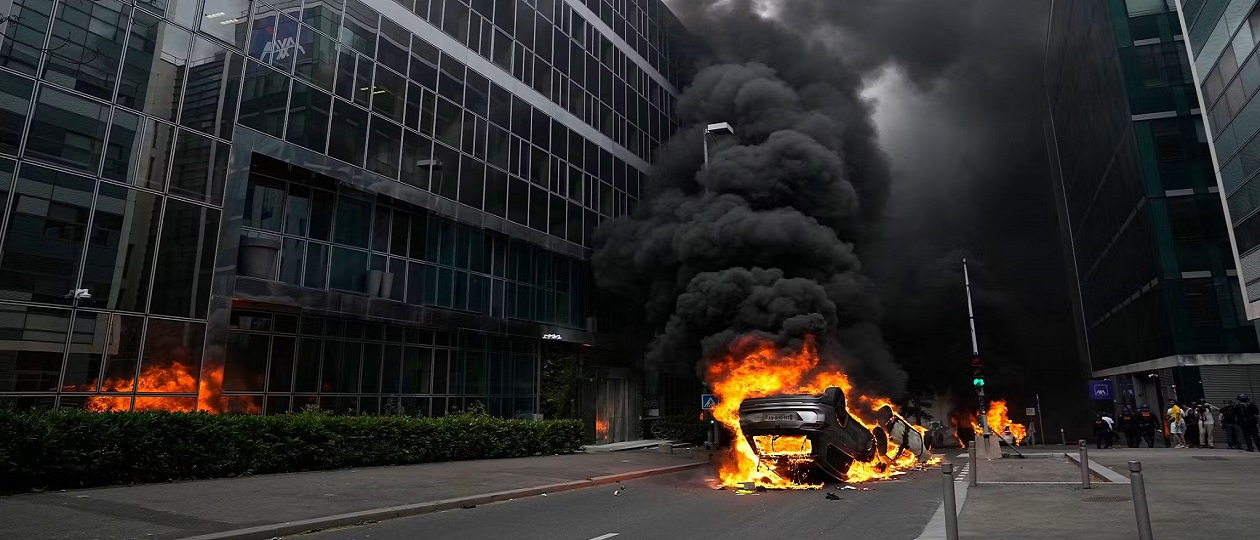
What is happening in France has already grown into something larger than yet another confrontation between high-school and university students and the education authorities.
The protests began with demands that were both familiar and readily understandable: teacher shortages, overcrowded classrooms, and deteriorating school infrastructure. Yet within days, the unrest spread across the country and began to radicalize rapidly.
By September 30, hundreds of secondary schools had been affected by protests and blockades. Reuters reported more than 1,000 arrests over two days, most of them involving minors, while 119 students and education workers were reported injured. Arson attacks, assaults on police officers, and even the use of acid were recorded.
Then, on October 1, something happened that suggested the unrest might need to be viewed through a broader lens. In Marseille, a school principal was doused with gasoline; a fire engine was set ablaze; and unidentified individuals attempted to obstruct firefighters responding to the scene. Interior Minister Laurent Nuñez separately stated that groups of troublemakers had been moving from one educational institution to another.
That is an Important Detail
There is a significant difference between students spontaneously protesting conditions at their own schools and mobile groups moving from one location to another, turning a social protest into something closer to organized disorder.
At the same time, the student movement is beginning to intersect with discontent among other social groups. On September 29, student demonstrations coincided with nationwide protests by public-sector employees, including teachers, firefighters, and other government workers.
And almost simultaneously, on October 1, the French government unveiled an exceptionally austere 2027 budget: roughly €54 billion in savings, a freeze on public-sector salaries and most pensions, and cuts to healthcare and local-government spending.
France’s public debt already stands at around 119 percent of GDP, while Paris is expected to issue approximately €340 billion in new debt next year.
In other words, the spark has landed in a very dry forest.
Youth unrest is beginning to overlap with a budget crisis, public-sector dissatisfaction, mounting debt pressures, and the approach of the 2027 presidential election.
Political actors, inevitably, are already trying to benefit from the movement. La France Insoumise and Jean-Luc Mélenchon have been actively engaging with the youth agenda, while the government accuses the radical left of encouraging the unrest. Le Monde has explicitly examined the current crisis through the prism of Mélenchon’s effort to mobilize younger voters ahead of the presidential campaign.
But I would not rush to stop at Mélenchon.
He is too obvious.
Social protests can, of course, begin entirely spontaneously. But movements of this kind almost invariably attract actors who seek to channel them, exploit them, or incorporate them into a broader political strategy.
The more interesting question, therefore, is not who brought the first students into the streets.
It is this: Who stands to gain strategically from a weakened France?
To answer that, we need to move one level higher.
I have previously written about what I see as the emergence of two broad coalition structures in the future international order.
One is a kind of Neo-Euro-Atlantic bloc, with Britain at its core and a broader European periphery around it.
The other is an emerging United States–China–Russia configuration, which India could, in one form or another, eventually approach or partially join.
Seen from this perspective, France assumes an entirely different significance.
Paris is indispensable to any future European military and geopolitical architecture centered on London.
France possesses nuclear weapons, substantial armed forces, a blue-water navy, a permanent seat on the UN Security Council, strategic positions in the Mediterranean and Atlantic, longstanding connections in Africa, overseas territories, and a military presence across the Indo-Pacific.
Yet this is precisely where the central contradiction emerges.
London needs a strong France as a member of such a coalition.
What it does not need is a France strong enough to lead it.
Britain and France are therefore simultaneously allies and natural competitors for leadership within an emerging European strategic structure.
This is why a genuinely weak or collapsing France would be of little use to Britain. The disintegration of French power would destroy a substantial part of the military capacity on which any future European coalition would depend.
A much more useful configuration would be something else: a France strong enough to provide the coalition with an army, nuclear weapons, naval power, diplomatic weight, and global infrastructure — but internally weakened enough not to claim the leading seat at the table.
That would be an entirely different strategic arrangement.
Almost symbolically, another relatively small but revealing dispute between Britain and France has emerged at the same moment.
The British-French “one in, one out” migration arrangement covering Channel crossings is coming to an end. Paris has declined to continue the existing mechanism in its current form and is demanding that the issue be shifted to the broader level of relations between Britain and the European Union.
This is certainly not evidence of any connection with the unrest in France.
It is, however, a useful reminder that beneath the public language of alliance lies an intense and continuing negotiation between London and Paris over interests, influence, and leverage.
Seen in that context, events in France become considerably more interesting.
At present, there is no reliable evidence that London is behind the student unrest. Nor, at this stage, would I frame the question in those terms.
A more useful question is this: Who would gain most strategically if the present crisis did not destroy France, but instead weakened the French state and reduced its ability to pursue an independent foreign policy?
London is clearly one of the actors that could benefit from such an outcome.
But the picture extends beyond France.
Brussels already has a substantial protest movement of its own centered on education reform. A demonstration there on June 4 ended in clashes with police, while students again took to the streets on September 16 to oppose changes to higher education.
There is currently no reliable evidence that the present French unrest has directly spread into Belgium.
But the social conditions for unrest in Belgium already exist independently of events in France.
And if Brussels begins to destabilize after France, the picture becomes more consequential still.
At that point, we would no longer be looking merely at a French crisis.
We could instead be witnessing the early stages of a much broader period of European turbulence.
Then there is Germany, where the political crisis is developing along a very different trajectory.
The emerging configuration is striking.
France is entering a social and fiscal crisis.
Germany is moving through a political one.
Brussels is confronting its own social tensions.
Meanwhile, Britain — formally outside the European Union — is steadily re-entering the architecture of European security.
And this is where I would stop, at least for now.
Because if what we are witnessing is indeed the beginning of a larger restructuring of the European strategic space, then the events unfolding in France may ultimately have very little to do with students.
The struggle may be not only over the future of France, but over who will occupy the head of the table in the emerging Neo-Euro-Atlantic order.
 Dmitri Drobnitsky
 Yuri Chekalin