 Kamil Askerkhanov
Developments in Poland are taking an increasingly intriguing turn.
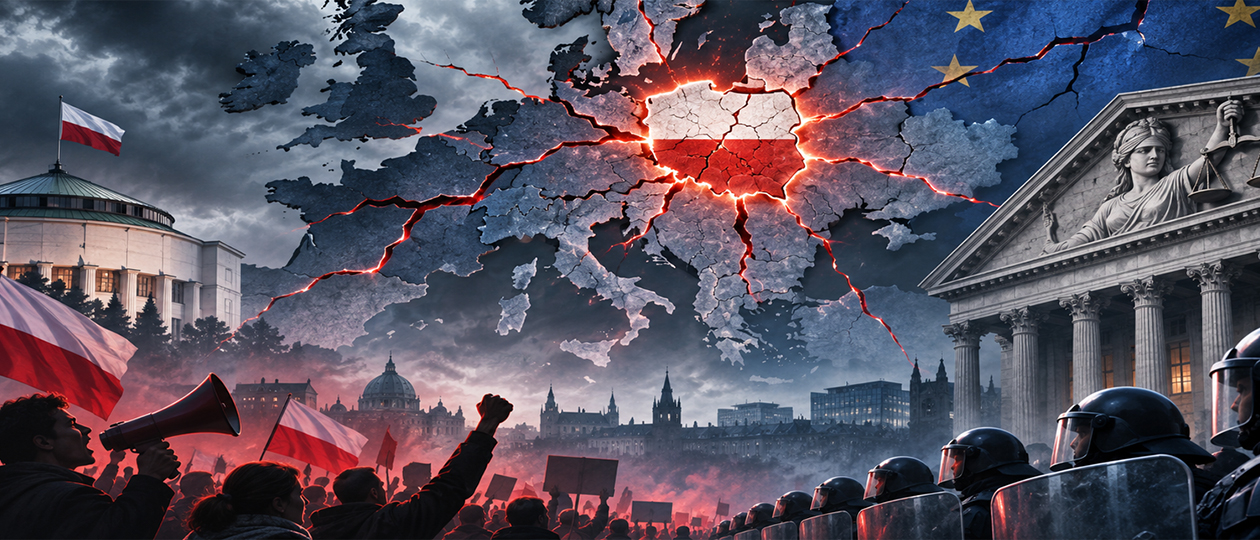
On October 30, an acute constitutional crisis erupted in Warsaw. Following the suspension of Constitutional Tribunal President Bogdan Święczkowski and his deputy, substantial police forces were deployed around the court. Protests and clashes followed, with several people detained. President Karol Nawrocki cut short his flight to Senegal and returned to Poland.
Prime Minister Donald Tusk’s government describes its actions as necessary to restore the rule of law, while the opposition, led by Jarosław Kaczyński, openly calls them a coup d’état. In effect, rival centers of power are battling for control over some of the country’s most important institutions.
All this is happening against a backdrop of mounting political and social turbulence across Europe
After widespread unrest in France, the wave of protests spread further. On October 31, mass demonstrations were scheduled in 34 German cities. More than 160,000 people had registered to attend, according to the organizers. Their demands included access to affordable education, lower living costs, and opposition to compulsory military service. Authorities prepared substantial police deployments, fearing a repeat of the scenes witnessed in France.
Readers of my private channel may remember that I have repeatedly singled out two countries that deserve especially close attention: Poland and Turkey.
The latter is also experiencing a persistent political crisis against a backdrop of serious economic problems.
And my choice of these two countries was hardly accidental
Poland is a pivotal hub of the eastern military and political architecture of the Euro-Atlantic world. Turkey occupies a similarly important position on its southern flank. Strategic routes vital to European security, energy supplies, and logistics run through both countries.
In my view, these developments should be considered in the context of the gradual breakdown of the existing Euro-Atlantic framework. Accumulated economic contradictions, the consequences of the war in Ukraine, and competition between national and supranational elites are increasingly turning Europe into an arena of internal conflict.
We are witnessing two parallel processes: public discontent is growing in the streets, while the struggle for power and legitimacy is intensifying within state institutions.
The European Union is beginning to fray as a unified political structure
Its institutions continue to function, but the mechanisms that once reconciled competing interests and preserved political cohesion are coming under growing strain.
And perhaps the most striking aspect is that the unfolding global economic crisis could accelerate these processes many times over.
History teaches us that large political structures begin to break down long before their flags, parliaments, and bureaucracies disappear.
First, the consensus over who has the right to govern dissolves. Then it turns out there is little left to govern.
 Vladimir Golstein
 Robert Reich