 Kamil Askerkhanov
With so much contradictory information circulating about the October 27 telephone conversation between Finnish President Alexander Stubb, Norwegian Prime Minister Jonas Gahr Støre, and Russian President Vladimir Putin, a few things are worth clarifying.
First, Stubb and Støre were not speaking on behalf of the European Union. Not in the slightest. The official statement went out of its way to emphasize that point.
This has already provoked indignation from Denmark’s prime minister and other guardians of European unity. How could this happen? Some European leaders are already talking to Moscow, while others have not even been invited to join the chorus.
But the most interesting part of the statement lies elsewhere.
It explicitly refers to regional security—not the abstract security of Europe as a whole, but the very specific concerns of the Baltic Sea region and the High North.
In other words, the conversation is gradually shifting away from the familiar declarations about a unified European position and toward a much more practical question: how does one live alongside Russia once the war in Ukraine is over?
Following the conversation, the Norwegian prime minister offered a reminder of a rather inconvenient geographical reality. Norway shares a border with Russia, has extensive maritime interests, and has every reason to seek stable relations with its neighbor as a matter of national security.
And suddenly it turns out that geography has not been abolished.
Russia is not going anywhere. The borders will remain where they are, as will the surrounding seas. Questions of regional security will still have to be settled with the very neighbor that, until quite recently, much of Europe seemed determined to isolate indefinitely.
There is another curious detail.
The call took place on October 27, the very day Putin was attending the Gas Exporting Countries Forum summit in Moscow.
And Norway, it is worth remembering, is not merely a major supplier of natural gas to the European Union. It is the largest. In 2025, Norway accounted for almost one out of every three cubic meters of natural gas imported by the EU.
Naturally, the timing was an entirely innocent coincidence.
After all, regional security, maritime transportation routes, and energy supplies have absolutely nothing to do with one another. Especially in Northern Europe.
For readers interested in understanding the broader strategic anxieties at work here, I would recommend watching the first three episodes of the Norwegian television series Occupied.
It is a fascinating production, particularly when viewed not simply as a political thriller but as a reflection of the fears and scenarios that have long figured in Norwegian strategic thinking.
More broadly, we may be witnessing the beginning of a development I have anticipated for some time: the emergence of separate diplomatic initiatives.
There is nothing particularly surprising about this.
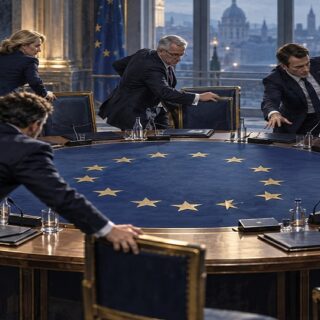
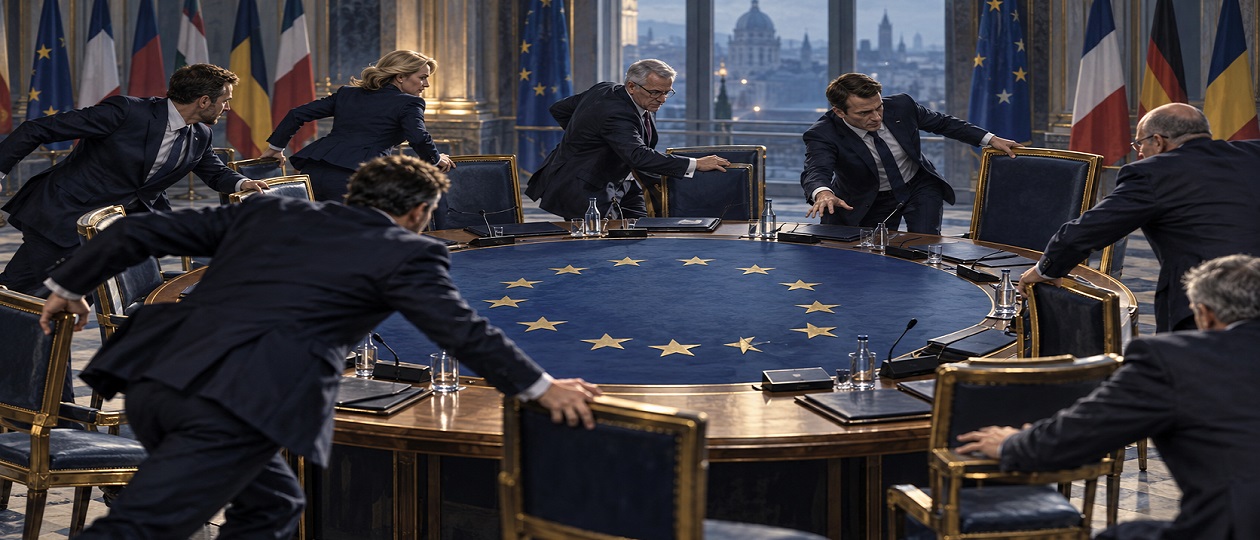
As major wars approach their conclusion, collective solidarity has a way of yielding to national interests. While the fighting continues, everyone speaks earnestly about shared principles. But once the outlines of a postwar settlement begin to emerge, governments start calculating where, precisely, their own chairs will stand at the negotiating table.
Preferably, they would like to claim those chairs before their neighbors do.
I suspect this tendency will only grow stronger.
Before long, we may see unexpected diplomatic initiatives, previously unannounced visits, and an abundance of elaborate explanations for why speaking to Moscow was categorically unacceptable yesterday but has somehow become not merely permissible today, but absolutely necessary.
And naturally, every such visit will be accompanied by solemn declarations of unwavering European unity.
Josep Borrell’s celebrated European garden, it seems, is gradually being divided into private plots.
And this is only the beginning.
 Michael Demurin