 Yuri Chekalin
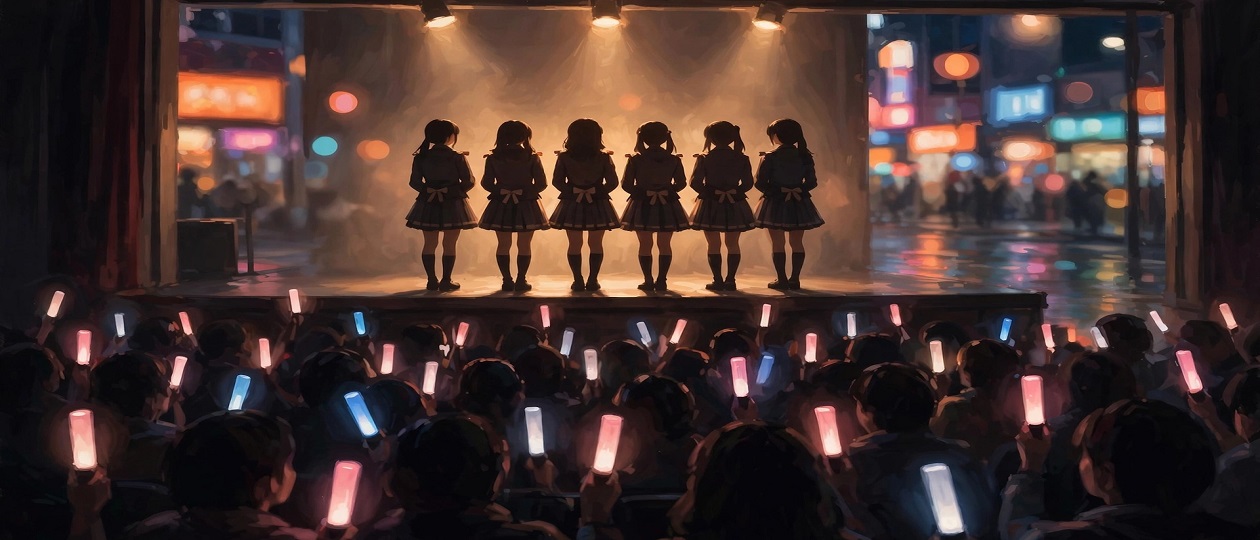
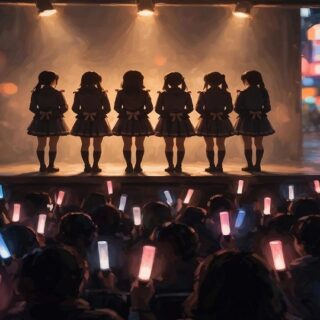
On 8 December 2005, on the eighth floor of a discount store in Akihabara, Tokyo, a new kind of pop group gave its first performance.
A Japanese Idols
By most accounts, seven people were in the audience. The theatre seated about 250, and the promise in its slogan was simple: these were “idols you can meet”. The group was AKB48, and the nearly empty room was the starting point of a business model that would dominate Japanese pop for two decades.
An idol, in the Japanese sense, is not quite a pop star. A Western singer is usually sold as a finished product: talent first, personality second. A Japanese idol is sold the other way round. Agencies recruit teenagers, often with little training, and market their growth rather than their polish. Fans are not just buying songs. They are buying a story of effort and improvement, and a feeling of access. The fan is not a spectator but a participant, cast in the role of the person who was there before the idol became famous.
The system was built by television. In October 1971, Nippon TV launched Star Tanjō!, an audition show with a radical format: ordinary teenagers performed, and talent agencies competed on air to sign the winners. The audience, in other words, watched the discovery itself, and arrived at an idol’s debut already invested in her. The show ran for twelve years and produced, among many others, Momoe Yamaguchi, the defining idol of the decade. Its most spectacular graduates were Pink Lady, two school friends from Shizuoka who won the show in 1976 and were repackaged as a disco duo. In the late 1970s they strung together nine consecutive number-one singles and spent 63 straight weeks at the top of the Oricon chart, a record that stood until 2015. Their faces sold lunchboxes, backpacks and toys: the fan economy that AKB48 would later industrialise existed already, in miniature, a generation earlier.
The 1980s were the golden age. Idols were not a niche but the wallpaper of Japanese life: Seiko Matsuda and Akina Nakamori ruled the charts while idols fronted variety shows, television dramas and advertising campaigns. In 1985, producer Yasushi Akimoto launched Onyanko Club, a large group styled as an ordinary after-school club, whose members were presented as the girls from the next classroom. Onyanko Club also popularised “graduation”, the ceremonial departure of members, which turned turnover into drama. Graduation solved the industry’s oldest problem: idols age, but a group with a graduation ceremony never has to. Members became replaceable, departures became events, and an idol career was understood to be short, bright and finished by the early twenties. Morning Musume revived the format in 1997, and once again the selection process itself was the entertainment.
Akimoto’s AKB48 took the logic to its limit. The group’s own Akihabara theatre staged performances almost daily, so that fandom became a routine rather than an occasion. Its signature ritual, the handshake event, began by accident: when stage equipment failed before a show on 16 December 2005, the members shook hands with the waiting fans instead. Systematised, it worked like this. A handshake ticket was bundled into a CD single; each ticket bought roughly ten seconds with a chosen member, timed by staff who kept the line moving. A fan who wanted a full minute bought six copies of the same disc. The CD had become a unit of access rather than a unit of music.
From 2009, the group’s annual general elections turned that access into spectacle. Fans voted with ballots bundled into a designated single; the results were announced at arena-scale events, broadcast on television and read out like election-night returns, and the winners delivered tearful acceptance speeches. The winner took the centre position on the next single; those who ranked too low might not appear on it at all, which is why election night felt less like a chart show than a public verdict on a career. At the model’s peak the numbers were extraordinary: by Oricon’s count, AKB48 recorded 37 consecutive million-selling singles, a streak no other act has matched. Critics had a name for the method — the “AKB commercial method” — and complained that the charts no longer measured how widely a song was known, only how deeply a core of fans would spend. Both things were true: the songs were ubiquitous, and the sales were a plebiscite. The model franchised across Japan, with sister groups from Nagoya to Jakarta, where JKT48 opened in 2011, and Bangkok, home of BNK48 since 2017. Akimoto also built an “official rival”, Nogizaka46, launched in 2011 under Sony, whose more elegant Sakamichi family now rivals the 48 groups.
The money follows the devotion. Japanese fans even have a word for the lifestyle, oshikatsu, the organised support of a favourite: buying the merchandise, attending the events, travelling to the venues. The word appeared online in 2016, spread as a hashtag by 2018 and was nominated for Japan’s word of the year in 2021. A 2025 survey by the marketing firms CDG and Oshicoco estimated that about 14 million people — roughly one Japanese in nine — practise oshikatsu, spending on average some 250,000 yen a year on their favourites, around 3.5 trillion yen in total. The averages conceal a split: in the survey’s January 2026 edition, mean spending per fan was about 210,000 yen, but the median fan spent only 40,000 — a minority of heavy spenders carries the market. Nor is it only the young: a 2024 survey by Harumeku found that 46 percent of women in their fifties had an oshi, a favourite they supported financially. The idol sector proper is smaller but fast-growing. The Yano Research Institute put the idol sector of its otaku market survey at about 165 billion yen in fiscal 2022 and roughly 190 billion yen in fiscal 2023, and idols were its fastest-growing segment in fiscal 2024, up 23.7 percent. Much of that spending is not on music at all, but on merchandise, photo sets and event tickets: the economy of showing up. The model has even been put to work by the regions, where local idols known as locodol are promoted by towns and prefectures to front tourism campaigns and sing the praises of local products — the fan economy as an instrument of regional policy.
For half a century, the male side of the industry belonged to one man. Johnny Kitagawa founded his agency in 1962 and built it on a trainee pool, the Johnny’s Juniors: boys recruited as young as ten, housed in a company dormitory, trained in singing, dancing and acting, and seasoned as backing dancers behind senior groups, sometimes for years, before their own debut. The system gave the agency total control of its product, and the product was everywhere. In 1997, at the height of the boy-band boom, the agency’s performers appeared in more than 40 television programmes and another 40 commercials; Kitagawa himself held Guinness records for the most number-one artists and number-one singles produced by an individual. The groups he produced, from SMAP to Arashi, monopolised Japanese television. The empire ended in scandal. A BBC documentary in March 2023 revived longstanding allegations that Kitagawa had sexually abused boys in his care over decades. That September, the agency publicly acknowledged the abuse for the first time; Kitagawa’s niece resigned as president, and the company split in two. Smile-Up exists only to compensate victims and will close when the work is done. According to the company, by late September 2026 it had received 1,047 claims and paid compensation to 578 people, with some cases still contested in court. The artists moved to a new agency, STARTO ENTERTAINMENT, which began full operations in April 2024. The machine, minus the name, still runs: STARTO’s flagship group Snow Man, which debuted in 2020, sold more than 1.8 million copies of its debut single, topped Oricon’s annual artist sales ranking in 2024, and sold over a million copies of a greatest-hits album on its first day in 2025. The trainee system survived its founder’s disgrace almost intact.
Below the television world lies another one. Underground, or chika, idols perform in tiny basement live houses to audiences of dozens, several nights a week. A typical night is a shared bill: several acts perform short sets to much the same few dozen regulars, and loyalty attaches to the room as much as to any single group. The show is only half the transaction. After it, fans queue for cheki, instant photos taken with the idol for a couple of thousand yen, with a minute of conversation thrown in: proximity, sold by the minute, is the real product, and for many small acts the photo queue matters more than the door money. The intimacy is real, and so is the precarity: by some accounts, underground idols may take home as little as 20,000 to 70,000 yen a month, and most hold other jobs. The underground is the industry’s farm system and its conscience at once — the same product with the television lights switched off.
The system’s strictness has also been tested. Many contracts and customs have long banned dating, on the theory that an idol’s availability is part of the product. When an AKB48 member was photographed leaving a man’s apartment in 2013, she shaved her head in a filmed apology. The courts, however, have split: in 2015 the Tokyo District Court ordered a former idol to pay 650,000 yen for breaking a no-dating clause, yet in January 2016 another judge threw out a 9.9 million yen claim, ruling that dating belongs to the freedom to pursue happiness. A decade on, the clause itself is disappearing. Entertainment lawyer Kunitaka Kasai told the Mainichi newspaper in 2026 that almost no major agency still imposes a formal dating ban — but the pressure has not vanished, only changed address. Where the conflict was once between the agency and the idol, it is now between the idol and the fans: in 2026, the Mainichi reported, two members of the group WEST. announced their marriages, and the online backlash was fierce enough that the group ended its activities within weeks. The state, meanwhile, has stepped into the contract itself. In September 2025, the Japan Fair Trade Commission and the Cabinet Secretariat issued guidelines on fair transactions between performers and talent agencies: contracts should state their length and any penalties for early termination in advance, obstructing a performer’s move to another agency may violate the Anti-Monopoly Act, and performers should normally be allowed to keep their stage names. Since the Johnny’s reckoning, contracts and working conditions face a scrutiny they never had before, and the harshest norms are slowly loosening.
The idol, meanwhile, keeps mutating. Hatsune Miku, a singing software character released in 2007, fills arenas as a hologram. VTubers, performers behind animated avatars, run the full idol playbook — auditions, agencies, graduations — with no physical performer at all, and it scales: Cover Corporation, the company behind the Hololive agency, reported revenue of about 49 billion yen in the year to March 2026, almost half of it from merchandise, and by YouTube’s own count VTubers account for 16 of the 20 channels with the highest Super Chat earnings of all time. Korean pop, which borrowed Japan’s trainee and fan systems and sold them back with interest, now shapes Japanese groups built for the world market, such as JO1, formed in 2020 via a Japanese version of the Produce format. NiziU closed the loop: nine Japanese performers selected by South Korea’s JYP Entertainment in partnership with Sony Music Japan, trained in Seoul and launched back home in 2020 — a Japanese group manufactured by the Korean system that Japan had invented. And in December 2025, AKB48 marked twenty years at the Nippon Budokan, where 135 former members performed alongside the current line-up before some 48,000 fans across six shows. The seven spectators of 2005 had become a national institution.