 Yuri Chekalin
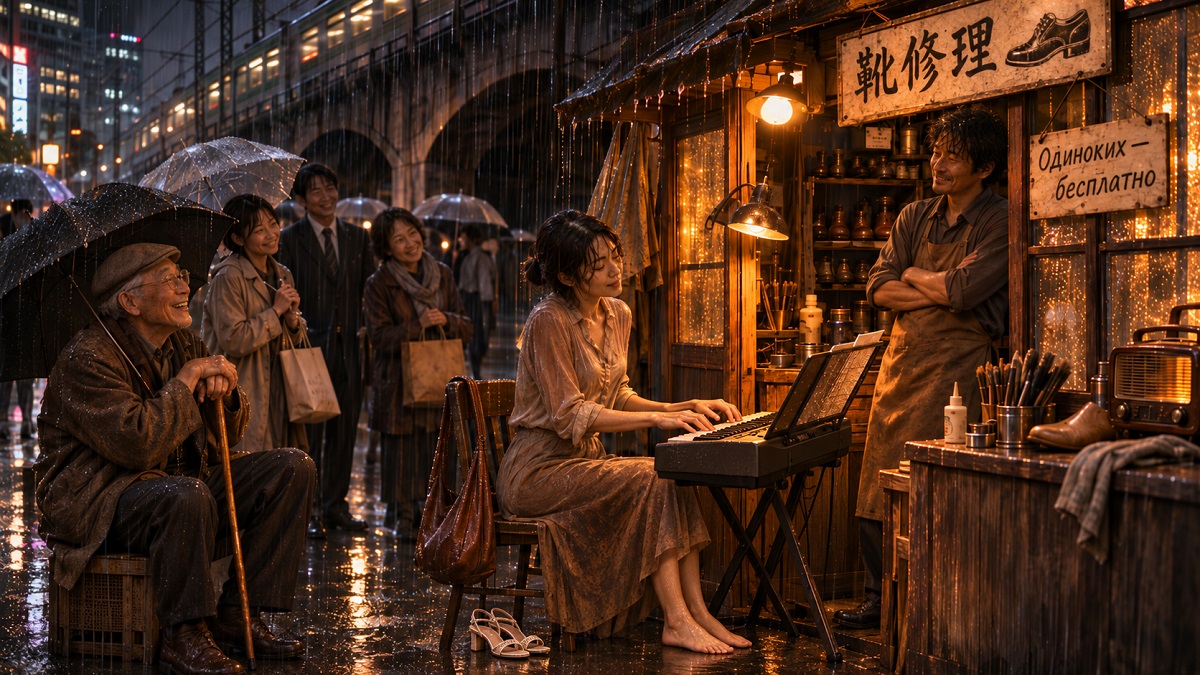
I signed it The Cobbler Under the Tracks — 高架下の靴修理屋.
VI. A Postcard Without an Address
At twelve fifty, Fukuda suddenly remembered he’d left an iron switched on, though he’d never owned one in his life.
He staggered off with the utmost dignity, but at the door he turned around and left his largest black umbrella beside my window.
At one twenty, she came.
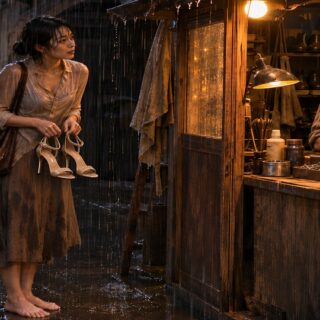
Barefoot, her wet hair clinging to her forehead, her sandals dangling from her hands, straps pointing downward, as though she were carrying something terribly fragile.
She stopped in front of the kiosk and looked at me the way people look at a house they’ve long wanted to visit but have been afraid to knock on the door.
I saw her face for the first time.
It was exactly the face her voice ought to have had: tired and kind, with a mole beneath her left eye.
“No price for the barefoot,” she said. “That’s what you wrote on the tag. I decided to test the rule myself. As you can see, it works. I walked all the way from Hibiya, and nobody charged me a thing.”
I wanted to say something.
Miyuki had once told me I never answered. Now I stood there turning a hundred words over in my head, and not one of them was right.
“The inside edge is worn down,” I finally managed. “On your right sandal. That happens to people who are afraid.”
Reika was silent for a moment, looking down at her feet and then back at me.
“I’m afraid,” she said, “that the person who’s been listening to me on the radio won’t be anything like the man I’ve imagined. It’s easy to trust someone you’ve made up. Real people are frightening.”
“The real one is even more afraid of you,” I said. “At least it’s mutual.”
She laughed, the way she had earlier, briefly and awkwardly. Then tears suddenly appeared in her eyes, but she made no attempt to hide them.
I reached into the pocket of my apron, where I had a postcard.
I’d written it that afternoon, before Reika appeared in my kiosk, and for the first time I’d filled in my real address in the sender’s box:
Kenji Yoshida. Kiosk Under the Tracks. Yurakucho.
I had meant to drop it in a mailbox on my way home.
For a month I’d left that space blank. And when I’d finally found the courage to fill it in, the postal service turned out to be unnecessary.
The addressee had come herself.
“You do owe me something after all,” I said, holding out the postcard.
She read it by the light of my lamp.
I won’t tell you what I’d written.
I’ll only say that the final stroke slanted to the right, as though it were hurrying home, and that she read the whole thing and didn’t give the postcard back.
VII. The Overnight Slot
A year passed.
In the entryway of our apartment in Nakano, there were now more women’s shoes than mine. A second toothbrush had appeared in the bathroom, along with so many little jars of cosmetics that I’d stopped counting them.
Exactly when Reika had moved in with me, I never managed to establish. An unforgivable oversight for a former accountant.
Everything two people needed fitted into our nine-tatami apartment, along with a black Yamaha piano covered by a crocheted tablecloth, like a sick animal under a blanket.
Reika hadn’t opened it since she was twenty-seven.
I never asked why.
At night she went to the studio, while I sat in the kiosk and listened.
Sometimes she came to see me barefoot, and I still never quoted a price.
Fukuda said there wasn’t a funnier couple in all of Tokyo: she walked around without shoes, and I repaired them.
In December, she grew quieter.
Three nights in a row she ate her noodles without noticing the taste and stared straight through the lamp.
On the third night, I said:
“Reika. Tell me.”
She told me.
Starting in April, the station was cutting back its overnight broadcasts. For Those Who Can’t Sleep would be replaced by a prerecorded music block.
“I’m not afraid of losing my job,” she said. “I’m afraid people will sit down beside their radios at night, and there’ll be nothing there. Just music.”
I wanted to tell her everything would be all right.
But that would have been a lie.
“I’m no good at comforting people,” I said. “I know how to fix things. Give me some time.”
VIII. Under the Tracks
I bought a basic microphone, a small audio interface, and found some live-streaming software on my old laptop.
There was internet access in the kiosk, though until then I’d mostly used it for bills and orders.
I had to buy a few more cables and figure out which one plugged in where.
Nothing special. Just somewhere a person could talk when there was nowhere else.
Reika looked at the microphone, then at me.
“Who’s going to listen to us?”
I didn’t know.
But I knew how to find out.
I found a platform for internet broadcasting, opened a channel, and showed Reika how to send the listeners a link.
She still had her own page, where people wrote to her after the broadcasts.
Some of them remembered the cobbler under the tracks.
We called the program Under the Tracks.
But before speaking into the new microphone, Reika went over to the piano in our apartment one evening.
She lifted the lid and closed it again.
I said nothing.
The following evening, she brought some sheet music.
The first notes were uneven.
Her left hand wouldn’t cooperate, and Reika had to start over several times.
I sat at the table with my accounts and pretended not to notice.
She pretended to believe me.
A few weeks later, I bought a small digital piano.
It fitted against the wall of the kiosk, beside the shelf where my father had kept his cobbler’s lasts.
At first, Reika protested that there was hardly room to turn around as it was.
Then she sat down and tried a few keys.
In March, after her regular broadcasts ended each night, we began going live on the internet.
At first, only for a little while. Twenty minutes or so.
Reika spoke more quietly than she did in the studio. Sometimes she had to search for words.
Sometimes she simply played, briefly and cautiously, her left hand still uncertain.
The first listeners appeared almost immediately.
One wrote that he could hear the trains behind her.
Another asked whether the kiosk really smelled of glue.
A third wrote nothing at all but listened every evening.
Then people started stopping at our window.
Some came especially to see us.
Fukuda set a chair outside his shop and listened in silence.
Though once he couldn’t help announcing that in thirty years of selling umbrellas, he’d never seen people voluntarily come out into the rain just to listen to music.
Reika laughed.
A few days later, she brought a new sign.
A small one, handwritten.
No Charge for the Lonely.
I hung it beneath my father’s Shoe Repairs sign.
Fukuda studied both for a long time.
“Yoshida,” he finally said, “who’s going to pay for the electricity?”
I looked at my accounts.
“There’s enough for now.”
“Just as I thought,” Fukuda said, and went off to open his shop.
IX. The Last Train
In the spring, the station dropped its overnight program.
Now, from eleven until one, Reika spoke from my kiosk, and her listeners found her on the internet.
The lamp beneath the tracks still burned as before.
By the end of April, she was playing more and more often.
Her left hand still faltered sometimes, but Reika no longer stopped at the first mistake.
One day, she brought in the sheet music for Debussy’s Clair de lune.
For several evenings, she worked through the difficult passages at home on the old Yamaha.
Then she tried playing the piece beneath the tracks.
That evening, people lingered at our window longer than usual.
Some were returning from the shops with bags in their hands. Others were coming home from work. Some had simply stopped to wait out the rain.
Fukuda sat outside his shop beneath his large black umbrella.
Reika began to play.
At a difficult passage, her left hand faltered.
She paused for a moment, then continued.
The music was quiet, and whenever a train passed overhead, several bars were almost lost beneath the clatter of the wheels.
I moved the microphone closer to the piano.
After the last train of the night, everything grew very quiet.
Fukuda held his large black umbrella and said nothing.
Reika finished playing and left her hands resting on the keys.
 Kamil Askerkhanov
 Dmitri Drobnitsky