 Yuri Chekalin
I signed it The Cobbler Under the Tracks — 高架下の靴修理屋.
I. The Kiosk Under the Tracks
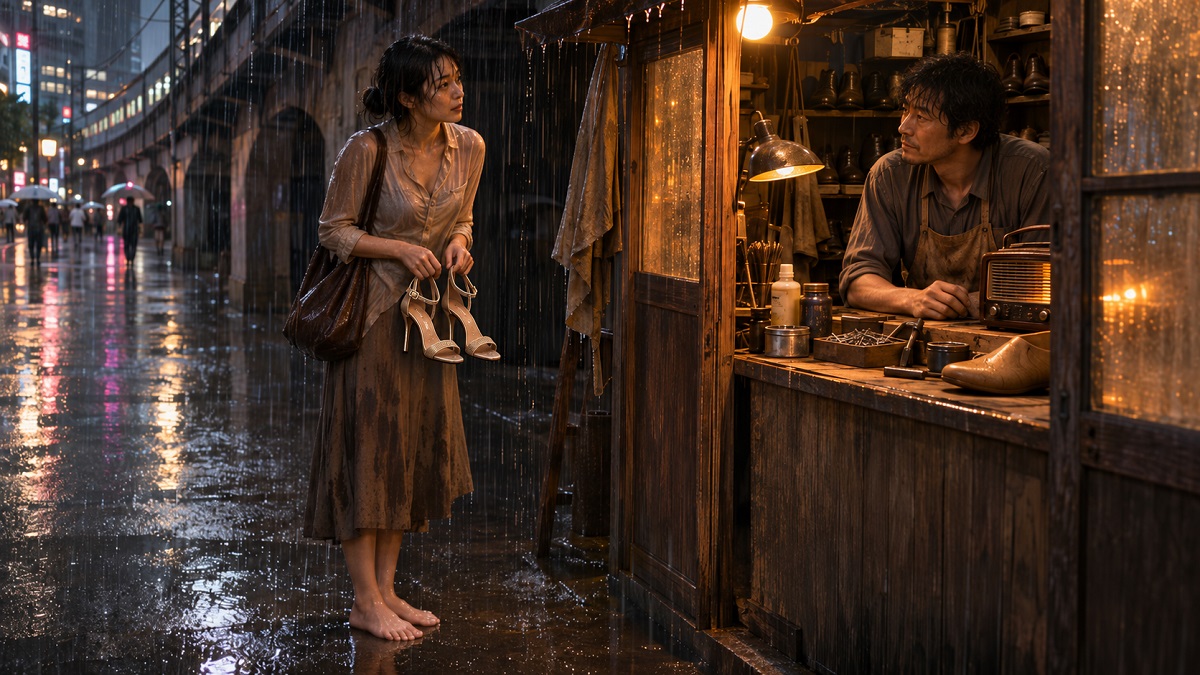
My kiosk stands beneath the elevated railway tracks in Yurakucho, between a noodle shop and old Mr. Fukuda’s umbrella store. It’s about the size of an elevator: two stools, a cobbler’s last, a shelf of glue and nails, and a radio older than my last girlfriend. Above the window hangs a sign reading “Shoe Repairs.” My father touched up the lettering every autumn. Now I do.
I’m forty-one. Until I was thirty-four, I worked as an accountant for a trading company in Marunouchi: twelve years, nine floors above the ground, not a single mistake in a balance sheet. Then my father died. Shigeru Yoshida had spent forty years sitting in this kiosk, and I came “for a week, just to settle things.” I settled things and stayed for seven years.
People think accounting and shoe repair are different professions. Not at all. In both, people bring you something that’s worn out, and your job is to make ends meet.
My father had his own ways of reading people. He taught me to read soles.
“People lie with their faces, Kenji, but they don’t lie with their heels,” he used to say. “Outside edge worn down? Always in a hurry. Inside edge? Afraid of something. Toe scuffed? Running away from something. And if the heel’s still intact, they’re simply tired.”
For all the soles I’ve examined, I’ve never once found the word happy written on one.
I had a fiancée once, Miyuki. She left for Osaka when I was thirty-six. On the platform she said, “You’re a wonderful listener, Kenji. But you never answer.”
I stood there, listened, and didn’t answer. It was probably the best thing I could have done to help her make up her mind.
I still follow my father’s rule: never quote a price to someone who comes barefoot. He never explained why. All he said was, “Anyone who comes barefoot has already paid dearly enough.”
II. The Voice
From eleven at night until one in the morning, Reika Mori talks in my kiosk. Her program is called For Those Who Can’t Sleep, and in three years I’ve never missed a single broadcast. Not even the evening my temperature climbed to thirty-nine and a half degrees Celsius and I repaired shoes wrapped in a blanket.
I’ve never seen her face. There’s a photograph on the radio station’s website, but I never opened it. I had the feeling that a face might frighten the voice away, the way light startles moths in the dark. But I know everything about her that she’s told her listeners. And she’s told us a great deal, like someone who had nobody else to tell.
I know she grew up in Asahikawa, on Hokkaido, and that her father drove a night bus. As a little girl, she often rode with him on his last run, falling asleep to the hum of the engine and the muttering of the driver’s radio.
“That’s where it all comes from,” she said. “I still can’t fall asleep unless I hear somebody’s voice. So I decided to become one myself.”
I know she came to Tokyo at nineteen to study piano, and that at twenty-seven she injured a tendon in her left hand. The doctors said she could still play, just not the way she used to.
“Then not at all,” she told them.
She mentioned it only once, in passing, between the weather forecast and a song. For the next three days I wanted to punch somebody in the face, though I had no idea who.
I know she takes off her shoes in the studio and sits barefoot at the microphone because, as she puts it, “My feet have to listen with me.” And I know her editor, Ogawa-san, has been complaining about it for three years, while she responds by playing his favorite old songs on the air.
We’ve never met.
But someone you listen to every night eventually stops being a stranger. They become something like a neighbor on the other side of the wall, whose name you know while they don’t know yours.
As you can imagine, it’s the most intimate form of loneliness there is.
III. Postcards
A month ago, she asked her listeners to send postcards.
“Tell me something you saw today. Just one detail. I need to know there’s still a city outside the studio window.”
I sat over a blank postcard all evening. Finally, I wrote two lines about the rain in Tokyo and how it smells of wet iron.
I signed it The Cobbler Under the Tracks — 高架下の靴修理屋.
I gave her no other information about myself and left the return address blank, the way people do when they want an answer but don’t want to be found.
She read the postcard on the air four days later.
“Cobbler, you’re right,” she said. “Now I can’t stop sniffing the rain.”
My ears turned red. I’m forty-one years old, and my ears turned red like a schoolboy’s when he’s called to the blackboard.
After that, I wrote to her every week.
About an old woman who brought in her dead daughter’s little boots and asked me, “Just don’t put new soles on them. Let her footsteps stay the same.”
About a boy wearing only one sneaker, who became the hero of the day because he’d lost the other on the platform and the train had carried it off to Shinagawa.
She read my postcards and answered them, and I listened to a woman I’d never seen talking to me across half of Tokyo, without knowing she was talking to me.
Old Fukuda, who sold umbrellas next door, figured me out in the second week.
He was seventy-four, a widower, devoted to horse racing and pachinko. He spoke loudly, like everyone accustomed to shouting over the rain, and believed nothing in life should be done by halves, except shoe repair.
“You write to her, and she answers you in front of the whole country,” he said, peering at my postcards over his glasses. “The most expensive love affair in Tokyo, Yoshida. Without a single date.”
“It’s not a love affair,” I said.
“Of course,” Fukuda agreed. “Love affairs at least come to an end.”
He was right. Mine wasn’t ending. It hadn’t even begun.
IV. Wednesday
It had been raining since morning on Wednesday, and by evening the rain had settled into the steady, businesslike rhythm of November rain once it realizes nobody is going to stop it.
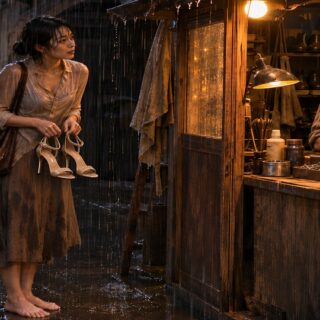
At ten thirty-five, a woman in a wet raincoat rushed into my kiosk, out of breath.
In one hand she held a sandal with a broken heel. In the other, its mate, which she’d already taken off. Her bare feet were small and wet, with chipped cherry-colored polish on the toenails. She stepped carefully across the cold concrete, as though it were burning sand.
“I have to be at the studio in half an hour,” she said. “Can you fix it?”
I wanted to say something polite, but then I heard her voice.
Low, slightly tired. The very voice that had been talking to me across half of Tokyo every night.
Now it was standing two steps away from my pliers, alive and a little hoarse from running.
I said nothing. A man who’s been recognized has to explain himself, while a man who keeps quiet can get on with fixing a heel.
Reika turned an empty glue box upside down and sat on it without waiting for me to clear a stool. She watched me work, curling her bare toes underneath her feet.
I’ve always read soles, but for the first time in my life I couldn’t read a thing. A person without shoes is a book without a cover.
Only when I examined her other sandal did I notice the worn inner edge, the very sign my father had taught me to recognize in people who were afraid.
I wondered what a woman whose voice reached all of Japan could possibly be afraid of.
She laughed while I worked, briefly and awkwardly, the way people laugh when they haven’t had much practice.
She told me her taxi had got stuck in Ginza, that Ogawa-san was furious, and that tonight would be the first time in three years she’d been late.
I nodded.
I finished in seventeen minutes.
Then, out of habit, I wrote two lines on a repair tag:
Shoe repair. Left heel. Urgent.
And beneath them, without thinking, my father’s rule:
No price for the barefoot.
I pinned the tag to her sandals and handed them over.
“How much do I owe you?”
“Nothing,” I said. “It’s raining.”
She looked surprised, nodded, and ran off without even putting her shoes on. There was no time.
For a long while I stared at the two pale footprints she’d left on the wet concrete.
They dried sooner than I would have liked.
V. On the Air
At eleven, I switched on the radio.
Fukuda, who closed early in weather like this, dragged over his folding chair, sat down beside me, and pretended he’d just happened to stop by.
He brought a bottle of warm sake and announced that rain was an occasion, and an occasion didn’t have to be a respectable one.
Reika didn’t come on the air until eleven-oh-nine. For the first time in three years, she was late.
Her voice sounded unusually alive.
“Today my heel broke,” she said. “I ran through Tokyo barefoot, and would you believe it, the pavement turned out to be kinder than we give it credit for. It’s cold, but it isn’t cruel. I only discovered that today, and I’m thirty-six years old.”
Fukuda grunted approvingly.
“A cobbler in a kiosk in Yurakucho came to my rescue. He wouldn’t take any money. But he pinned this to my sandals.”
Paper rustled through the speaker.
“A repair tag,” she said. “A note about an urgent heel repair, and one sentence underneath. And do you know, I froze, because I recognized the handwriting. The character for shoe — 靴 — with its last stroke running to the right and slightly upward, as though it were hurrying home. I’ve been reading that character every week for a month, right here in this studio.”
Fukuda dropped his sake cup.
I dropped nothing. My hands had gone so weak that I doubted I could have held anything at all.
“Cobbler Under the Tracks,” Reika said, and her voice grew very quiet, as though she were speaking into my ear. “I won’t say your name, because you haven’t told me what it is. And I won’t try to coax you out, because you’ll hide. I’ll only say this: the program ends at one. Don’t close the kiosk.”
Then she put on a song.
Fukuda and I sat through all four minutes without looking at each other.
I’d spent years reading other people’s soles and had never once considered that someone might be able to read me.
Apparently, all it takes is a single character.
“Yoshida,” the old man finally said, “you’re as red as the lantern over my shop.”
“It’s the sake.”
“You haven’t had a drop.”
“Then it must be the rain,” I said.
To be continued…
 Kamil Askerkhanov
 Dmitri Drobnitsky