 Kamil Askerkhanov
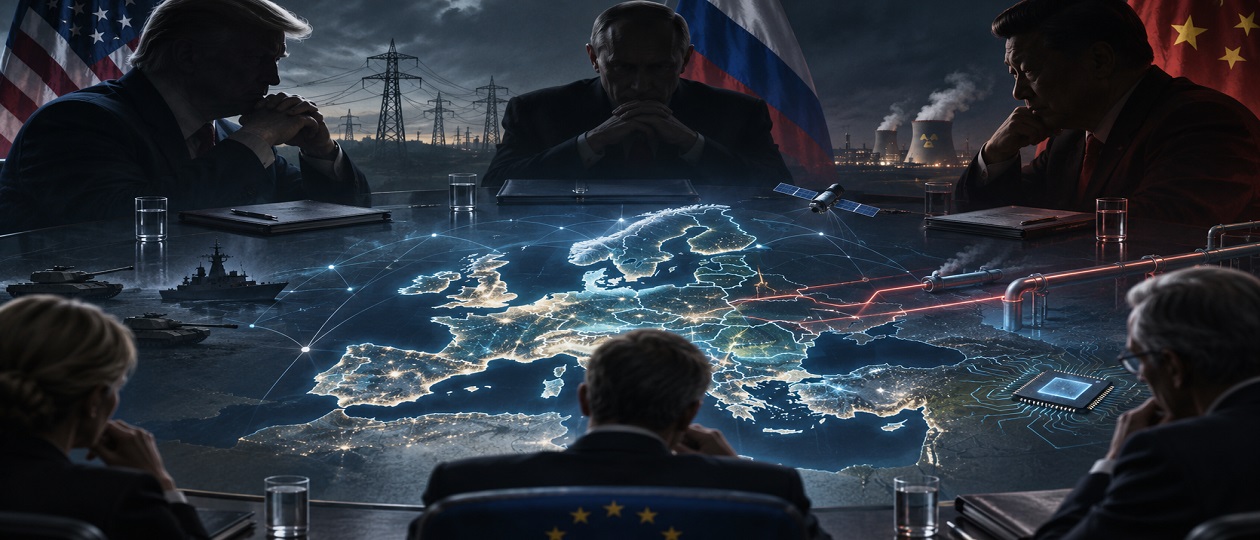
Recent developments increasingly suggest that preparations are underway for potential agreements whose scope extends far beyond the war in Ukraine.
Viewed together, these events reveal a striking sequence. And certain details, seemingly insignificant at first glance, suggest that what is at stake may be nothing less than a fundamental reconsideration of the international order established after the Cold War.
Germany and the Ghost of 1990
Let us begin with the unexpected proposal for a trilateral meeting involving representatives of the United States, Germany, and Russia in the spring of 2027.
For now, this is an initiative put forward by Germany’s Alternative for Germany (AfD), with no official government backing. The proposed agenda is primarily economic, including the possible restoration of the Nord Stream pipelines. But something else about this arrangement interests me.
Consider the 1990 Two Plus Four Treaty, which established the conditions for German reunification and codified some of the most important principles of Europe’s postwar settlement. At the time, the two German states and the four victorious powers effectively negotiated the foundations of a new Europe.
Now, 36 years later, a configuration involving Germany, the United States, and Russia is emerging once again — conspicuously without Britain and France, both of which were also parties to the original treaty.
A coincidence? Perhaps.
But should such a format acquire official status, discussions could extend well beyond economic cooperation to the political and economic restructuring of Europe itself. This possibility becomes particularly significant when one considers that energy is among the most powerful instruments of geopolitical influence.
Abu Dhabi: More Than Ukraine
Now consider the negotiations held in Abu Dhabi on November 10–11.
Formally, the talks have focused on resolving the war in Ukraine. Yet American officials have already spoken openly about the future architecture of European security.
Equally revealing is the arrangement for European participation. European representatives have been involved in separate consultations, while the principal negotiating format has remained trilateral, bringing together the United States, Russia, and Ukraine.
The resulting situation is rather curious: the future of European security is being discussed at one table, while some European politicians find themselves in something resembling an antechamber, waiting for separate conversations with the Americans.
The composition of the Russian delegation is no less significant.
Among its members is Deputy Foreign Minister Sergei Ryabkov. It is worth recalling that Ryabkov was closely associated with Russia’s so-called ultimatum of December 2021, when Moscow presented the United States and NATO with draft agreements on security guarantees.
Those proposals included demands to halt further NATO enlargement and restore certain parameters governing military deployments to those that existed in May 1997. This did not mean formally expelling countries from NATO, but rather restricting the alliance’s military infrastructure and presence.
Moscow has recently reaffirmed the continued relevance of those demands.
This raises an obvious question: if negotiations encompass security guarantees, weapons deployments, NATO activities, and Russia’s relationship with the West, how can they be regarded as exclusively concerning Ukraine?
The war in Ukraine would, in that case, constitute only one element of a much broader process.
From Abu Dhabi to Shenzhen: A Diplomatic Sequence
And now comes perhaps the most intriguing part: the calendar.
The Abu Dhabi negotiations took place just days before the November 18–19 Asia-Pacific Economic Cooperation summit in Shenzhen, where a possible meeting between the leaders of the United States, Russia, and China is under discussion.
This is the very triumvirate whose potential emergence I discussed earlier this summer.
China’s Foreign Ministry has already confirmed that contacts concerning such a meeting are underway, although no final decision has been announced.
The next major event is the G20 summit in Miami on December 14–15.
The sequence suggests a possible logic: preliminary discussions on security arrangements, potential agreements among the major powers, followed by negotiations over a new economic configuration involving the broader international community.
Of course, this remains an analytical reconstruction, not a publicly disclosed diplomatic roadmap.
Nevertheless, the coincidences are becoming too numerous to dismiss out of hand.
Moreover, preparations appear to extend well beyond Europe.
The Persian Gulf and the Geography of Energy
Beijing has been actively engaged in Persian Gulf security, maintaining contacts with both Iran and Saudi Arabia. Moscow has been pursuing parallel diplomatic efforts.
On November 5, Russian President Vladimir Putin received Mohsen Rezaei, secretary of Iran’s Supreme National Security Council.
The discussions took place against the backdrop of regional security concerns, relations with the United States, and energy cooperation.
Also present was Igor Kostyukov, the head of Russian military intelligence, who subsequently joined the Russian delegation in Abu Dhabi.
An interesting coincidence, to say the least.
Particularly when considered alongside my earlier hypothesis concerning the energy encirclement of Europe and the roles of the Strait of Hormuz and the Bab el-Mandeb Strait in the emergence of a new system of control over global energy flows.
But another theme runs through these developments with remarkable consistency.
Nuclear energy.
Nuclear Disarmament and the Energy Demands of AI
Consider how persistently nuclear power has been appearing on the economic and political agendas of the United States, Russia, China, and now the G20.
Small modular reactors, electricity supplies for data centers, the expansion of computing infrastructure, uranium resources, and new nuclear fuel cycles are all becoming increasingly prominent.
Rosatom chief Alexei Likhachev recently spoke of possible cooperation with the United States on small-scale nuclear power generation to supply artificial intelligence data centers.
This brings us back to our hypothesis concerning potential nuclear disarmament, which has emerged as one of the subjects that could be discussed at a meeting of the three major powers.
What if one objective of reducing nuclear arsenals were to redirect some of the nuclear materials released from military stockpiles into civilian energy production?
There is a precedent.
The U.S.-Russian Megatons to Megawatts program converted 500 metric tons of highly enriched uranium from military stockpiles into fuel for American nuclear power plants.
Against the backdrop of rapidly growing electricity demand from the digital economy, such an arrangement could acquire an entirely new strategic significance.
Naturally, converting military nuclear materials into civilian fuel requires specialized technologies, and it does not automatically provide suitable fuel for every reactor design.
But the underlying principle has already been demonstrated in practice.
Seen from this perspective, potential nuclear disarmament, the expansion of nuclear power generation, the protection of energy transportation routes, and the construction of new digital infrastructure begin to form a coherent economic framework.
After all, the financial system of the future will require enormous computing capacity. That capacity will depend on reliable energy supplies. Energy production will require resources and technologies. And the entire structure will depend on physical security.
This is precisely where the interdependence of the major powers becomes apparent — a subject we have discussed repeatedly.
That is why any future agreements among the three powers, should they materialize, could involve considerably more than the traditional division of political spheres of influence.
They might instead concern the allocation of responsibility for maintaining a new global system in which no single power possesses the full range of resources, technologies, and capabilities required to function independently.
Such a prospect, naturally, would not be welcomed by everyone.
Two Competing Visions of Europe
Consider what is happening simultaneously in Europe.
Britain and France are leading military exercises in Poland. Berlin is bringing together members of the Coalition of the Willing. Separate European forums for discussing security are expanding.
At roughly the same time as the potential trilateral meeting in Shenzhen, the European coalition intends to coordinate its next steps regarding Ukraine.
Within the framework of my hypothesis about two competing models of the future international order, these developments are understandable.
On one side, a potential system of agreements among major sovereign centers of power is beginning to take shape.
On the other, the established Euro-Atlantic order is attempting to preserve its existing mechanisms of political, financial, and military influence.
Germany occupies a particularly important position in this struggle.
Its industrial capacity, dependence on external energy supplies, and geographic location make the German question central to any future restructuring of Europe.
Consequently, a return to the logic of the Two Plus Four Treaty — albeit under entirely different historical circumstances — no longer seems quite so implausible as an analytical hypothesis.
Who Will Decide Europe’s Future?
There is one more important dimension to consider.
All of this is unfolding against a backdrop of mounting strains within the global financial system, growing concerns about a potentially massive artificial intelligence bubble, and the redistribution of capital.
As we have discussed previously, a future financial crisis could become a mechanism for transferring control over critical infrastructure and subsequently delegating managerial authority to a new elite.
Under such circumstances, political, energy, and financial developments would become closely interconnected.
It would, of course, be premature to claim that all the participants are following a single, coordinated scenario.
There are too many contradictions, too many competing interests, and too many actors pursuing their own agendas.
Nevertheless, the concentration of diplomatic activity around security, energy, infrastructure, and new economic rules is itself an indication of the potential scale of the changes underway.
For this reason, I would pay particularly close attention to the results of the Abu Dhabi negotiations, preparations for the possible meeting in Shenzhen, and the subsequent G20 summit.
And often, what fails to appear in the final communiqués may prove considerably more revealing than what does.
Let me return to where I began.
In 1990, the major powers negotiated German reunification and the future structure of postwar Europe.
In December 2021, Russia demanded a reconsideration of the principles governing European security.
Now, almost five years later, those questions have returned to the negotiating table — but under radically different geopolitical and economic circumstances.
What may be beginning is a discussion of the terms on which a new Europe will exist.
And the greatest question is not even how Europe might be divided.
It is who will be allowed to take part in deciding its future.
 Dmitri Drobnitsky
 Yuri Chekalin