 Kamil Askerkhanov
History offers some guidance.
After the crash of 1929 and the banking crisis that followed, America’s economic system underwent a radical transformation. The state took on a much more active role in economic life. In 1933 Roosevelt’s administration created the Tennessee Valley Authority, a state-owned corporation charged with developing the energy and infrastructure base of an entire region.
That said, it would be wrong to imagine Roosevelt’s New Deal as a blanket nationalisation of the American economy. What emerged instead was a new model of interaction between the state, finance and industry, accompanied by substantial changes in ownership relations and economic regulation.
A more recent mechanism was visible in 2008–09, when the American state acquired large equity stakes in firms such as AIG and General Motors in order to save systemically important companies.
Something similar—only on a much larger scale—could conceivably happen in the next crisis.
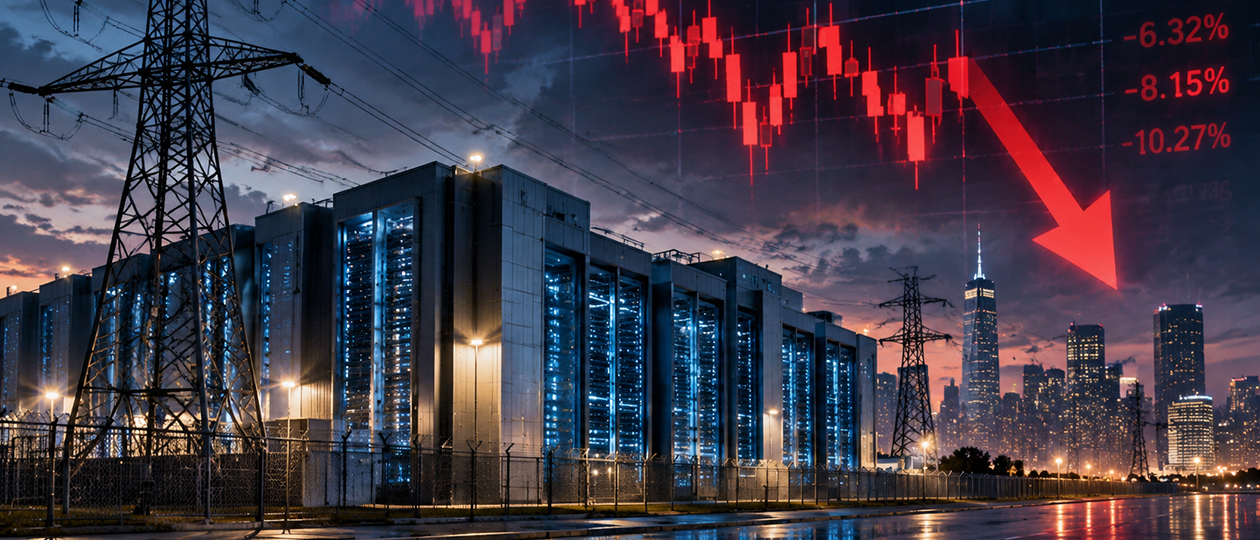
Picture a scenario in which bankrupt private data-centre operators are no longer capable of maintaining the infrastructure on which the financial system, public administration, the defence sector and digital communications all depend.
The state would have to intervene—first through guarantees, emergency financing and debt restructuring; then through the acquisition of controlling stakes, the creation of special public operators or the direct transfer of strategic assets into public ownership.
To be sure, nationalisation is far from the only possible outcome. Some assets could pass to creditors or to the largest financial groups with enough liquidity to buy them. But the deeper the crisis and the more strategically important the infrastructure, the stronger the case for state intervention becomes.
And so we return to the oil monarchies.
Their capital is now being used to build digital infrastructure. Then a financial collapse sharply reduces the value of those investments.
At the same time, war and economic instability in the Middle East force the governments of those countries to spend down reserves in order to maintain domestic stability.
Under such conditions, the danger is clear: distressed asset sales, the loss of control over investment projects and a redistribution of ownership in favour of more resilient financial and state-backed actors.
Such a scenario does not even require a deliberately orchestrated crash.
It would be enough to create an excessively leveraged investment system—one too fragile to withstand changes in the price of money or a decline in expected returns.
Still, I would not yet discard the hypothesis that such a structure may have been built, at least in part, to facilitate the later extraction of foreign capital.
That proposition would need to be tested by examining the architecture of specific deals, the distribution of financial risks and the terms under which ownership changes hands during debt restructuring.
There is another point worth noting.
The Great Depression ended with a profound transformation of the global economic system, a stronger role for the state and a reordering of international monetary relations.
The present crisis may likewise be accompanied by a shift towards a new financial order, one that includes digital payments, the tokenisation of assets and the emergence of large currency-economic blocs.
Digital money, computing power and energy infrastructure are linked far more closely than may appear at first glance.
That is why the possible nationalisation of AI infrastructure could become one of the instruments through which a new economic architecture is built.
And this is where the remarks by Mr Trump and Mr Fink acquire an added significance.
The former is effectively laying down the political authority’s conditions for the infrastructure being built. The latter is warning of the catastrophic consequences of constraining the private investment cycle.
Perhaps what we are seeing is a tension between financial groups that want capital expenditure to continue and a state that will ultimately be responsible for keeping the whole edifice standing.
The central intrigue is this: the material foundation of the new digital world is being financed today by private and international capital, including the accumulated wealth of the oil monarchies. Yet after a major financial crisis, control of that foundation may pass to entirely different owners.
If that hypothesis is correct, then what is now unfolding should be understood on a historical scale comparable to the transition from the economic order of the 1920s to the post-war settlement.
The question is who is paying to build the future world, who will bear the losses when the current financial structure breaks apart and, finally, who will acquire the right to control the infrastructure once the great bust has run its course.
Perhaps that is why it is worth watching so closely where the world’s trillions are going today.
 Dmitri Drobnitsky
 Yuri Chekalin