 Kirill Benediktov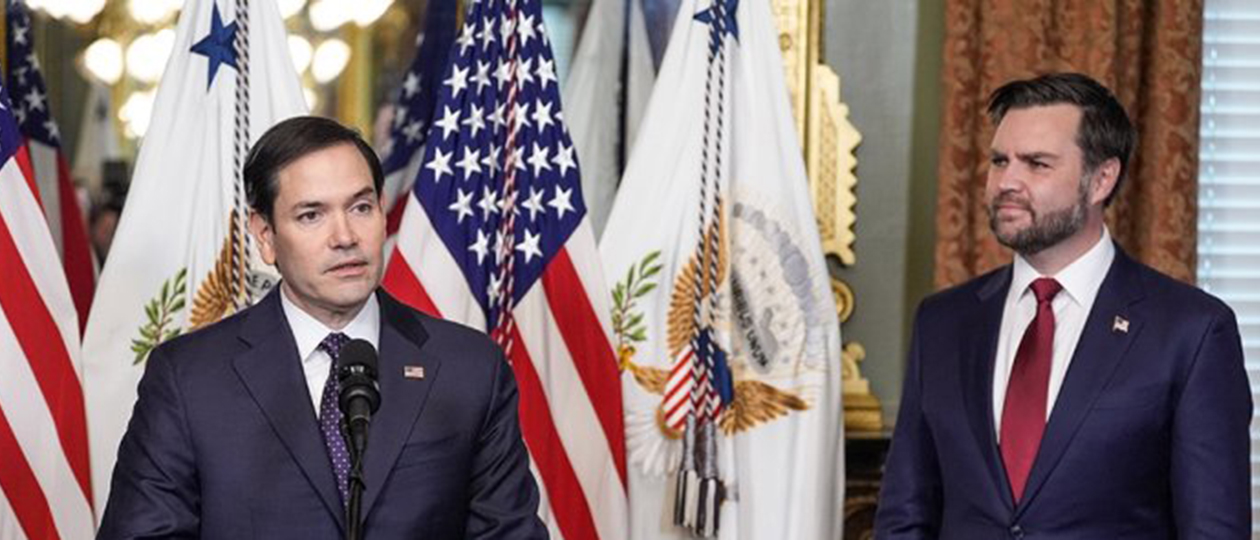
While the world’s attention is focused on the U.S. and Iran emerging from the Middle East crisis, an even more unpredictable drama is unfolding behind the scenes of Washington politics: the rivalry between the two most likely successors to Trump in 2028, J.D. Vance and Marco Rubio.
Evidence that this struggle is intensifying can be seen in the sharply increased number of media reports (either hostile to Trump or reflecting the views of the old Republican establishment) claiming that Rubio is improving his position relative to Vance.
This is true, but it is interesting that the narrative itself has not changed since Trump took office in January of last year.
The difference is that back then Vance was ahead of Rubio by 30–35 percentage points, whereas now his lead is, at best, around 5 points.
Yet the basic narrative—“Rubio is catching up to Vance”—has remained unchanged.
This comes despite Trump once again stating (in an interview for The New York Post podcast Pod Force One) that Vance and Rubio should run together in the 2028 election, though he did not specify which of them he would prefer at the top of the ticket and which as vice president.
“I like them both. And I like them together. I don’t know how you beat them if they’re together. That would be a great team.” Trump said in the interview.
It is known that Trump regularly asks people in his circle whom they would prefer to see leading the Republican ticket. In the same interview, he hinted that he is still actively evaluating both candidates, describing them as “very talented.”
“I’m constantly watching them, you know,” he said. “I study how they interact. It’s very interesting to me.”
The differences between the two politicians are obvious. Marco Rubio, who serves simultaneously as Secretary of State and National Security Adviser, is closely aligned with the Republican establishment and the intelligence community (his particularly close relationship with the CIA—never officially confirmed—allegedly dates back to the Florida phase of his career).
J.D. Vance, by contrast, is regarded as the second most important figure in MAGA and, to some extent, Trump’s ideological heir (at least the Trump who existed before the controversy surrounding the release of the Epstein files and the start of the Iran war).
Vance is also close to several influential military figures (Elbridge Colby, the Pentagon’s Under Secretary for Policy, and Army Secretary Dan Driscoll), as well as to the billionaire technocrats in Peter Thiel’s circle.
It is obvious that the “old money” wing of the Republican camp—the party’s donors, many of whom are Jewish or Christian Zionists sympathetic to Israel—support the more familiar Rubio rather than Vance, whose stance on Iran has made him arguably Israel’s chief adversary in Washington since Obama.
It is equally obvious that the sympathies of the segment of MAGA that remained loyal to Trump even after his turn toward war in March of this year belong to Vance. Within the Republican Party itself, the informal movement Republicans Against Israel is gaining strength, drawing on the ideology of America First and on the anti-Semitism that has always existed—though often carefully concealed—within parts of the American elite.
At present, the rivalry between Vance and Rubio is expressed mainly through U.S. foreign-policy operations in the Middle East and Latin America. Rubio outmaneuvered Vance bureaucratically by making him the public face of the Iran deal (with considerable help from Trump himself, who stated that if a deal with Iran succeeds, he will take all the credit, but if it collapses, he will blame Vance).
At the same time, Rubio planned the Venezuelan operation of January 2026 with remarkable effectiveness—and flair. Following Maduro’s abduction, Rubio’s bureaucratic influence, as well as that of his ally and fellow strategist, CIA Director John Ratcliffe, increased substantially.
Rubio, who oversees Latin America and is the Spanish-speaking son of Cuban exiles, undoubtedly credits himself as well for the successes of right-wing candidates (loosely speaking, Trumpists) in elections across key countries in the region, such as Colombia.
There, the right-wing candidate Abelardo de la Espriella won by a razor-thin margin. As a result, Washington rid itself of the headache posed by the left-wing extremist Gustavo Petro and his potential successor, Iván Cepeda Castro, whom the White House considers a communist.
However, Rubio faces a serious test in the form of Cuba, which Trump has repeatedly declared his intention to bring under Washington’s influence. Cuba may prove to be the hard nut that the powerful U.S. Secretary of State risks breaking his teeth on. Meanwhile, the Iran deal—constantly hanging by a thread and portrayed by anti-Trump media as the greatest U.S. foreign-policy defeat since Vietnam—could unexpectedly become the launching pad for J.D. Vance’s political career.
Everything depends on how skillfully J.D. Vance and his team—whose members, it should not be forgotten, include the U.S. president’s son-in-law Jared Kushner and his friend and golfing partner Steve Witkoff—play their poker game with the Iranians. The stakes are extraordinarily high, but the potential reward is undoubtedly great enough to make this attempt at a “Washington-style Game of Thrones” worth playing.
 Robert Reich
 Vladimir Golstein
 Paul Sadchikov