

 Vitaly Golovkov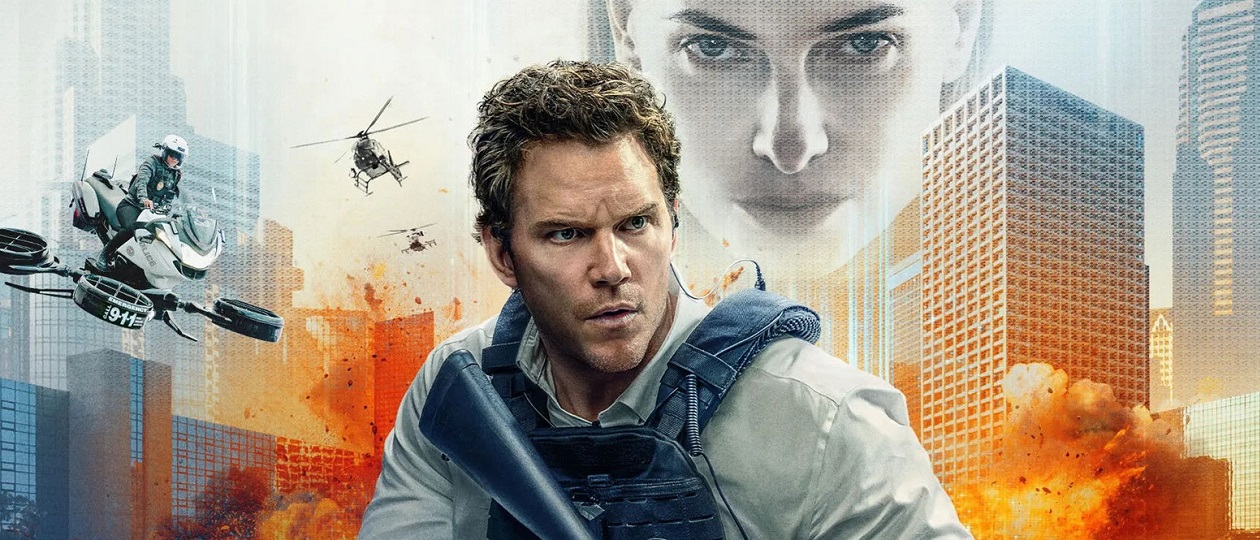
As a former federal judge who has handed down sentences for serious felonies and aggravated assaults, I view this on-screen trial not as a detective thriller, but as a very gripping legal drama. I apologize in advance to readers for paying little attention to the visual effects and dynamics, which are top-notch in this work.
Director: Timur Bekmambetov
Cast: Chris Pratt, Rebecca Ferguson
Genre: Techno-thriller, legal drama
Chris Pratt is used to saving the galaxy or training dinosaurs, but here he’s been entrusted with the legal code and exactly 90 minutes to handle it all. Against the backdrop of his cinematic past, this looks particularly amusing.
The core idea of the movie
Bekmambetov’s “Mercy” is built upon the classic legal dilemma: “Execute, or spare”. While the film is often compared to Philip K. Dick’s “Minority Report,” the resemblance is purely generic.
The year is 2029. Chris Pratt’s character, Detective Raven, is engaged in a “high-tech sprint” against a machine algorithm. He has 90 minutes to refute a presumption of guilt to lower his pre-determined 97.5% probability of being executed. In the world of “Mercy,” the “digital justice” system issues a verdict first and then gives you an hour and a half to disprove it.
Bekmambetov is as good as ever with the “Screenlife” format. He effectively shows how the interfaces of the future look when examining digital evidence in real-time. The “Mercy” system integrates the functions of justice, prosecution, defense, and execution into an AI judge named Maddox. At first glance, this seems to violate the traditional adversarial model, but I see a very sound kernel of logic here. In our traditional procedure, the separation of the arbitrator, prosecution, and defense is a necessary tool for finding the truth amidst the “human factor”. However, a powerful and impartial AI is, by definition, devoid of subjective interests. AI eliminates human cognitive biases (fatigue, sympathy, or hatred toward the defendant), incompetence, and vested interests. In such a model, a single entity can execute the entire justice process much more efficiently. Of course, this holds true only if the technological development shown in the film is actually achieved.
But the filmmakers decided that a logical AI wasn’t enough and added some “spice”. Here, I must argue with the director. We are proudly told that in two years, the system has handled a whopping 18 cases. Eighteen cases! Just moments ago, we were convinced that “Mercy” was introduced specifically to relieve court congestion. While I, as an ordinary judge, would handle more cases in a month, this digital “mega-machine” was apparently busy updating its antivirus or playing Solitaire. This statistical paradox suggests that justice in the future, as envisioned by the screenwriter, will be a privilege for the chosen few. The rest, apparently, face justice without trial or investigation.
Case #19 is the catalyst for the plot. Is #19 really the case number for a capital offense?
Did the AI mistake the case number for a McDonald’s order? No, fast-food order numbers are much more complex. More likely, it’s the number of seconds spent on a legal consultation. In the US, for example, a case number like 1:23-cr-567-TSC includes the district code, the year, the case type, the sequence number, and the judge’s initials. In our case, the number should at least include the AI’s version number. If a “bug” were found in a specific version of the AI judge, the case would be subject to review—though, judging by the plot, likely posthumously.
Regardless, my main question is: why the 90-minute limit to prove innocence? A machine that processes billions of operations per second and is in no hurry suddenly treats a defendant like a football match.
“You have an hour and a half, human; surprise me!”—that seems to be the AI’s logic. This isn’t a legal procedure; it’s a show where the “red button» is a death sentence. I understand that 90 minutes sets the rhythm and the “pulse” that makes “Mercy” an exciting thriller. But the director simply presents us with this time crunch as a fact, without any coherent explanation. This void in justification spoils the impression.
I felt that the real main characters of the film were the logical plot holes, which significantly devalue the director’s excellent visual work. Logically, the film should have ended at the 11th minute after reviewing the video chronology from 9:49 to 10:15 AM. The door camera captures the daughter’s scream when she finds the body, yet why did that same camera “go deaf” during the preceding 26 minutes? If the noises of the struggle had been investigated, the case would be closed with a 100% alibi. But no, AI Maddox was apparently listening to podcasts at that moment.
The victim’s strange silence also requires explanation. She is alive and conscious until the police arrive. What did she and her daughter talk about all that time? The fact that she remained silent and then only gave the name to the police makes her an accomplice to a screenwriter who desperately needed to start that 90-minute clock.
As for Chris Pratt—he’s used to saving the world by feeding a raptor or facing a villain, but here he’s forced to work with evidence faster than Windows boots up. He tries hard, sweats, cries, and even flirts. His hero is lucky he isn’t uneducated; he knows how to use a smartphone and check emails. For anyone with an IQ under 140, there’s no chance against “Mercy”.
There are also questions for Rebecca Ferguson’s character, the AI judge. During the “last word” procedure, she suddenly interferes with a police operation and deactivates a drone simply out of sympathy for the defendant’s feelings. When she starts arguing with her own algorithm and discussing her feelings, you just want to hit Ctrl+Alt+Del.
The director aimed for a powerful entry but landed in a logical vacuum. We are shown “justice through a technical glitch,” which becomes the key to the finale, even though the true justice of an AI should lie in its flawlessness.
My Verdict: The film is acquitted on the charge of being an “exciting and dynamic action race against time with cool visuals,” but found guilty of an especially aggravated assault on common sense.
Returning to the classic dilemma, I have made my choice: it is a brisk action movie that offers a glimpse into the future of justice and evokes a wide range of emotions. For that, one can forgive the authors’ negligence to detail.
Final Scores:
Visual Concept: 9/10
Script: 3/10
Dynamics: 8/10
Chris Pratt: 6/10
Rebecca Ferguson: 8/10
Overall Rating: 6.8
 Alexander Rimov
 Robert Reich
 Dmitri Drobnitsky




2 comments
Ivory Plummer
27.03.2026 at 07:21
I got this website from my buddy who informed me concerning this web site and now this time I am browsing this site and reading very informative articles or reviews here. Thanks to the writers for sharing your posts.
Frederic Bujold
28.03.2026 at 14:50
Hi there everyone, it’s my first pay a quick visit at this web site, and article is actually fruitful for me, keep up posting these really really nice reviews of new films.